Subscribe now for full access and no adverts
By the time you read this, February fill dyke will be over for another year and March will (perhaps) have come in like a lion. Sherds is always glad when winter is over, but in the depths of the cold, dark, and grey weeks of January and February there is one sure way to find warmth and consolation – by reaching for a book called Next to Nature, an anthology of the ‘Word from Wormingford’ diary columns that Ronald Blythe wrote for many years for the Church Times.
Blythe finds delight in every season: cold and frosty nights are valued because the stars shine all the brighter; cold wind is an opportunity to close the shutters, draw the curtains, and sit by a fire watching the dancing flames; puddles are enjoyed for reflecting the passing clouds. Looking up, Blythe observes the ‘narrow knife-slits of sunlight cut into the rain clouds’, and looking down he notices an early flowering primrose lit by Epiphany sunshine, forerunner of thousands more to come.
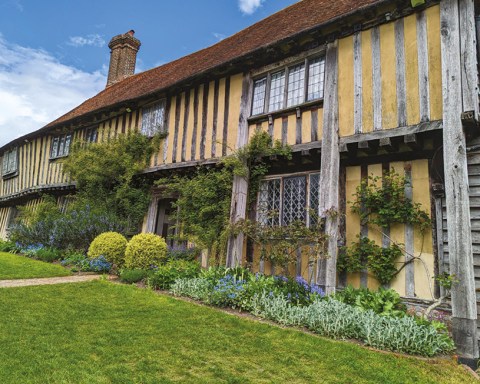
Unlike so many nature writers who strain for poetic effect, Blythe’s prose-poetry is gentle and undemonstrative, as he shares with his readers his daily life at Bottengoms Farm. This 16th-century yeoman farmer’s house, nestled in a hollow in the Stour Valley, near the Essex village of Wormingford, was bequeathed to him by his friends, the artists John and Christine Nash. When he died in 2023, just after his 100th birthday, he left the house and its two-acre garden to the Essex Wildlife Trust for use as an educational resource and as a retreat for writers, artists, and naturalists. There is hope, therefore, that we will all be able soon to visit the place that is so vividly brought to life in Ronnie’s writings.

Ronald Blythe was himself a regular guest at Benton End, the Tudor house near Hadleigh, Suffolk, that was the base for the art colony run for 40 years from 1939 by Cedric Morris and his partner Arthur Lett-Haines. Renowned for its food, wine, and hedonism – every day was a party – it was here that Lucian Freud and Maggi Hambling developed their skills.
That house has also come into the hands of a charitable trust – the Benton End House & Garden Trust – which aims to open it to the public. While the two properties will share a head gardener, they could not otherwise be more different. The garden at Bottengoms is a semi-wild extension of the Stour Valley countryside, while Benton End is filled with plants collected by Morris on expeditions to the Mediterranean and North Africa, including 1,000 varieties of iris. The garden was as much a canvas for experimenting with colours, textures, and shapes as the paintings it inspired. Comparing it to Monet’s garden in Normandy, Ronald Blythe described it as ‘floating about in a kind of Giverny haze’. One does not want to wish one’s life away, but roll on 2026, by which time both properties should be open.
Portland’s limestone heritage
You don’t have to wait that long to visit another attraction that combines art, nature, and archaeology. Tout Quarry Sculpture Park and Nature Reserve, in Dorset, has just been awarded a grant under Historic England’s Everyday Heritage programme to celebrate the history of the quarry workers who shaped Portland’s landscape over 18 generations, providing stone for many of the world’s finest buildings – most recently for repairs to the dome of St Paul’s Cathedral.
Worked commercially from 1780 to 1982, Tout was one of 80 quarry sites on the Isle of Portland. The Portland Sculpture & Quarry Trust, which owns the site, turned it into a sculpture park in 1983 and runs courses in architectural and sculptural stone-carving and letter-cutting. Visitors can explore the 70 different sculptures placed around the site, including an Icarus-like figure falling head first, carved by Antony Gormley into one of the quarry walls. Ravines and tramway lines thread the quarry, showing where waste was once taken to the cliff edge to be tipped into the sea or where blocks of limestone were carried to Castletown for shipping to building projects around the world. Fissures in the stone support a host of plants, which attract common blue and grayling butterflies, and the very rare silver-studded blue.
Among the other projects being funded under the Everyday Heritage scheme is a study of the annual Shrovetide football matches that are held in Atherstone, Warwickshire, and Ashbourne, Derbyshire. Similarly boisterous village events, said (implausibly) to date back to ancient Roman army training, take place in Bourton- on-the-Water, Gloucestershire, where the match is played along the bed of the River Windrush every August Bank Holiday, and the Shrove Tuesday event in St Columb Major, Cornwall, in which two teams compete to place a silver-covered wooden ball in each other’s territories. Working-class holidays are also to be documented through a study of the Pontins Holiday Park in the village of Hemsby, Norfolk, which, at its peak in the 1970s, regularly played host to 2,440 guests in 512 chalets spread over the 22-acre site.

Mona Lisa in the flesh
Passing through the British Museum regularly, Sherds often has cause to ponder the desire of so many visitors to validate their experience with a selfie that is then posted online for all their followers to admire. People who live much of their lives in the virtual world are nevertheless hungry to encounter what they consider to be ‘iconic’ objects in the flesh. That is why the room in which the Mona Lisa is displayed in the Louvre is always packed with camera-wielding visitors. They want to be seen in the presence of the physical painting, which they then, paradoxically, turn into a virtual image. The idea that anyone anywhere in the world can study the Mona Lisa in comfort and in pinpoint detail online seems not to have the same appeal.
In future, those visitors will not only have to endure queuing and a very restricted view of Leonardo’s painting, they will soon be charged extra for the privilege. The Louvre’s Director estimates that 7 million out of the 8.9 million annual visitors to the Louvre come primarily for the one painting, which is to be moved into a room with its own entrance and a premium-priced entry ticket.
Should we charge?
The question on many lips is whether the UK’s free-to-enter national galleries and museums should do the same, moving the most famous treasures into a Gallery of Honour and charging for admission. In the case of the British Museum, it is the Rosetta Stone that the crowds want to be pictured with, so why not maximise its earning potential and leave the rest of the museum free?
It was a Director of the National Gallery who, some years ago, pointed out that the grant-in-aid from the government was only just sufficient to pay the lighting bill. The result is that curators are under relentless pressure to come up with a string of blockbuster exhibitions three or more times a year for which visitors can be charged. This stops them doing the kind of collections cataloguing, care, and research that might have prevented the recent thefts suffered by the British Museum.
On the other hand, to charge overseas visitors and exempt local people might have unfortunate political consequences, given the American president’s fondness for using tariffs to even out perceived imbalances in trade. Figures from the Office of National Statistics show that the USA has the biggest UK ‘tourism deficit’ of any nation: 5.1m Americans visited the UK in 2023, whereas 3.9m UK tourists visited the USA. By contrast, visitors to the UK from Spain, France, Italy, and Portugal numbered 7.6m, whereas UK visitors to those countries numbered 34.2m, putting into perspective recent protests about ‘over-tourism’.

Heritage crime
Talking of thefts, Sherds was wrong in suggesting in last month’s column that theft might not be the reason why three listed street lamps had disappeared in Cambridge. Hertfordshire police announced in January that they had arrested an 18-year-old man from Barkway, near Royston, Hertfordshire, on suspicion of stealing street lamps from the city. Some 300 lamps were found at the same address, which the police say were mainly stolen from the counties of Hertfordshire, Bedfordshire, and Cambridgeshire over the last six months. The police are now trying to reunite the street lamps with their owners. It will be interesting to learn, in due course, the motives of the alleged thief for such an unusual crime.