Subscribe now for full access and no adverts
Metaphorical thinking
Our Neanderthal cousins may now be extinct, but they are rarely out of the news. Writing in The Conversation, archaeologist Steven Mithen tackles the perennial question of why Homo sapiens flourished while Neanderthals died out by examining the differences between the brain cavities of the two species. He concludes that Neanderthals had a relatively large occipital lobe, devoting more brain matter to visual-processing, and a relatively small and differently shaped cerebellum, the neuron-packed part of the brain that is used for language-processing and speech.
As we evolved, our brains developed neural networks that linked up the different clusters that are responsible for storing groups of concepts, and our species gained the capacity to think and communicate using metaphor, while ideas and words remained isolated in the Neanderthal brain. This key difference ‘transformed the language, thought, and culture of our species, creating a deep divide with the Neanderthals’.
Not so different
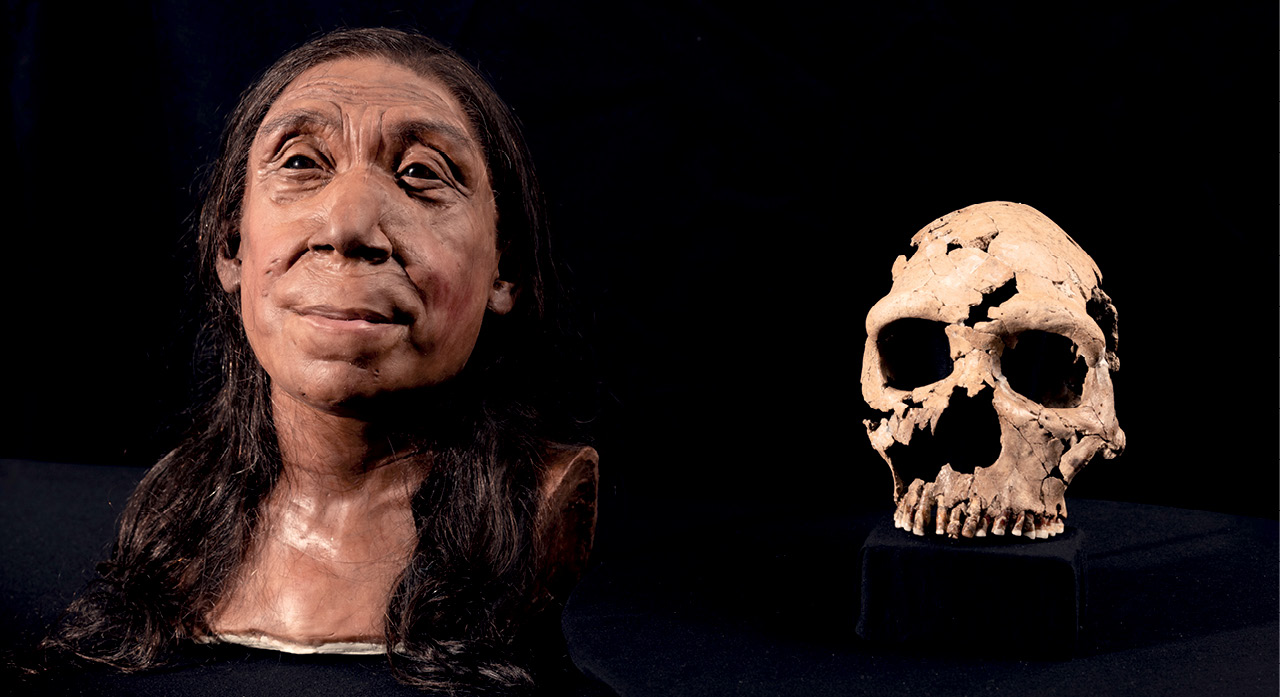
Looking at brain and skull shape alone highlights the differences between archaic and modern humans, but a Cambridge-based team of archaeologists has reconstructed the face of a 75,000-year-old Neanderthal woman as part of an effort to demonstrate that the species was not the ‘brutish and unsophisticated’ hominin of popular imagination.
The reconstruction was based on the remains of a woman dubbed ‘Shanidar Z’, one of ten Neanderthals excavated in 2018 in a cave in Iraqi Kurdistan. Dr Emma Pomeroy, University Associate Professor in the Cambridge Department of Archaeology, who excavated the skull and upper body of Shanidar Z, described her as ‘the best preserved Neanderthal individual to be found this century’.
Reconstructing her appearance involved piecing together the 200 pieces of her skull, which, said Dr Pomeroy, ‘looks very different to ours, with huge brow ridges and a projecting midface that results in a more prominent nose’. The recreated face suggests those differences ‘were not so stark in life’, and that it is ‘perhaps easier to see how interbreeding occurred between our species’.
The missing Y chromosome
Scientists at Stanford University have been debating the reasons why no Neanderthal DNA has ever been found in the Y chromosome of modern men, despite the fact that people outside sub-Saharan Africa have inherited between 1% and 4% of their genome from our Neanderthal cousins as a result of interbreeding.
The geneticist Fernando Mendez is the lead author of a study published in the American Journal of Human Genetics in 2016 that first identified the anomaly, reporting that there was no overlap whatsoever between Neanderthal and modern human Y chromosomes. This could be the result of genetic drift, the mechanism whereby particular gene versions die out among isolated populations, he says, adding that small populations also allow harmful mutations to accumulate within the gene pool at a higher rate than within larger populations, and natural selection might have favoured males with the Y chromosome of modern human males over those with the Neanderthal chromosome.
The Y chromosome can only be passed from father to son, so another theory being canvassed is that only female hybrids were able to reproduce and that male hybrids were sterile. Another possibility is that the immune systems of female H sapiens attacked male hybrids in the womb, leading to recurrent miscarriages and fewer male births. Three antigen alleles in the Neanderthal Y chromosome have been identified that can cause modern women to reject organs transplanted from men, as well as to have miscarriages after the birth of their first child. It is possible that any male foetus carrying the Neanderthal Y chromosome could have sensitised his mother’s immune system so that her body would miscarry any males subsequently conceived.
Dr Mendez stressed this was still only a hypothesis, but that ‘reduced fertility or viability is consistent with Haldane’s rule, which says that when you have a cross of differential populations, the male offspring are the ones that have more trouble’.
When did interbreeding take place?
In a paper, yet to be peer-reviewed, that was published on the bioRxiv platform (https://doi.org/10.1101/2024.05.13.593955), researchers at the Max Planck Institute for Evolutionary Anthropology, Leipzig, and the Department of Molecular and Cell Biology, University of California, Berkeley, report on their work to understand when modern and archaic humans interbred. They concluded that the Neanderthal genes in people alive today date from admixture events that took place between 47,000 and 40,000 years ago, thus ending around the time that Neanderthals were nearing extinction.
The authors looked for the presence of Neanderthal DNA in 275 present-day individuals from around the globe. They estimated how many generations back these gene segments had been acquired by looking at their presence in the previously sequenced genomes of 59 ancient H sapiens dating from between 2,000 and 45,000 years ago, mostly from Western Europe and Asia.
Though interbreeding probably took place on numerous occasions when modern humans first began migrating out of Africa and encountering Neanderthals in Eurasia some 120,000 years ago or earlier, little if any of the DNA gained from those early encounters survives in people today. H sapiens individuals older than 40,000 years were found to have Neanderthal DNA that is not found in modern populations, so their lineage died out without leaving any known descendants. The researchers also found that the earliest stretches of Neanderthal DNA acquired by modern humans were relatively long, while later Neanderthal segments were much shorter, suggesting an evolutionary process whereby only the most advantageous genes were retained.
The first Australians
Commenting on these findings, Chris Stringer of the Natural History Museum in London said that precision dating helps to pin down the timing of major migration events. People of African ancestry do not carry substantial amounts of Neanderthal DNA because their forebears were not part of the migration out of the continent that took place before Neanderthals became extinct. But Aboriginal Australians today carry the same Neanderthal ancestry as all other non- African populations, so their ancestors must have reached Australia after this period of gene flow, no earlier than 47,000 years ago.
A trace of an earlier dispersal may survive in the genomes of some Papuans, while the archaeological evidence from the Madjedbebe 2 rock shelter indicates that modern humans were present in Australia much earlier, at around 65,000 years ago. ‘The implication’, says Chris Stringer, ‘is that those early dispersals either went extinct or were effectively replaced or swamped by larger later waves.’
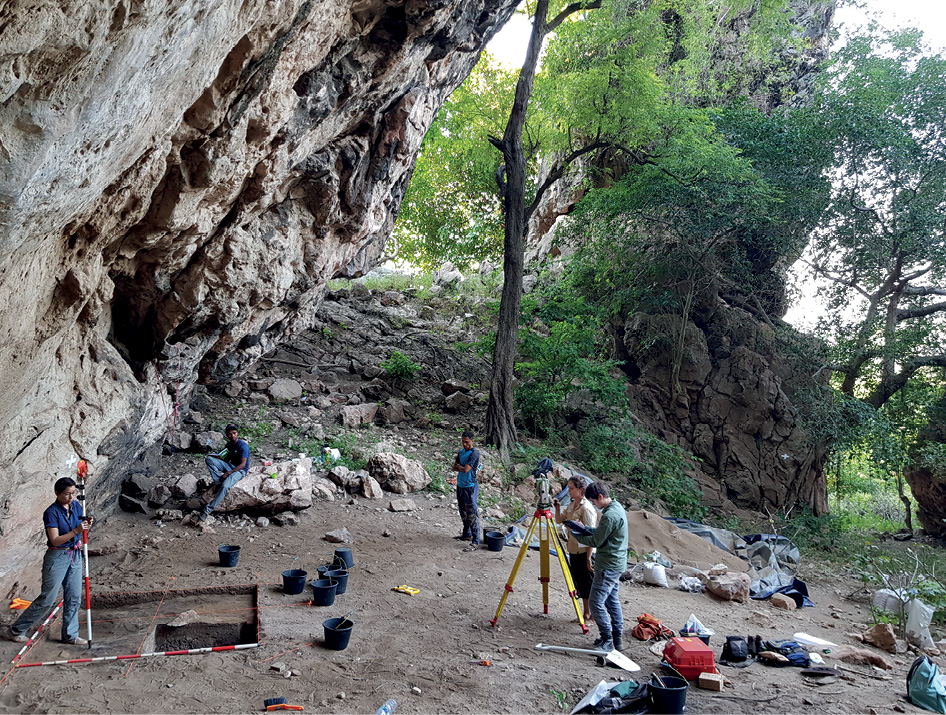
Elsewhere, the dating of thousands of stone artefacts and animal bones in a deep cave in Timor Island adds substance to this suggestion of a late dispersal that reached Sahul (the combined continent of Australia and New Guinea at times of lowered sea level) around 44,000 years ago, overwhelming and obscuring the genetic signature of earlier migrations.
In a paper that was published in Nature Communications (https://doi.org/10.1038/s41467-024-48395-x), the authors say that Timor Island has long been considered a stepping stone for the first human migration between mainland South-east Asia and Australia and New Guinea. However, the sediments from the Laili rock shelter on Timor Island show no evidence for humans there before 44,000 years ago.
The absence is significant, said study co-author Professor Sue O’Connor from the Australian National University (ANU), because it indicates that ‘humans arrived on the island later than previously believed’, thousands of years after the initial settlement of Australia.
Co-author Professor Mike Morley, from Flinders University, said that the shift from pre-occupation to intensive human activity at the Laili rock shelter site was sudden and very clearly marked in the stratigraphy: ‘as soon as people arrived on the scene, their use of the cave was very intensive, with clear evidence of burning and trampling of the shelter floor underfoot’. Finds from the occupation layers included haematite (red ochre) and grinding stones marked with red-ochre residues, along with knapped stone artefacts of chert, limestone, and quartz. Dietary evidence included charred fish bones and shellfish residues.
The authors conclude that the intensive early occupation at Laili was no accident: rather it represents a deliberate colonisation phase that may have overwhelmed previous human dispersals in this part of the world. Dr Shimona Kealy, of ANU, said: ‘the traditional view is that early humans were stumbling upon these islands by mistake. But this was a major colonisation effort, evident through the sheer number of people who were making the journey. It’s a testament to these peoples’ level of maritime technology and the boats they created, but also their confidence and competence in braving maritime crossings.’
Images: BBC Studios, Jamie Simonds; Ceri Shipton
Chris Catling is an archaeologist and writer, fascinated by the off-beat and the eccentric in the heritage world.