Subscribe now for full access and no adverts
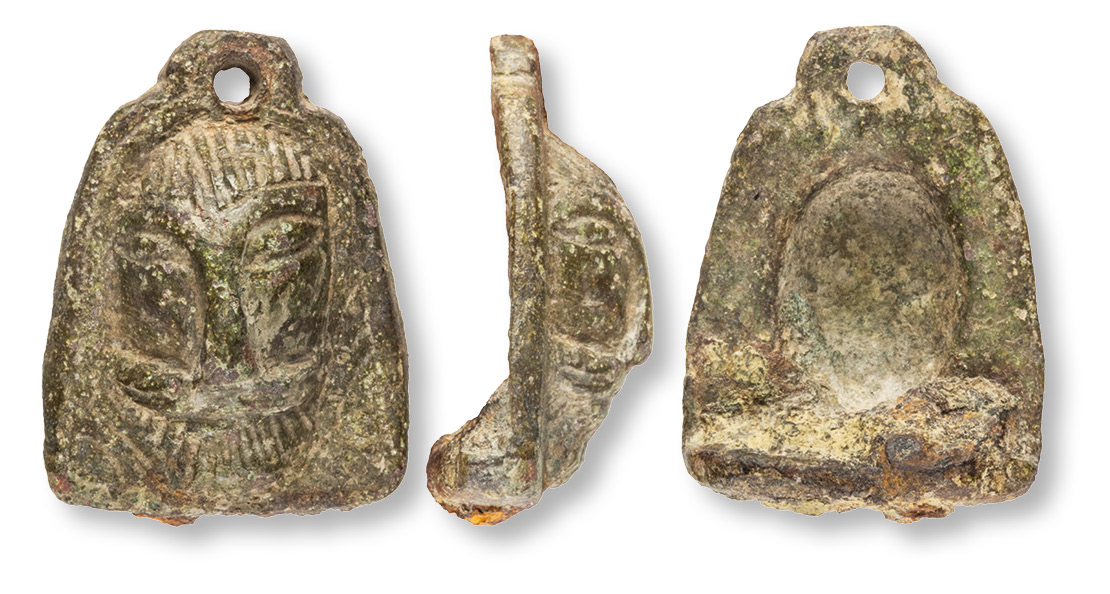
This is an early medieval stirrup mount made of copper alloy, which was found late last year by a metal-detectorist near Wick St Lawrence in northern Somerset. It would have once been affixed to the top of a triangular stirrup, and there is iron corrosion on the back attesting to the presence of a rivet, which would have been used to join it to the leather strap. While the earliest examples of this type of mount come from 9th century contexts in Norway, it is believed that they did not appear in England until the 11th century.
As was traditional for such mounts, this example is roughly triangular in shape and carved with a detailed projecting face, or possibly a full modelled mask, which is surrounded by incised radiating lines. The rounded head has vertical grooves representing hair or possibly a helmet, with a V-shaped brow extending down into a Y-shaped nose and, below this, a raised horizontal ridge that might represent a moustache. The eyes are two incised ovals, and a horizontal groove represents the mouth. Below the mouth, another series of vertical ridges form a possible beard.
Many Anglo-Scandinavian mounts from this period depict animals, particularly wolves, but a few human faces like this are known. While no exact parallels have been recorded in England, examples from the Portable Antiquities Scheme website include similar items from Lincolnshire (LIN C868AE on the PAS database) and Wiltshire (WILT-6EE94E).
For more information about the stirrup mount, see
https://finds.org.uk/database/artefacts/record/id/1245601 or search for SOM-B02A20 on the PAS database.
The Portable Antiquities Scheme is an initiative to encourage the recording of archaeological objects found by members of the public in England and Wales. For more information on the Scheme, and to browse its database of almost 1.8 million finds, visit https://finds.org.uk. Information on this find was provided by Laura Beckwith – Finds Liaison Officer for Somerset.

Text: Kathryn Krakowka / Image: Portable Antiquities Scheme