Subscribe now for full access and no adverts
This is a Roman tortoise or turtle figurine that was recently found by a metal-detectorist near Wickham Skeith in Suffolk. Cast in copper-alloy, it has a flat base with no evidence of having once had a fixing, suggesting that it was a free-standing figurine, and possibly part of a larger set of figures.
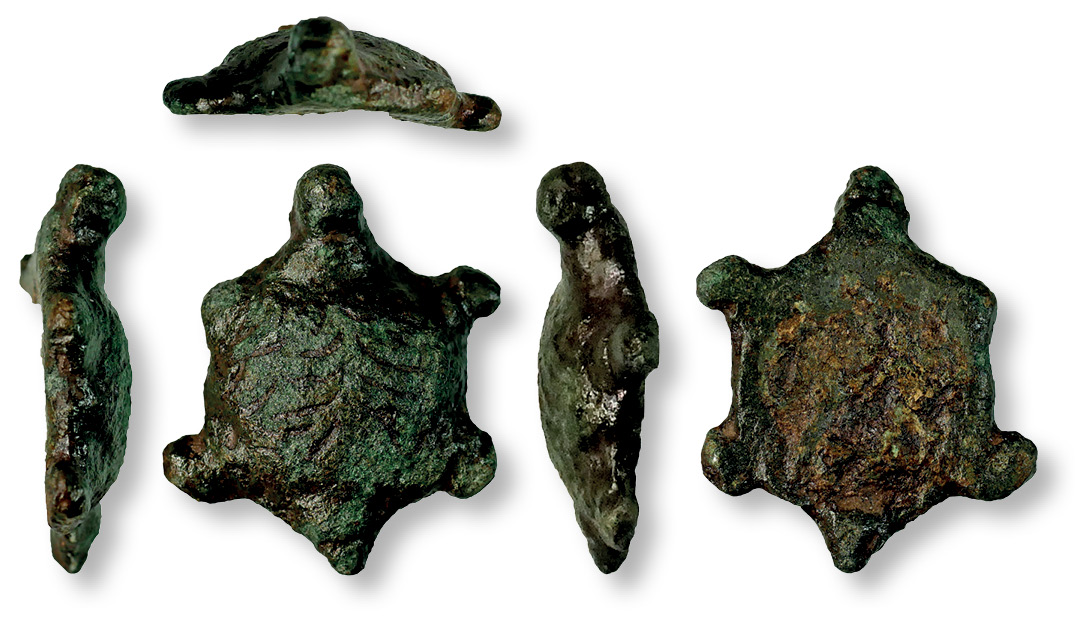
The body of the figurine is shaped like a typical turtle/tortoise shell, sub-circular in plan and D-shaped in section. While the top of the shell is very worn, it appears to have once been decorated with two sets of crescent-shaped grooves, positioned on either side of the midpoint. The figurine has a crudely shaped head protruding from the apex of the shell, and four feet projecting from the sides. The left forelimb seems to have been broken away some time ago, leaving only a short stump. There is also a small tail on the lower edge. The underside of the shell is flat and does not appear to have been decorated.
It is believed that, during the Roman Empire, tortoise shells were often used to make lyres. Their invention is attributed to Mercury in Classical myth, and so the turtle/tortoise appears to have a long-standing link with the messenger god. It may have been associated with Sabazios, too, a god of the Phrygians and Thracians.
One of the first recorded turtle/tortoise figurines in Britain was found in Colchester and dated from the 2nd century AD. Several similar figurines have also been recorded in Suffolk by the Portable Antiquities Scheme over the years, including one found near Little Blakenham ten years ago (SF-35D186 on the PAS database) and another found near Barking 14 years ago (SF-A53C93).
For more information about this figurine, see https://finds.org.uk/database/artefacts/record/id/1133659 or search for SF-13EDD8 on the PAS database.
The Portable Antiquities Scheme is an initiative to encourage the recording of archaeological objects found by members of the public in England and Wales. For more information on the Scheme, visit https://finds.org.uk. Information for this find was provided by The Finds Recording Team/Portable Antiquities Scheme, Suffolk County Council Archaeological Service.
Text: Kathryn Krakowka / Image: Suffolk County Council