The citizens of York must now be accustomed to Vikings taking over their home – but the ‘invasion’ that takes place every February half-term is rather more friendly than that which conquered Anglian Eoforwic in 866. Reforged as Jórvík, the settlement flourished as a major trade centre whose remarkably well-preserved remains were excavated in the 1970s, immeasurably illuminating our understanding of the Viking Age. This archaeological legacy is showcased year-round in the ever-popular JORVIK Viking Centre – but since 1985 it has also inspired an annual city-wide celebration that has grown to be the largest Viking festival in Europe.
For the whole week of this year’s JORVIK Viking Festival, bustling ‘living history’ encampments populated Parliament Street and St Sampson’s Square. Stalls hosted traders selling jewellery, ceramics, and mead; opportunities to handle replica weapons and shields; and costumed interpreters eager to talk about life in the Viking Age. The festival had a busy programme, including talks, tastings, storytelling, and craft activities, and the weekend saw the addition of a bustling market within the Merchant Adventurers’ Hall, as well as the return of the Viking Games. There, contenders performed feats of strength and endurance, while more light-hearted events included competitions to find the best beard, best beast, and best-dressed cosplayer.
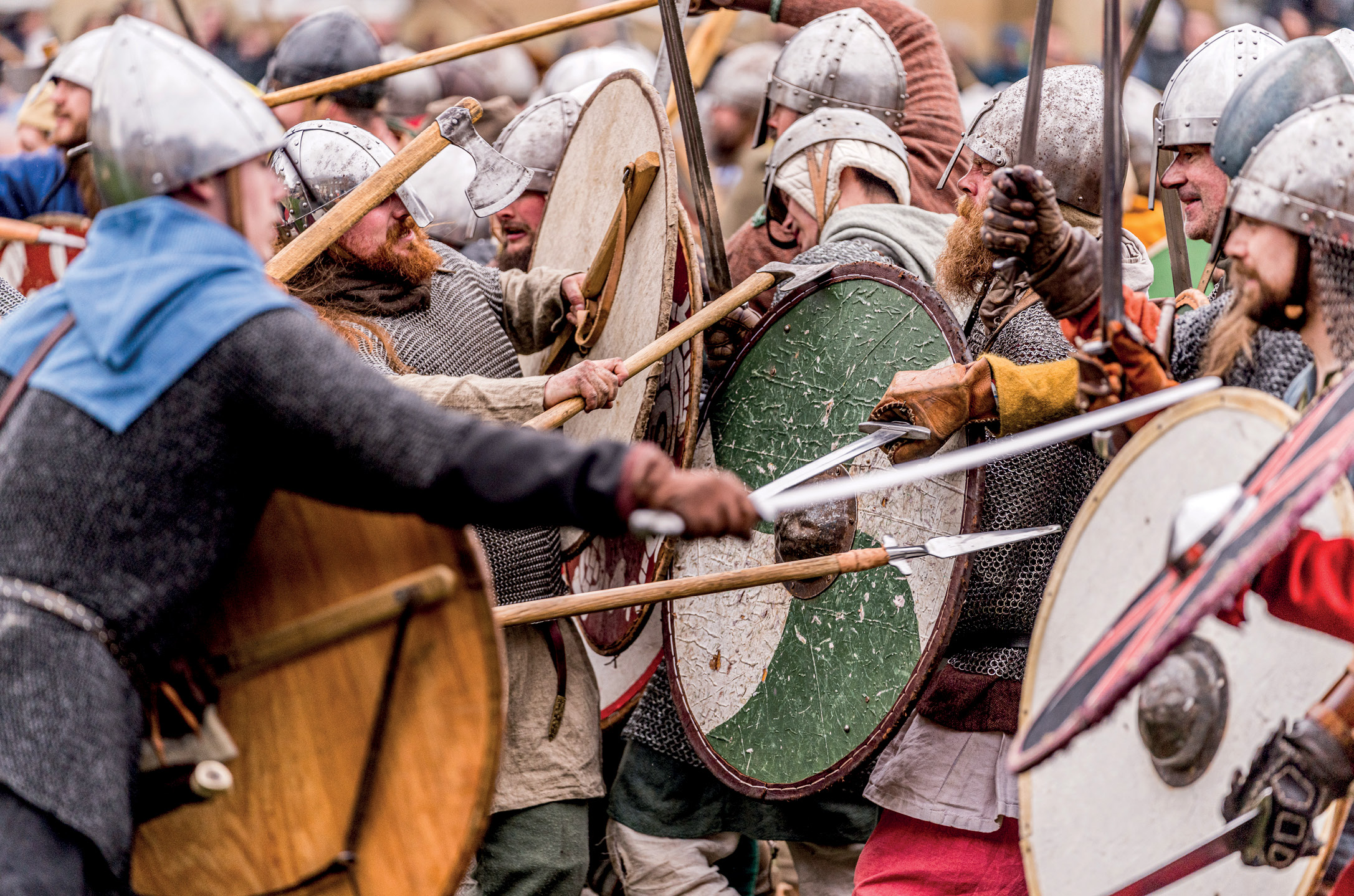
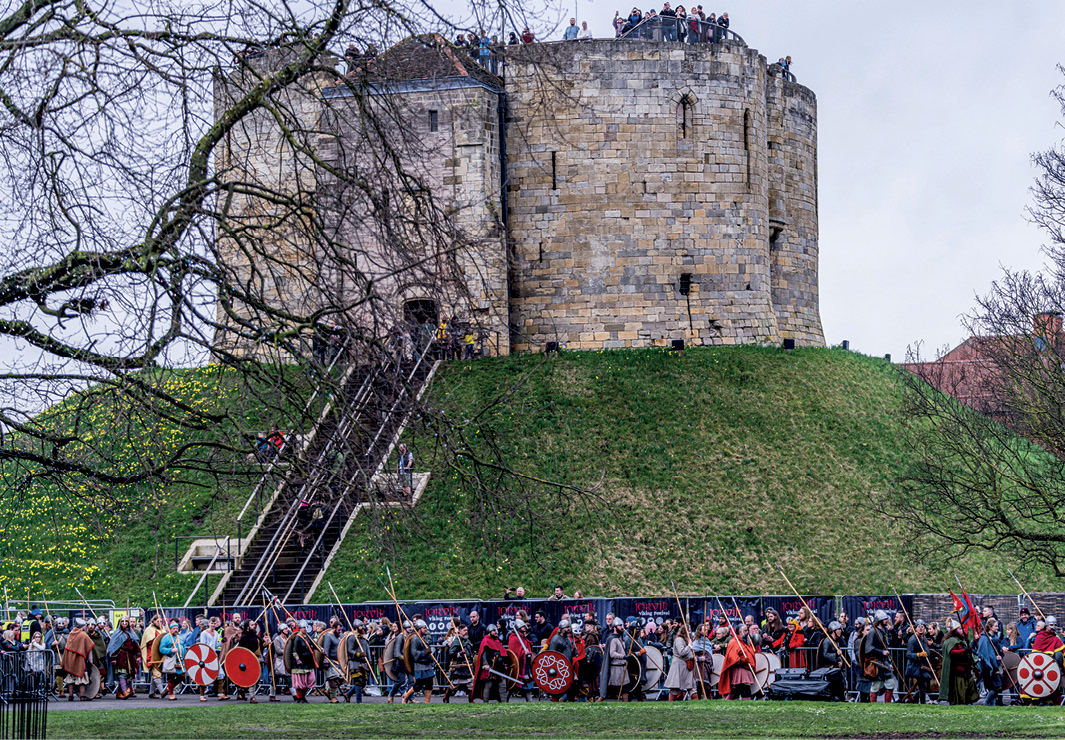
Celebrations culminated in the now-famous March to Coppergate, featuring more than 300 re-enactors, before two armies clashed in a dramatic battle. This year’s finale was themed around Yggdrasil, the mythological World Tree, and featured stories of the Nine Realms and the rise and fall of the Norse gods.
Ongoing exhibits
While visiting the festival, I dropped in on three temporary exhibits in York Archaeology attractions, showcasing different aspects of the city’s past. These displays are still running even now that the celebrations have finished. Within the JORVIK Viking Centre, a new display hosts the Herefordshire Hoard until the summer. Set among the attraction’s permanent displays of metalwork and domestic items (including England’s only Viking Age sock), a glass case holds a small but significant collection of coins and other early medieval artefacts.
The former group includes a number of issues of Alfred the Great and Ceolwulf II, late 9th-century kings of Wessex and Mercia respectively. Written sources depict Ceolwulf as a junior partner, but the shared imagery on their coins intriguingly indicates a much more equal relationship. There are also two foreign coins – a Frankish denier and a dirham from Islamic Spain – emphasising the international spread of the hoard’s contents. Other highlights include a gold arm-ring with an animal-headed clasp; a large gold finger-ring with an unusual octagonal outline and an inlaid pattern in Anglo-Saxon Trewhiddle style; and a rock crystal pendant with possibly Frankish origins.
The cache was buried near Leominster, probably in 878-879 when the Viking Great Army was active in Mercia, and the display is accompanied by captions and QR codes providing more details of individual items, and explaining the context of their discovery by metal-detectorists, their illegal sale, and the recovery of what is thought to be 10% of the hoard’s original contents.
A short walk from the JORVIK Viking Centre is DIG: an archaeological adventure, whose interactive, child-friendly displays and activities are designed to introduce young people to how we explore the past. The exhibition currently running there, however, can be enjoyed by all ages, combining artistic designs with an innovative soundscape themed around Roman York. Soundmarks is a collaboration between archaeologist Rose Ferraby and artist Rob St John, inspired by the ‘Roman York Beneath the Streets’ project, which has been using antiquarian records, excavated evidence, and new Radar surveys to illuminate the city’s past.
Large collages represent six key locations: the cemeteries discovered under the railway station; the River Ouse; the fortress walls preserved in Museum Gardens; the heart of the fort located under the Minster; the Roman industrial activity found where DIG now stands; and the civilian settlement at Micklegate. Each has its own palette of colours and textures, weaving abstractly evocative shapes and more figurative imagery through the designs, and these creations are accompanied by displays revealing how they were devised – sketchbooks, photographs, scrap material – and recordings reflecting their themes. A short film (silent, but with subtitles) plays on loop, discussing aspects of the Roman city in more detail.
My third exhibition visit took me to Barley Hall, the atmospheric 15th-century building that was bought by York Archaeological Trust (now York Archaeology) in 1987. Its interior is staged to reflect its medieval use, while its upper floor is used for a series of long-running temporary exhibitions. During the festival, its displays were supplemented by Staging the Vikings, a series of photographs and other images depicting Viking-themed performances that have been put on in York since 1909. Now, the main focus of these exhibits has returned to the long-running Bard at the Barley Hall, which explores how Shakespeare depicted the past in his plays, and how modern productions often use his texts to scrutinise the present.
Complementing boards interrogating key themes such as kings and queens, witchcraft, anti-Semitism, and the differences between comedy, tragedy, and history plays, are colourful costumes loaned by York’s Theatre Royal – as well as outfits worn in famous productions by such household names as Helena Bonham Carter, Kate Winslet, and Michael Fassbender. Visitors can also find out more about the rise of community theatre and re-enactment in York, and learn what connects Barley Hall with Shakespearean performances: the same expert conservators who restored its timbers were commissioned to reconstruct the Globe Theatre in London.
Further information:
For more information about the JORVIK Viking Festival, see http://www.jorvikvikingfestival.co.uk, and for more about the JORVIK Viking Centre and its sister-attractions, see http://www.jorvikvikingcentre.co.uk.
All images: Charlotte Graham/JORVIK Viking Festival