Subscribe now for full access and no adverts
By the end of the 18th century, Britain was at the centre of the clockmaking world, producing almost half of all the watches and clocks that were then being made globally. This period also saw great enthusiasm for Chinese exports like tea, silk, and porcelain, and travelling in the other direction were intricate and highly decorative clockwork automata showcasing the expertise of British artisans.
These were not just beautifully decorated timepieces: they also played music and were adorned with a complex array of moving parts, bringing their designs to life. Although mechanical objects were familiar in China, these items were appealingly novel, and Qing Dynasty emperors eagerly amassed collections of them. Displayed as Western curiosities that showcased their owners’ international influence, they were known as ziminzhong – ‘bells that ring themselves’ – which British merchants rendered as ‘Sing Songs’.
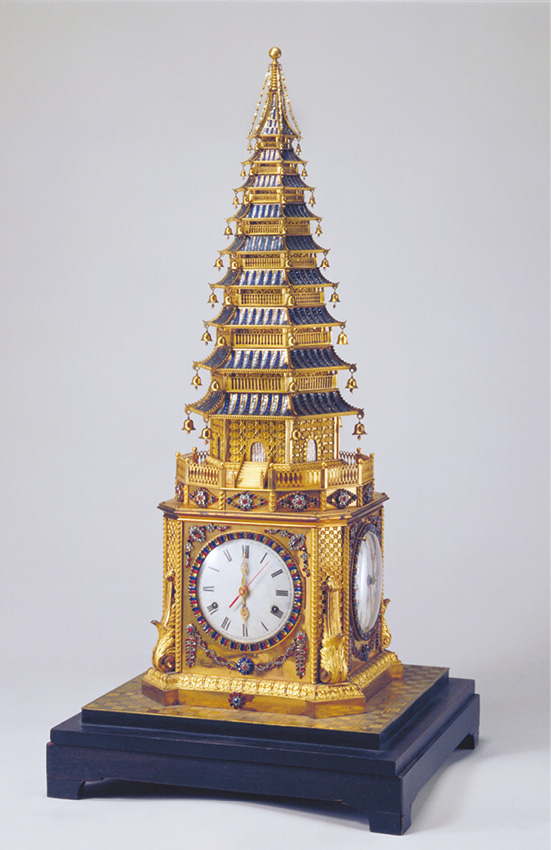
Today, the Palace Museum in Beijing’s Forbidden City is home to an impressive permanent display of these items, and now 23 examples have travelled to the Science Museum to trace the centuries-old trade links and cultural exchanges that they represent. Most of the examples on show have never been displayed in UK before, and their stunning designs feature golden pagodas (above), flowers, birds, and animals including an elephant whose eyes, tail, and trunk move when the zimingzhong is wound up. Interactive elements of the displays allow you to explore how their intricate inner mechanisms worked.
Visitors can learn about the lives and interests of three Qing rulers (the Kangxi Emperor, r. 1662-1722; the Yongzheng Emperor, r. 1723-1735; and the Qianlong Emperor, r. 1736-1795), as well as key individuals like Wu Bingjian (1769-1843), an influential Chinese merchant who was one of the richest people in the world at the time, and Matteo Ricci (1552-1610), a missionary who, in 1601, was the first European to enter the Forbidden City.
Other displays reflect Georgian Britain’s (lack of) understanding about contemporary Chinese culture: many of the clocks were intended to appeal to presumed Chinese tastes, with imagery based on ‘Chinoiserie’ – European ideas of an imagined, exotic ‘East’. More culturally specific examples were soon produced in the clockmaking centres that sprang up in 18th-century China, particularly at the important trading port of Guangzhou, which created distinctive zimingzhong adorned with blue enamel. We can see timepieces, too, that combine elements made in both countries, with one example depicting a crane (below).

As you walk through the exhibition, there is a constant backdrop of bell-like chimes and mechanical ticks that feels meditatively peaceful. It also seems fitting that the displays are housed in Special Exhibition Gallery 2, which is on the same floor as, and opposite, a gallery called the ‘Clockmakers Museum’, home to the oldest clock and watch collection in the world.
Further information:
Zimingzhong 凝时聚珍: clockwork treasures from China’s Forbidden City runs at the Science Museum until 2 June; tickets are ‘pay what you can’ (minimum £1); visit http://www.sciencemuseum.org.uk/see-and-do/zimingzhong for more details.
Images: 铜镀金嵌料石升降塔钟 Moving Pagoda Zimingzhong and 铜镀金仙鹤驮亭式表 Zimingzhong with parts from China and Britain, © The Palace Museum