Subscribe now for full access and no adverts
Gladiators occupied an intriguingly ambivalent position in ancient Rome. Regarded as infames, they were among the lowest of the low socially, but successful fighters could become fan favourites who were celebrated like modern pop stars. Today they remain iconic figures, immortalised in film just as they were once depicted in mosaics and Pompeiian graffiti, and still very much a focus of fascination – but what is the historical truth behind the often glamourised depictions we see today? Exhibitions running in Leeds and Northampton place visitors on the front row of ancient arena spectacles, drawing on recent research to separate fact from fiction and illuminate the hundreds of thousands of individuals who risked, and sometimes lost, their lives in amphitheatres across the empire in the name of entertainment.
Fans of Squid Game aside, it can be difficult for modern observers to understand the appeal of festivities – often lasting for several days – that mixed innocuous events like acrobatic displays and comic performances with staged animal hunts, the execution of condemned criminals, and visceral armed combats. However, Gladiators: heroes of the Colosseum, which is currently at the Royal Armouries Museum in Leeds, skilfully places arena events within the context of a society that prized military success, bravery, and fighting skill, and believed that its power and prosperity depended on such qualities. The displays of foreign captives and exotic animals who were compelled to participate in these spectacles would have hammered home Rome’s dominance over the human and natural worlds – as would the impressive architecture built to stage these spectacles.
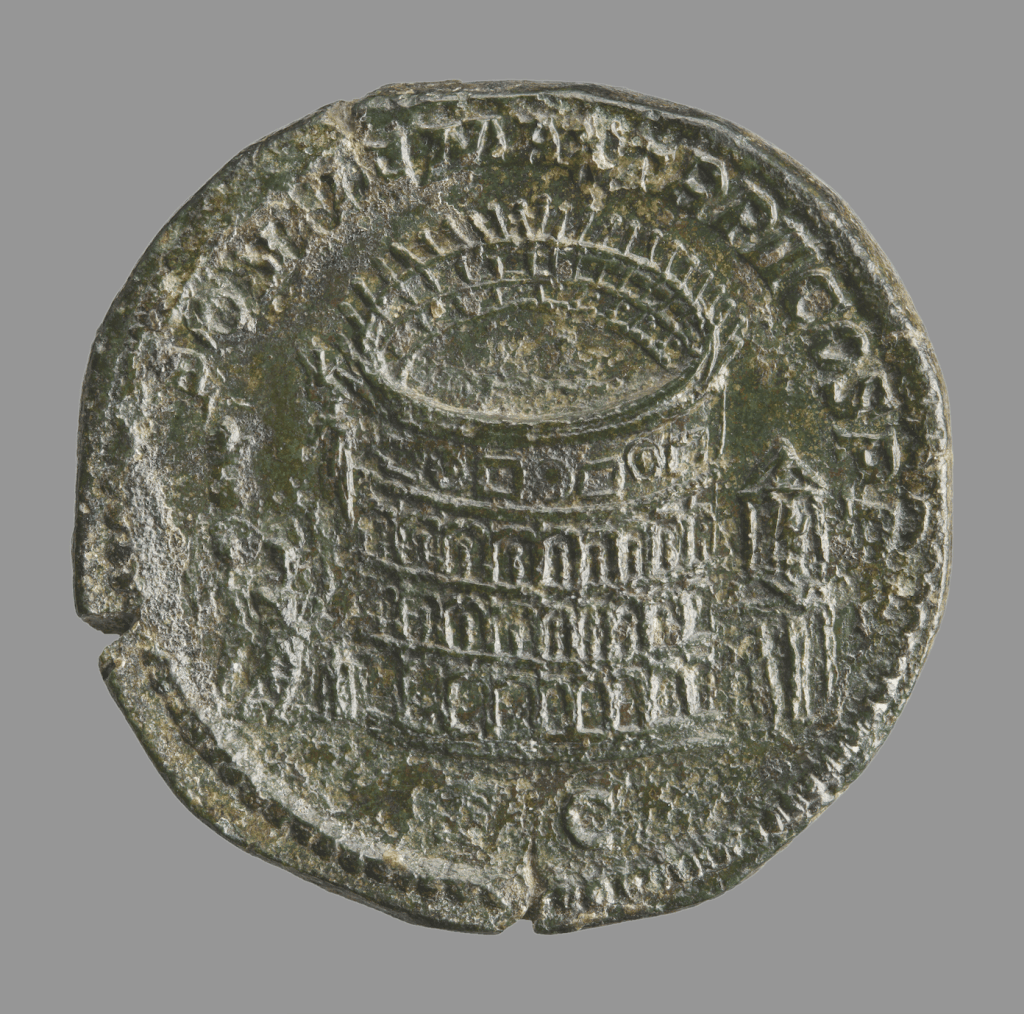
The exhibition (which has previously travelled to countries including Australia, Canada, Germany, and France) is curated by Dr Rossella Rea, a former Director of the Colosseum, and the first displays that visitors encounter after emerging from a darkly atmospheric ‘immersive space’ focus on the construction and use of this imposing amphitheatre, the largest of its kind, which was able to accommodate c.55,000-75,000 spectators. Touchscreens and a wonderfully detailed fly-over video allow you to explore its interior and key features of its design.
After this, we learn about the gladiators themselves. Some were prisoners of war, slaves who had been sold by their owners, and convicts, all of whom were forced to fight – but free citizens could also sign away their rights for a fixed term, whether out of a reckless desire for fame and fortune, or sheer desperation (the exhibition mentions a young man who entered the arena to pay a friend’s ransom). Other displays explore what life in a ludus (gladiator school) was like, including training regimes, the mostly vegetarian diet that saw gladiators nicknamed hordearii or ‘barley-eaters’, and the masseurs and medics who were dedicated to ensuring that they survived to fight as many bouts as possible – it is a myth that every combat ended in a death: training gladiators was expensive, and managers were keen to protect their investments.
Touchscreens are used to great effect, allowing visitors to explore different classes of gladiator, zoom in on distinctive elements of their weapons and armour, learn about particularly popular pairings, and watch clips of modern re-enactors fighting in the guise of each example. Elsewhere, longer videos offer more detailed insights into themes including how animals were sourced, captured, and transported to the Games (colourfully illustrated using imagery from the 4th-century Great Hunting Mosaic from the Villa Romana del Casale in Sicily), and scientific analysis of human remains excavated from the gladiator cemetery at Ephesus, Turkey.
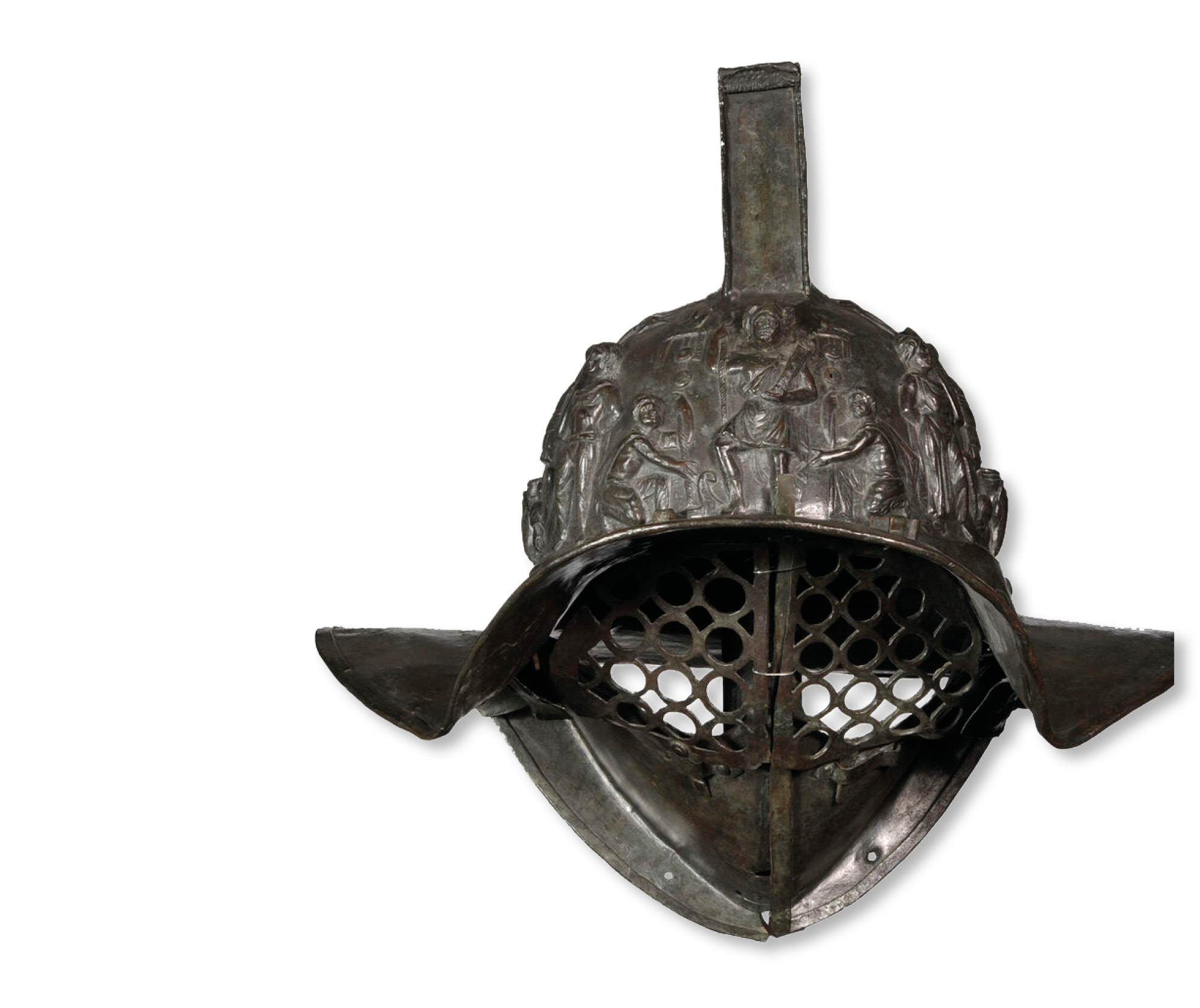
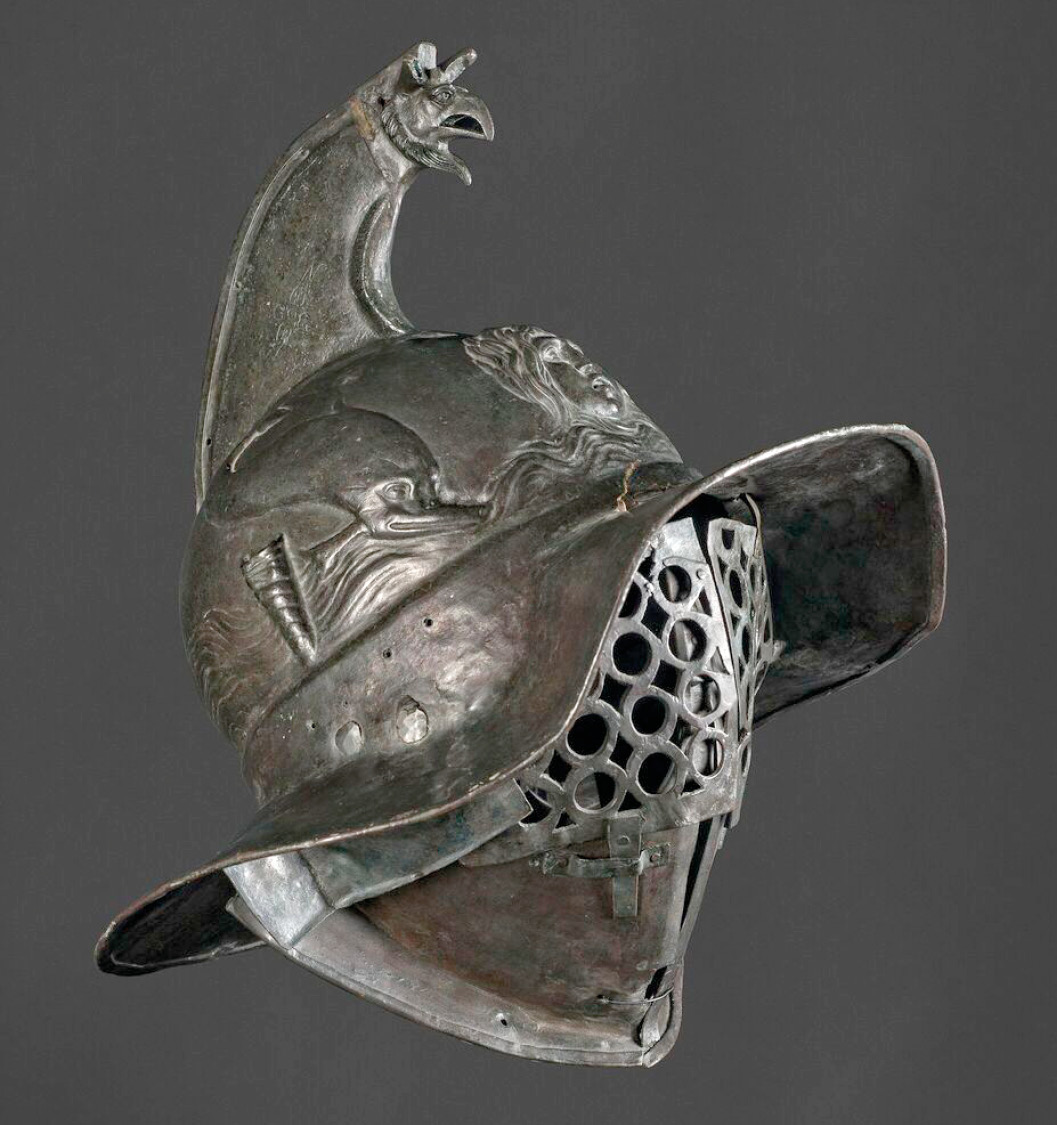
Other sections describe the events of the Games themselves, as well as the myriad other industries supported by these spectacles, from betting agents and souvenir stalls to food vendors. Perhaps the most impressive objects on show, however, are examples of gladiator equipment – helmets, greaves, spearheads, and the point of a trident – that were excavated at Pompeii. These are show-stopping artefacts, 2,000 years old but so well preserved and elaborately decorated that they look like props from Ridley Scott’s films.
Undercutting the glamour of such ornate items is a poignant final display captioned ‘Game over’. This features a replica of a 3rd-century gravestone commemorating the secutor Urbicus, who is shown in armour, but also (rather touchingly) accompanied by his dog. Its inscription provides a wealth of biographical information: Urbicus was originally from Florence but met his end in Milan at the age of 22 – having fought 13 times and achieved the highest rank of primus palus, he was unsportingly cut down by an opponent whom he had just spared, leaving behind a wife and young family.
Gladiators in Britain
Moving from the heart of the Roman Empire to its western fringe, how did these entertainments play out in Britannia? Currently running at Northampton Museum & Art Gallery, Gladiators of Britain is a touring exhibition, held in partnership between the British Museum and Colchester + Ipswich Museums, that combines a core collection drawn from the holdings of these institutions with artefacts added at each host location to reflect that area’s history. As a travelling exhibition, the displays are thoughtfully staged, with supplementary information conveyed through beautifully styled (and sensibly portable) fabric banners, together with video screens that offer more in-depth insights into two key objects (of which, more below).
While Britain may not boast a Roman time capsule on the scale of Pompeii, the artefacts on display in this exhibition offer intriguing glimpses into how arena spectacles may have been staged far from the imperial heartlands. A number of amphitheatres have been excavated in England, Scotland, and Wales, but were their spectacles as spectacular? Gladiators of Britain suggests that there may have been a local flavour to the proceedings, with more easily accessible species like stags, boars, bears, and bulls playing key roles in staged hunts and animal fights – though evidence from York suggests that more exotic beasts may also have been imported. While no amphitheatre has yet been identified in the city (though, given its status during the Roman period, it is likely that one may wait to be found), excavation of a cemetery at Driffield Terrace identified a number of men who were interpreted as possible gladiators. One had a bite-mark on his pelvis (which visitors to the exhibition can examine via a 3D digital model; see also CA 245 and 397) indicating that big cats may have appeared in British arenas, too.
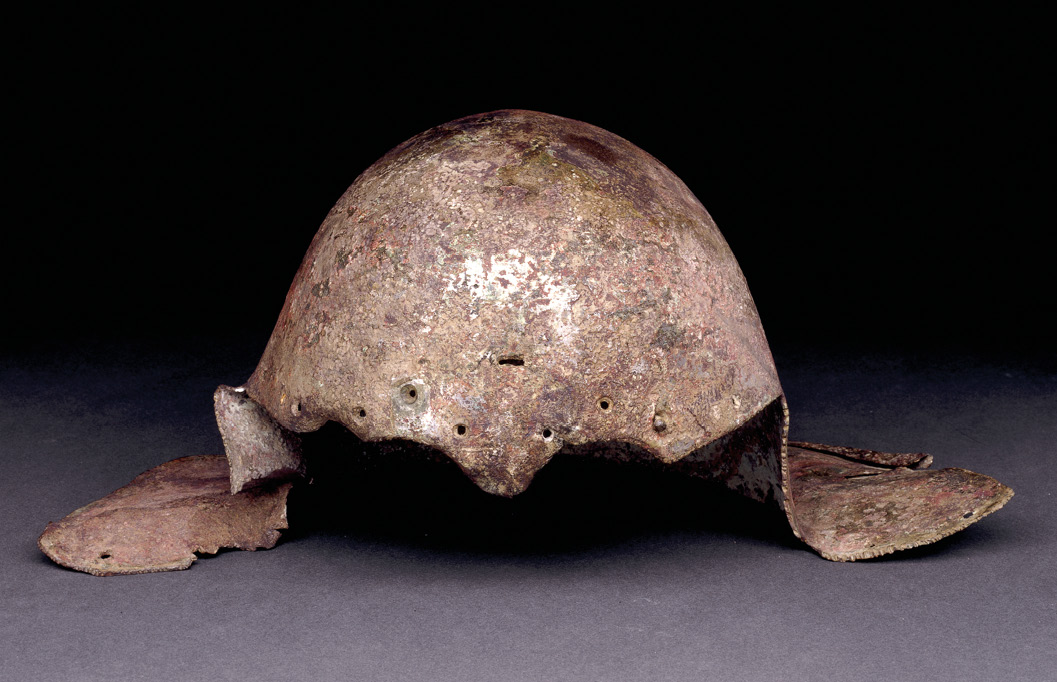
What about gladiator fights? Only one piece of confirmed gladiator armour has been found in Britain: the Hawkedon Helmet, from Suffolk, which would have been worn by a class of fighter that was also common on the Continent, called a provocator. The bronze headgear would have originally had a protective faceguard that today is represented only by a row of rivet holes, and in the exhibition an accompanying video describes an experimental initiative to reconstruct the missing visor, as well as recent analysis of the helmet’s metalwork.
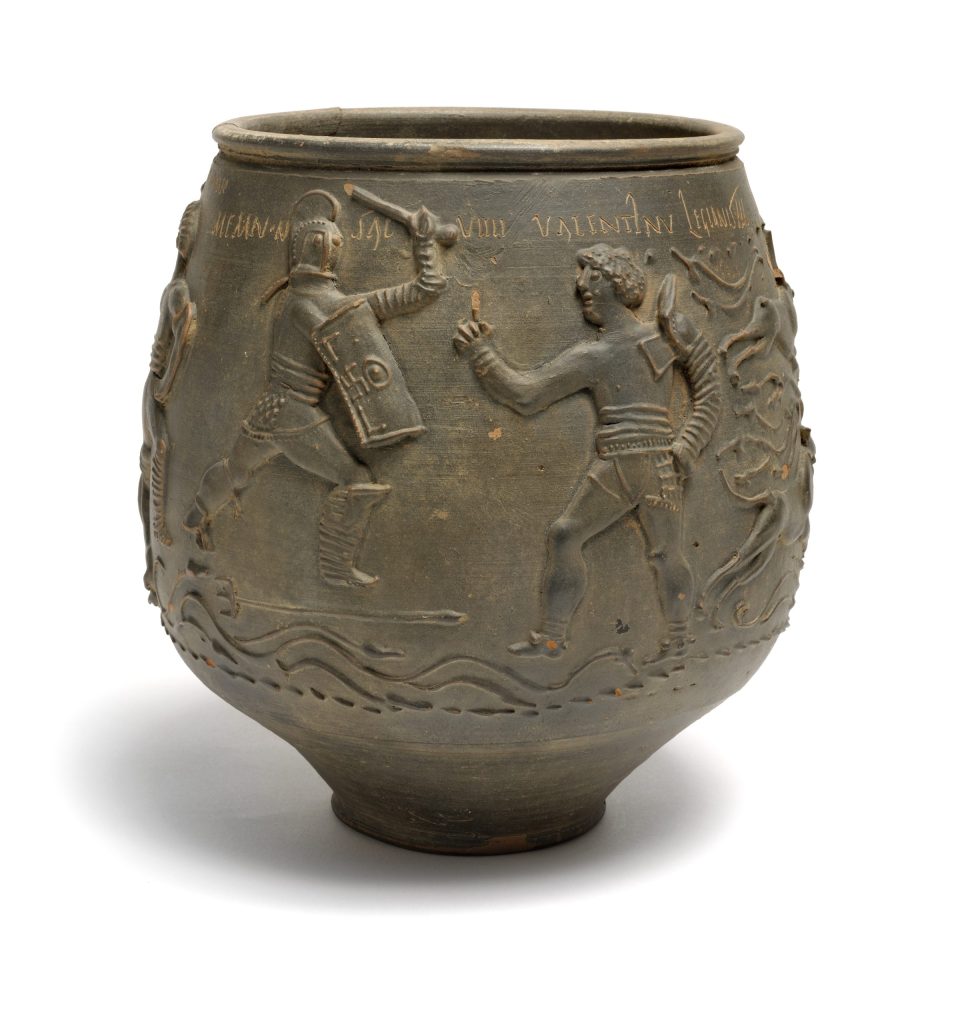
The nearest known amphitheatre to the helmet’s findspot lies 20 miles away at Colchester, and this city has also produced persuasive evidence that gladiator fights were staged in Britain, in the form of the exhibition’s other ‘star item’: the Colchester Vase (CA 402). This large pottery vessel ended its days as a cremation urn, but it may have originally been commissioned as a piece of fan art commemorating real fighters. Its decoration includes images of gladiators whose names are supplied by an inscription running around the rim. Significantly, a video playing on a nearby screen attests, these names form part of the original design, cut into the clay before the pot was fired, which suggests that the Vase may have been made to order (locally, analysis of its clay suggests), with its patron specifically requesting depictions of their favourite combatants.
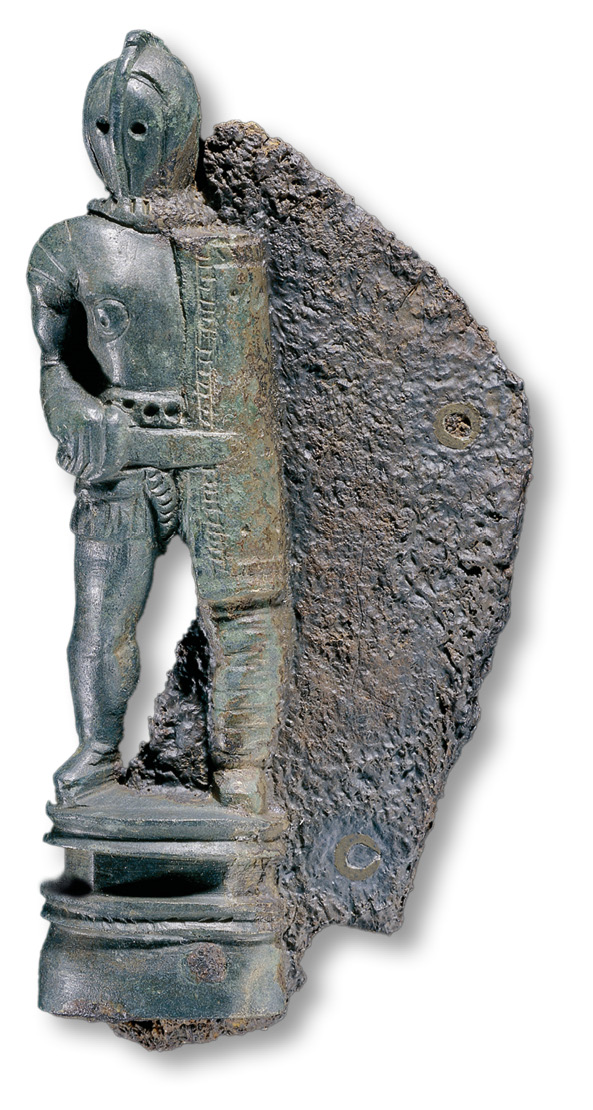
Within the materials that have been added for the exhibition’s Northampton incarnation, we learn that, while no amphitheatre has yet been identified in this region (the nearest is at St Albans), some of the wealthy individuals who built villas along the Nene Valley appear to have had a keen interest in the Games. One of the most characterful finds from the long-running excavations at Piddington is the copper-alloy handle of a clasp knife in the shape of a secutor (CA 182); the same type of gladiator appears on pieces of a glass beaker from Whitehall Farm, while Stanwick has produced a pottery vessel painted with an armoured individual who is also interpreted as an arena fighter. These are displayed close to another pot, this time from Water Newton near Peterborough, whose surface has been painted with thick, liquid clay (a technique called barbotine) to create images. While these have now flaked into fragments, traces of a gladiator fight, a leopard, and an acrobat can still be seen. Whether such items indicate that their owners had actually witnessed such spectacles, or reflect a more passive interest geared instead towards associating themselves with Mediterranean culture, the range of objects bearing imagery on this theme, and the long span of time that they represent, stretching some 300 years, attests to how enduring enthusiasm for the arena was, even in more provincial settings.
Further information:
• Gladiators: heroes of the Colosseum is at the Royal Armouries in Leeds until 2 November. Entry to the rest of the museum is free, but visitors to the exhibition must book a timed entry slot with tickets costing £6.50 for adults and £4 for concessions and children aged 4-17 (under-4s are free). See http://www.royalarmouries.org/leeds/whats-on/gladiators for more details.
• Gladiators of Britain will be at Northampton Museum & Art Gallery until 7 September; entry is free, see http://www.britishmuseum.org/gladiators for more details. Its tour will then continue to the Grosvenor Museum, Chester (20 September 2025-25 January 2026), and Tullie, Carlisle (7 February-19 April 2026).