Hidden treasures

Karl Harris continues his ‘Travels in an Antique Land’ with visits to the First Intermediate Period Tomb of Ankhtify at Mo‘alla, and a multi-era temple complex dedicated to the god Montu at Tod.
June 17, 2025
This article is from Ancient Egypt issue 149


Subscribe now for full access and no adverts

I had been meaning to revisit the two archaeological sites of Mo‘alla (ancient Hefat) and Tod (ancient Djerty, Classical Tuphium) for several years, but had somehow managed to overlook them. So this time I arranged for a driver (Ahmed) to take me and my travel companion Paul to visit both places, which are located just south of Luxor. It is important to note that tickets for both Tod and Mo‘alla are available only at the Luxor Temple ticket office. There is no sign at Luxor Temple that says that you can buy the tickets there, so you need to ask for them. In January 2025, they cost a reasonable LE100 each (around £1.50).

Some of the 30 strangely shaped limestone columns inside the Tomb of Ankhtify at Mo‘alla. 
The Montu Temple Complex at Tod. A Graeco-Roman pronaos enshrines what was the earlier temple of Senusret I, now visible only as a pavement and a small piece of interfacing wall.

MO‘ALLA

Both sites are on the eastern side of the Nile, with the temple complex of Tod approximately 20 kilometres from Luxor. Mo‘alla is a further 15-20 kilometres south of Tod, and the tombs are found on a hillside immediately across a canal and the Cairo–Aswan railway line. The Eastern Desert Road neatly shadows the canal and the railway for much of the route. We had already decided to go to Mo‘alla first, so Ahmed drove us for 45 minutes along smooth tarmac roads past dozens of small vegetable farms and numerous picturesque plantations of bananas and dates. We went through one police road check, which required no paperwork (we were simply waved through), and a bustling street market of local farm produce at a small village. Just beyond the modern-day village of el-Mo‘alla, we turned left to cross one of the many bridges that span the canal and waited at the level crossing for the Cairo–Aswan train to pass. The archaeological site lies almost immediately in front of, and to the left of, a dirt-track road. The local inspector and site guardians came out of their office to greet us, check our tickets, and walk us up a small slope to the tombs.

The Tomb of Ankhtify is on the lower slopes of a hill that is in the shape of a pyramid – a rather royal setting for a regional ruler, which perhaps explains the choice of location. 

The necropolis of ancient Hefat, located just south of el-Mo‘alla, was established in the early part of the First Intermediate Period, possibly earlier, and there are many rock-cut tombs to be seen dotted around the limestone landscape. The only one currently open to the public is the c.2100 BC tomb of the nobleman Ankhtify (‘the one who will live’). We were told that the poorly preserved Tomb of Sobekhotep is no longer open without special permission.

 One of several carved depictions of Ankhtify.

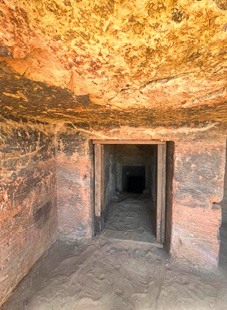
The Tomb of Ankhtify had already been raided when it was discovered by local quarry workers in 1928. It was excavated and surveyed by a French team led by Jacques Vandier from 1930 onwards. Although Vandier wrote his report around the same time, the tomb was not fully published, because of the outbreak of World War II, until 1950. The tomb comprises a large, approximately rectangular chamber, with roughly hewn pillars supporting the ceiling, and a burial shaft in the middle of the floor.

The rock is a very poor-quality limestone, and this probably caused the strange shapes of the pillars, which may have originally been intended to be circular representations of marsh plants. Outside, there is evidence of an open-air solar court and a small causeway. The tomb interior has carved and painted portraits of Ankhtify and his wife, plus many colourful and often cartoon-like depictions of humans and their livestock.

One man tastes a piece of stew, while the other stirs the big terracotta pot and fans the flames of the fire. 

The fishing scene

One highlight of the scenes painted on mud plaster is a detailed depiction of the tomb’s owner fishing.

 The fishing scene, painted on mud plaster. The fish depicted that have been identified include Lates niloticus (Nile perch – the first fish on the spear), Citharinus latus, Hydrocynus forskahlii, Tetraodon lineatus (fahaka puffer), Synodontis schall, and various species of Chromis

The Autobiography of Ankhtify

An important text referred to as the ‘Autobiography of Ankhtify’ appears in the tomb, and I am very grateful to Bill Manley for giving me access to his translation of that text for this article:

What I am is a man, than whom can be no other.

Ankhtify lived around 2100 BC and came from Hefat near Esna. He was a nomarch (governor and regional ruler) of the third nome (region) of Upper Egypt, before becoming governor of the second nome later in his career. Very little is known about his family, although he had a wife called Nebi and (possibly) four sons and two daughters. His autobiography is written on seven pillars surrounding the burial shaft of the tomb. The boastful texts describe a man of humble origins who rises through the ranks of the local army before achieving multiple honours and titles, bestowed on him by an unnamed king. He claims to bring peace and prosperity to the areas that are under his rule, and to support those suffering a famine in neighbouring regions. He lists acts of generosity including giving ‘bread to the hungry’, ‘clothes to the naked’, and ‘sandals to the barefooted’, before ending with a serene spiritual vision:

I have made a gateway to the summit of the sky, and its roof is heaven and its belly the sky. It is covered in stars.

The text on the pillars is boastful and written in the first person. Ankhtify includes his name (ringed) in many places. 
The quality of the paintwork in Ankhtify’s tomb is exceptional. Here a man wearing a green collar and long wig is seen driving a gazelle forward, gripping a yellow leash and the animal’s tail.

TOD

Taking the same route back towards Luxor that we had taken to reach Mo‘alla, we turned right after 20 minutes and once again crossed the canal and railway. We then drove towards the small town of el-Tod, and began to weave our way through the neat and compact streets of a modern-day settlement. The archaeological site is at the very heart of the oldest part of the settlement and is surrounded by a very high mud-brick wall.

A falcon-headed god of war

The temples at Tod are dedicated to Montu and together form one of only four major cultic centres to the falcon-headed warrior god. The other three locations were all close by in the Theban nome: Karnak, Armant, and Medamud. In earlier times, Montu was a solar divinity, but he gradually morphed into a god of war during the Middle Kingdom, and was depicted either with a falcon head or (later) as a bull.

Tod is an absolute joy for those who like to spend time exploring block yards. The blocks are laid out neatly in chronological order around the site. Although the settlement may be older, the earliest construction evidence at Tod is a fragmentary Old Kingdom granite pillar inscribed with the cartouche of the Fifth Dynasty ruler Userkaf (c.2494-2487 BC). This is often seen as evidence that this king was the one who either commissioned, or extended, the original temple of Montu at Tod. It was found reused in the pavement of the courtyard in front of the Ptolemaic temple, face down in sand. There is no inscription linking it to Montu, however, so it may have been brought to the site later. There are some spectacular pieces in the block yard bearing the cartouche of Senusret I (c.1965-1920 BC).

The Senusret I block yard.

After coming through the entrance, the visitor walks past a few interesting Ptolemaic blocks, towards what was the rear of the temple complex in ancient times, before seeing the very picturesque remains of a small Graeco-Roman pronaos made of sandstone. The wall decoration on this part of the complex was started during the reign of Ptolemy VIII Euergetes II (170-116 BC) and added to by several others, including Ptolemy XII (80-51 BC) and Antoninus Pius (AD 138-161). The pronaos abutted an earlier limestone temple constructed from scratch during the reign of Senusret I. The temple was built on top of previous Middle Kingdom temples, which were demolished, although many of their blocks were reused in the new structure. It was largely destroyed in the 5th century AD and replaced by a mud-brick Coptic church. It is hard to imagine what the Senusret I temple originally looked like, since only parts of the heavily usurped front wall and some of the stone paving survive to this day.

 A relief on the wall of the Graeco- Roman pronaos depicting Montu and his consort Raet Tawy, who is shown wearing a Mut headdress and Hathor crown surmounted by a Nephthys hieroglyph

The other surviving monuments at Tod are mostly from the New Kingdom, including the remains of a barque shrine, started under Thutmose III (c.1479-1425 BC) and subsequently restored by several New Kingdom rulers. It is located halfway along what was once an avenue of sphinxes linking the temple to a paved quayside. In the north-east corner, there are a few blocks from the remains of a Roman kiosk, and an area of reeds where a sacred lake was once located. You can also see the remains of various secular and religious buildings from the Coptic and Islamic eras. The church was destroyed sometime after the 13th century, but an early mosque still stands, built with many reused limestone blocks and granite pillars from the Middle Kingdom. A modern-day village still stood on top of the avenue of sphinxes during the first half of the 20th century, but was cleared for archaeological work to continue across the site.

Tod Treasures

On Saturday 8 February 1936, a French archaeology team led by Fernand Bisson de la Roque discovered what has become known as the ‘Tod Treasures’. They were found under the remains of the mud-brick church and among the sand foundations of the Senusret I temple. The ‘treasure’ consisted of four heavy copper-alloy chests, surrounded by ten loose and widely scattered bent nails. According to the official publication of the 1934-1936 seasons, the artefacts found within the chests were: a large quantity of silver vessels and chains; silver and gold ingots; a single gold cup; a cylindrical silver container for liquid with a rounded bottom and an elegant swan-necked handle attached to two rings of grooved electrum; a small silver lion made in the Babylonian style; Sumerian cylinder seals with cuneiform texts and glyptic images; assorted bits of jewellery; and many raw and worked pieces of lapis lazuli from Afghanistan. The carving on the worked pieces of lapis was in both Egyptian and Mesopotamian styles. The silverware notably displayed Aegean and Near Eastern artisanship and delicate repoussé crafting skills which, together with the other foreign items, suggested that trade or tribute was occurring between several ancient civilisations from a variety of regions during the Middle Bronze Age. The cartouches on two of the chests were those of Nubkaura Amenemhat II (c.1922-1878 BC), who was the successor, and probable son, of Senusret I. (For more about Amenemhat II, see pp.20-27.) It is believed by some historians that these chests were deposited at the temple by Amenemhat in memory of his father. However, others have suggested that the contents of the chests were from a later era, and that the chests were simply reused containers.

 A barque shrine started by Thutmose III is located on the northern side of the site.

The Tod Treasures were divided under the partage system between Cairo and Paris, where some of them are now displayed in the Louvre Museum. The silver repoussé items were mostly found flat and folded, but have since been reshaped and presented alongside ingots, chains, beads, and boxes. Back at the site, I tried to locate the exact find-spot of the Tod Treasures using the description in the official publication: ‘in the foundations of the Senusret I temple, 2 metres from the north-east edge, 7 metres from the back wall, at the level of -1.70 metres’ – but even with the help of the local inspector and site guardians scrutinising the 1936 photos which I had on my phone, the exact location of this curious deposit of foreign tribute eluded me. I am, however, going to plan extra time on my next visit to Tod to be more methodical and accurate with my very own treasure hunt.

Looking east towards the Ptolemaic temple from the paved quayside area. The monumental gateway looks unfinished and abandoned rather than being in a state of collapse.

Low visitor numbers

Visiting the two archaeological sites of Mo‘alla and Tod could not be easier, and yet the tourist footfall at both locations is pitifully low. The site inspector at Mo‘alla told me that they received on average 50 visitors a month during the high season (so approximately 250 visitors per annum), with most of those arriving as part of a special interest tour group rather than independently as we had. The numbers were even less at Tod, with a mere 10 visitors having visited during the two months prior to our visit. The site inspector there said that they averaged between 30 and 50 visitors per annum, and that most visitors were independent travellers arriving in taxis. I later discovered that several tour group companies had pulled Tod from their itineraries ‘due to the presence of a pack of wild dogs’, although there were no dogs to be seen on the day we visited. For less than £30, we had spent a hugely enjoyable morning visiting two wonderful ‘hidden’ archaeological sites, which we had completely to ourselves, and I came away feeling rather sad that so few visitors experience them.

Part of the Tod Treasures, as displayed in the Louvre. In this photo you can see some of the silver chains, ingots, cups and bowls, plus one of the copper-alloy boxes that held the treasure.

Further reading:
• J Vandier (1950) Mo‘alla – la tombe d’Ankhtifi et la tombe de Sébekhotep (Institut Français d’Archéologie Orientale).
• F Bisson de la Roque (1937) Tôd (1934-1936) (Institut Français d’Archéologie Orientale).
• F Bisson de la Roque (1950) Catalogue général des antiquités égyptiennes du musée du Caire: [70501-70754] trésor de Tôd (Institut Français d’Archéologie Orientale).

All images: the author, unless otherwise stated

By Country

Popular
UKItalyGreeceEgyptTurkeyFrance

Africa
BotswanaEgyptEthiopiaGhanaKenyaLibyaMadagascarMaliMoroccoNamibiaSomaliaSouth AfricaSudanTanzaniaTunisiaZimbabwe

Asia
IranIraqIsraelJapanJavaJordanKazakhstanKodiak IslandKoreaKyrgyzstan
LaosLebanonMalaysiaMongoliaOmanPakistanQatarRussiaPapua New GuineaSaudi ArabiaSingaporeSouth KoreaSumatraSyriaThailandTurkmenistanUAEUzbekistanVanuatuVietnamYemen

Australasia
AustraliaFijiMicronesiaPolynesiaTasmania

Europe
AlbaniaAndorraAustriaBulgariaCroatiaCyprusCzech RepublicDenmarkEnglandEstoniaFinlandFranceGermanyGibraltarGreeceHollandHungaryIcelandIrelandItalyMaltaNorwayPolandPortugalRomaniaScotlandSerbiaSlovakiaSloveniaSpainSwedenSwitzerlandTurkeySicilyUK

South America
ArgentinaBelizeBrazilChileColombiaEaster IslandMexicoPeru

North America
CanadaCaribbeanCarriacouDominican RepublicGreenlandGuatemalaHondurasUSA

Discover more from The Past

Subscribe now to keep reading and get access to the full archive.

Continue reading