Subscribe now for full access and no adverts
Illuminating medieval manuscripts
The University of Leicester has announced major European Research Council funding for an ambitious project that will study manuscripts that were created in Britain and Ireland between AD 600 and 900.
The INSULAR project takes its name from the distinctive ‘insular’ styles of handwriting that were used in the Anglo-Saxon and Irish kingdoms during the early medieval period; famous examples of manuscripts using this script include the Lindisfarne Gospels (below) and the Book of Kells. Hundreds of manuscripts using this style were, however, imported into, and produced in, Francia – particularly during the reign of Charlemagne – reflecting the activities of Christian missionaries who travelled to this kingdom from Britain and Ireland, and established scriptoria there.
The project team is led by Joanna Story, Professor of Early Medieval History at the University of Leicester, who will be working with Dr Anna Dorofeeva, Lecturer in Digital Palaeography in the Institute for Digital Humanities at the University of Göttingen, Germany, and a host of scientists, conservators, and curators of European manuscript collections. Their aim is to transform our understanding of the influence of these clerics.
They will combine cutting-edge digital imaging techniques and biomolecular analyses (identifying proteins and aDNA preserved in parchment to reveal their animal origins) with investigations into the writing and art styles of the manuscripts, in order to identify differences between those that were produced on the Continent and those from Britain and Ireland.

Hallaton Helmet back on display
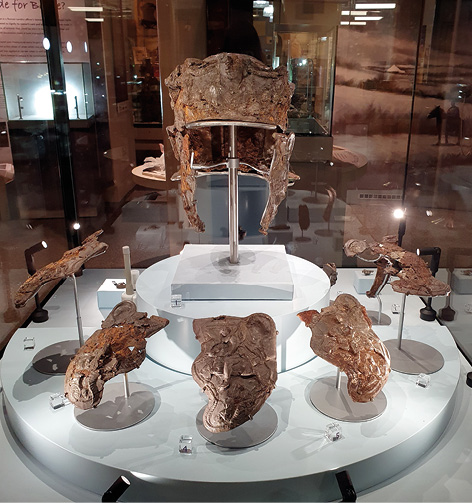
Another Leicestershire story features the Hallaton Helmet, a unique early Roman find, which has been redisplayed at Harborough Museum almost a quarter of a century after it was first excavated.
The cavalry helmet was found on the site of an Iron Age shrine, where it had been buried with thousands of coins, animal bones, and silver objects (see CA 233 and CA 236). It had corroded into many pieces by the time it was uncovered by the Hallaton Fieldwork Group and University of Leicester Archaeological Services in 2001, but has since been reconstructed by British Museum conservators (CA 264). The helmet is now displayed with cheekpieces in position for the first time, along with other key finds from the deposit, including five additional helmet cheekpieces and other objects.
The new displays also include two new replicas recreating the equipment’s original appearance. One was devised by Rajesh Gogna, a Leicestershire-based silversmith, senior lecturer, and practice-based researcher at De Montfort University, who created a CAD model of the helmet which has been 3D printed in resin, electroformed, silver-plated, and gilded. The other was handcrafted by archaeologist and replica-maker Francesco Galluccio, who used traditional methods that would have been familiar to Roman armourers.
For more information about the replicas and the wider research project behind them, see https://leicestershirecollections.org.uk/behind-the-scenes.
New exhibitions
Creatures of the Nile
Victoria Gallery & Museum, Liverpool, 4 May-5 October 2024
http://www.vgm.liverpool.ac.uk
Kimono: Kyoto to catwalk
V&A Dundee, 4 May 2024-5 January 2025
http://www.vam.ac.uk/dundee/whatson/exhibitions/kimono
Last chance to see
Made by the River
Ancient House Museum of Thetford Life, Until 30 June 2024
http://www.museums.norfolk.gov.uk/ancient-house/whats-on/exhibitions/made-by-the-river
Fashioning Bodies in the Ancient World
Ashmolean Museum, Oxford, Until 8 May 2024
http://www.ashmolean.org/exhibition/fashioning-bodies-in-the-ancient-world-display
Aotearoa – Māori myths and legends of New Zealand
Worcester City Art Gallery & Museum, Until 9 June 2024 http://www.museumsworcestershire.org.uk/events/aotearoa-maori-myths-and-legends-of-new-zealand
Legion: life in the Roman army
British Museum, London, Until 23 June 2024
http://www.britishmuseum.org/exhibitions/legion-life-roman-army