
Subscribe now for full access and no adverts
In the 20 years since the publication of Harry Potter and the Philosopher’s Stone in 1997, the wizarding world created by J K Rowling has become something of a phenomenon. Hogwarts School of Witchcraft and Wizardry, Platform 9¾, and quidditch have all become familiar to readers of the books and viewers of the film franchise, young and old alike. Many of the series’ key elements, such as broomsticks, wands, and cauldrons, have long been known to humanity, though. So how does Harry Potter fit in with the history – and archaeology – of magic?
For thousands of years, people have had a keen interest in magic, whether that concerns fantastical creatures, healing charms, or the ability to fly. Bringing together a wealth of documents and artefacts, the British Library’s new exhibition, Harry Potter: a history of magic, sets out to show the substance behind the stories and reveal some of the research that went into the books. The material, largely displayed in immersive settings akin to the relevant Hogwarts classrooms, explores how past peoples across the globe have tried to understand and engage in different aspects of the magical world.
Written in the stars
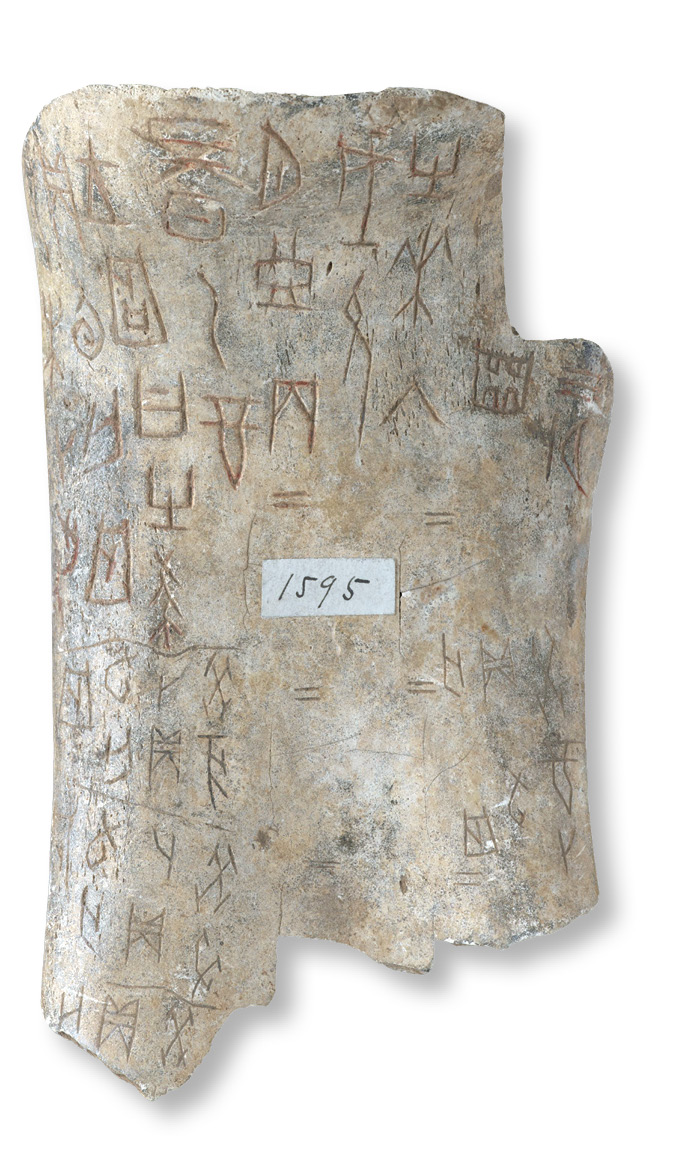
Many cultures, for instance, have had a desire to determine the future. Divination is one of the subjects taught at Hogwarts, with tea leaves and crystal balls, and in the British Library’s homage to the divination tower we find the oldest items in their collection: not, as one might expect, papyri or manuscripts, but pieces of bone from China’s Shang dynasty (1600-1050 BC). These are oracle bones (also known as dragon bones), engraved with questions about natural disasters, agriculture, and warfare. Diviners would apply heat with metal sticks which would crack the bone, and they would then interpret the resulting patterns to get their answer. One of the featured oracle bones records a lunar eclipse that we know took place on 27 December 1192 BC; it was believed that the darkness was caused by an ancestral spirit that needed to be pacified.

Astronomy forms another core part of the Hogwarts curriculum, and interests of a celestial nature can also be seen across civilisations, from Anglo-Saxon manuscripts depicting constellations to pages in Leonardo da Vinci’s notebook outlining his theories on the moon. The Dunhuang Star Atlas, an 8th-century AD paper scroll showing more than 1,300 stars, is the earliest complete map of the night sky that we know of. Eclipses carried a different interpretation at this time, though, as it was believed that the movements of the stars reflected events at the imperial court, with a lunar eclipse perhaps signalling a forthcoming coup.
Other guides to the stars, astrolabes, most likely have their roots in ancient Greece, but they were in service for centuries to come – as an ornate 13th-century brass and silver example found in Syria eloquently demonstrates. Astrolabes were used to pinpoint stars, planets, and latitudes, and in the Islamic world they took on additional function, as they can be used to find the qibla (the direction of prayer, facing the Kaaba in Mecca).
Double, double, toil and trouble
Another strand that the exhibition follows is how depictions of witches, wizards, and other magical beings have developed over time. Witches are often portrayed with broomsticks and their familiars – animal companions, most commonly a cat. ‘The beast is dangerous to soul and body’ and has a ‘cunning character’, as the 16th-century naturalist Conrad Gessner puts it in his Historiae animalium.