Subscribe now for full access and no adverts
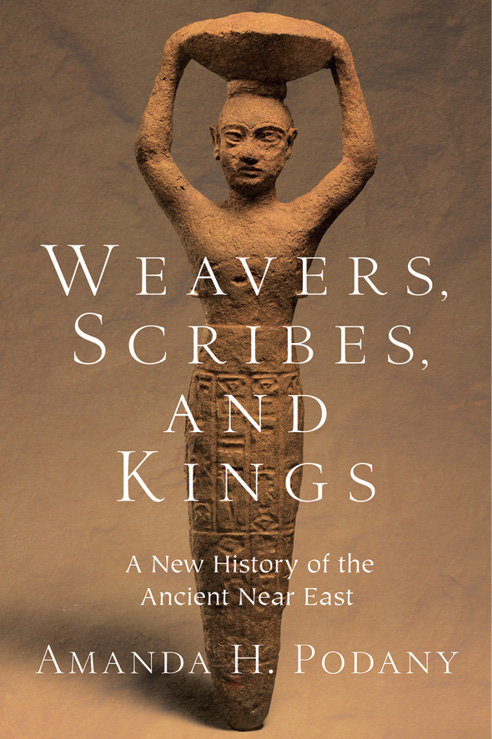
REVIEW BY ECKART FRAHM
Mesopotamian history, Amanda Podany argues in the introduction to her new book, ‘is more of a weathered mosaic than a grand narrative’. What she provides in her long but never boring account, which covers events and individuals across more than 3,000 years, is exactly such a mosaic, one that is often shimmering, though, rather than weathered. Podany offers a great many highly entertaining historical vignettes, introducing Mesopotamian rulers, but also merchants, musicians, priests, poets, gardeners, brewers, barbers, artisans, charioteers, mercenaries, conspirators, slaves, and of course the eponymous ‘weavers and scribes’. Many of them were women. They all come to life in this illuminating history, thanks to the author’s impressive ability to synthesise arcane technical studies by other scholars (and herself) without dumbing them down, and to turn the data and statistics these studies provide into engaging stories.
This never happens at the expense of historical accuracy. Podany does not add artificial colour to her narrative – she finds the colour in her source material, which comprises both archaeological and textual evidence. Her description of the process behind the construction of the mysterious ‘Stone Cone Temple’ in mid-4th-millennium Uruk – like the rest of the book, helpfully illustrated – is based on the physical traces on the ground; but when the author examines the building of the great ziggurat in Ur during the reign of King Ur-Namma (2112-2095 BC), she adds texts to the mix – not just royal inscriptions, but also economic and administrative records. Based on documents indicating that individual labourers had to manufacture some 240 bricks per day on average, Podany establishes that it took 145,700 man-days of work to manufacture and place the bricks for the first stage of the ziggurat alone. For readers exhausted by these statistics – and by the thought of how strenuous the construction process must have been – she offers relief in the form of a photo showing a brick from the time of Ur-Namma, on which a feral dog had left clearly traceable paw prints. Not only the newbies but also the cognoscenti have a lot to learn from this particular chapter – as well as the others.
It is often the little things that are fascinating here. Since clay, used not only for bricks but also as a medium for writing in Mesopotamia, is almost indestructible, even the most ephemeral communications have survived from the rivers of Babylon, allowing modern readers glimpses into aspects of everyday life that in other ancient civilisations remain largely opaque. What the material does not so easily reveal is the ‘big picture’: the long-term transformations of Mesopotamian society, economy, and culture and the structural factors, from technological advances to climate change, that triggered them. Discussions of such matters are not absent from Podany’s book but remain very much in the background: Podany’s statement, on p.6, that ‘life got better [for the people of ancient Mesopotamia], and then it got worse, and then it got better again’ epitomises the author’s case-based, microhistorical approach.
Publishers like to put on the dust jackets of their books that these provide the ‘definitive account’ of the topic they cover. With regard to history-writing, the truth of the matter is that such definitiveness is of course elusive; and Podany’s book cannot be considered the final word about the civilisations of the Ancient Near East. But it offers an enormous amount of detailed information, in accessible prose, and stands out as a unique achievement of synthesis. Highly recommended!
Weavers, Scribes, and Kings: A new history of the Ancient Near East
Amanda H Podany
Oxford University Press, £30.49
ISBN 978-0190059040