Subscribe now for full access and no adverts
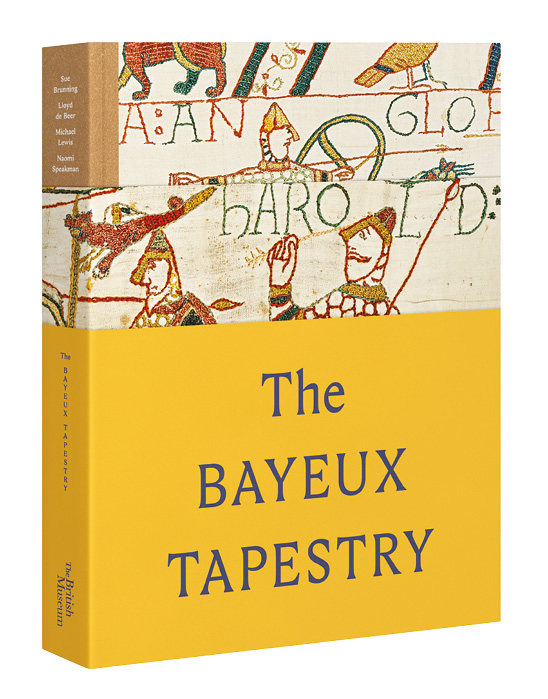
Britain has been overcome by Bayeux Tapestry fever (as has CA: see our feature on here and more in Sherds on here) with the famous embroidery returning to British soil for the first time since its creation almost 1,000 years ago for a new exhibition at the British Museum. The Tapestry is on loan from the Bayeux Museum, where it is usually housed, while the building undergoes renovation. In celebration of this historic loan, the British Museum has produced a series of books to accompany the exhibition, which includes a hardback and paperback version of the book reviewed here, as well as a fold-out paperback edition that features a 12m full-colour fold-out of the Tapestry, and a collectors’ edition that showcases a close-up reproduction of the embroidery in which every stitch can be appreciated.
The exhibition book is written almost as a play, with a ‘Cast of Characters’ that is broken up into the ‘Main Cast’ and the ‘Supporting Cast’. It next provides a guide to ‘reading’ the Tapestry, describing its different parts and discussing what is original and what has been added over the centuries. The full Tapestry is then reproduced over 40 pages – it is here that the fold out version is probably visually the best, as in the copy I reviewed it can be difficult to appreciate some of the scenes as they had to be broken up over pages (although care has been taken in the reproduction to keep important scenes together when possible).
After this, the meat of the book commences, with sections detailing the history of the Norman Conquest, the unique viewpoint the Tapestry brings to these events, and the Tapestry’s creation from political, religious, and artistic perspectives. Interspersed between these contextual elements is the summarisation of each main character – beginning with Harold and William the Conqueror, continuing with Emma, Edward the Confessor, and Edith, and finishing with Odo of Bayeux, who is believed to have commissioned the Tapestry – as well as a brief overview of that ‘Supporting Cast’.
The book concludes with the ‘afterlife’ of the Tapestry, and evidence for how it has been perceived and studied since its creation: from later in the medieval period to Napoleonic France and Nazi Germany. Overall, this is a beautifully illustrated volume that provides an easily digestible overview of the Tapestry’s history and importance.
REVIEW BY KK
The Bayeux Tapestry
Sue Brunning, Lloyd de Beer, Michael Lewis, and Naomi Speakman (eds)
British Museum Press, £40 (hbk)/£30 (pbk)
ISBN 978-0714123530