Subscribe now for full access and no adverts
REVIEW BY ANNA GARNETT
For those undertaking formal or informal study of Egyptian archaeology, a number of key textbooks focusing on the social lives of the ancient Egyptian people will always be on the reading list – Barry Kemp’s seminal Ancient Egypt: Anatomy of a Civilization, of course, being one of them. Bussmann’s exploration of the complexities of society and culture during the ‘Pyramid Age’ (Egypt’s Old and Middle Kingdoms) provides an essential addition to that list, and will transform our perspective on this fascinating era. The author describes the volume as ‘an archaeology of people’, focusing not on the grand monuments themselves, nor courtly activities, but looks rather in the shadow of the pyramids: what happened behind the scenes? These are often untold stories, but are arguably more important than the predominant stories of kings, queens, and high officials.
Setting Egyptian history firmly within the context of Africa, Bussmann presents the spatial and temporal development of urbanism in early Egypt in an accessible narrative. Readers are introduced to the historical background and theoretical approaches to the subject in an introductory ‘Orientation’ chapter, before delving into wider issues regarding urban growth, life in ancient Egyptian settlements, and Egypt’s place in the wider world, supported by case studies from key sites including Tell el-Dab‘a, Giza, Dahshur and Lower Nubia. By emphasising the interactions and complex interdependencies between Egypt’s urban centres and neighbouring foreign societies during this period, the author gives a greater sense of Egypt’s place in the wider world – a vital perspective when ‘ancient Egypt’ can sometimes seem like a wholly unique and isolated culture.
The administrative and ritual aspects of ancient Egyptian life are explored though a combination of object-based analysis; cross-cultural debate around gender, materiality, and the body; architectural and iconographic study; and theoretical and anthropological assessment. Readers will study the intricacies of daily life at a range of ancient sites, from small ‘local’ shrines at the periphery of the Nile Valley to well-established administrative centres such as Elephantine, gaining a comprehensive understanding of ancient Egyptian society beyond the royal court.
By taking this concept right back to ‘grassroots’, Bussmann helps us see the reality of life in these monumental settings where the populations – who were not as homogenous as they may seem – formed the ‘bedrock of society’.
Richly illustrated with greyscale images and line drawings, including detailed maps and site plans, this volume will become essential reading for all students of Egyptology, and for all those who are open to exploring ancient Egyptian society through a people-centred lens. A comprehensive bibliography will also guide readers to further research on this complex and absorbing subject.
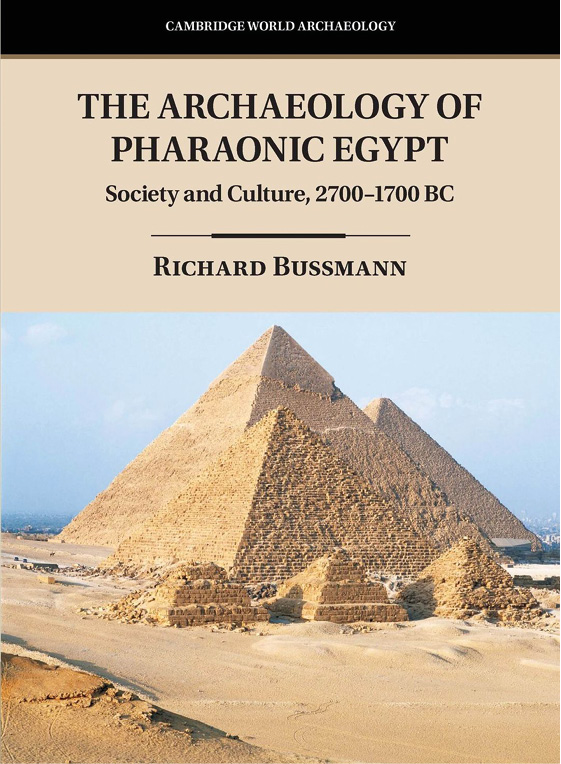
The Archaeology of Pharaonic Egypt: Society and Culture, 2700-1700 BC
Richard Bussmann
CAMBRIDGE UNIVERSITY PRESS, 2023
ISBN 978-1-10703-038-1
Hardback, £100