Subscribe now for full access and no adverts
REVIEW BY ANDREW MULHOLLAND
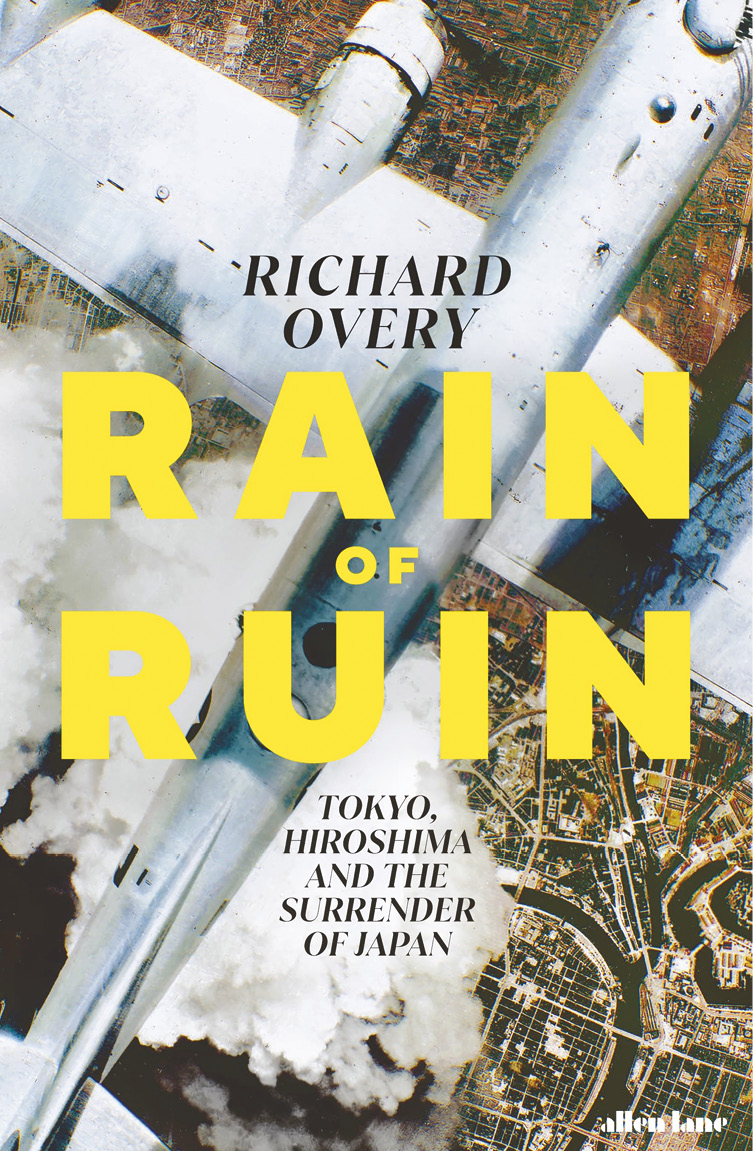
Most of us have an opinion about the two atomic attacks made by the United States on Japan in August 1945, which brought about the end of the Second World War, and most of us probably think we understand more or less what happened. With the 80th anniversary of the bombings of Hiroshima and Nagasaki later this year, debate about the whole subject will surely resurface – not that it has ever really gone away. It is timely, then, for Richard Overy, one of Britain’s most distinguished historians, to present Rain of Ruin, a crisp and brief account of the American strategic bombing campaign against Japan through the entirety of the war.
Overy’s purpose with Rain of Ruin is not to engage in post facto moral or strategic analysis. Rather, he hopes to explain the history in its own terms: to examine the circumstances, the thinking, and the decisions of the campaign as they were understood by the actors at the time. He is also anxious to treat the American air war against Japan as a single campaign, instead of a conventional one followed by two separate atomic attacks. In this approach he is surely right, for the book amply demonstrates just how interlocked the two aspects of the story are.
One of the strengths of his latest book lies in its use of extensive Japanese sources, together with a careful examination of the British role during this period. These two perspectives, on what is more typically presented as a purely American enterprise, provide some valuable nuance to the story, revealing a highly complex situation which might have resolved itself in a number of ways. Nowhere is this nuance more important than in the discussion of Japan’s eventual decision to surrender.
This section of the book, which sets out the lengthy and convoluted political process involved, alongside an insightful examination of Japanese society and culture at the time, exemplifies Overy’s approach. He has ferreted out the detail – of the Japanese constitutional practices, the personalities involved, the differing factions, and the terrible military context – and has carefully assembled them to provide a multifaceted account, which nonetheless remains succinct and lively.
Options for war
The book begins, though, with an account of both American and British strategic thinking on options for war with Japan. This is supplemented with a useful overview of the story of American strategic air power – a technology which very much came of age during the Second World War. The concept was extremely controversial to begin with, as many doubted its feasibility. Astonishingly, the entire B-17 bomber project, which began in the mid-1930s, was initially cancelled, and only in 1938 did President Roosevelt reverse this decision. This was just one of the many twists in the road that make this story so intriguing.
The United States and Britain recognised the difficulty of invading Japan and therefore thought in terms of naval and air power. As events transpired, British Pacific naval power was effectively neutralised with the Fall of Singapore in February 1942, leaving the Americans to roll the Japanese back across the ocean in the following three years. In the air, the British had no strategic bombers to spare for the Pacific. Significant British and Commonwealth naval power would reappear towards the end of the conflict, but bringing about that end was a task mostly shouldered by the Americans. The strategy was therefore largely theirs to determine.
Overy provides an account of the deployment of the 20th and then the 21st Air Forces, in China and the newly captured Pacific islands respectively, together with the development of their tactics. Initially dismissive of the area bombing employed by the British against Germany, American commanders gradually persuaded themselves that such tactics would work against Japan. Again, Overy weaves together questions of technology, morality, and personality to present an intriguing narrative. As with the run-up to Japan’s capitulation, this is a more complex story than one might have imagined.
The book’s central chapter picks up the story of the atomic raids, from the early decisions to research the technology, through its development and testing, and, ultimately, its use. Allied decision-making is well covered from all perspectives. We read about the exchanges between Churchill and Roosevelt, the Soviet spies who infiltrated the project, the work of the scientists themselves, and the managers and military figures who drove it all forward.
At every turn there is argument and debate, although sometimes this can seem alarmingly shallow or callous to our modern eyes. Although to repeat, Overy is determined to present this history as it would have been understood at the time.
The science is clearly explained without becoming too technical, and the scientists themselves emerge in all their diversity. While the decisions and outlooks of the politicians and soldiers will be familiar enough to those who are interested in military history, the outlook of this other group makes for a particularly intriguing read. The extent of critical challenge and indeed outright opposition to the use of the new weapons is one example of the breadth of this account.
It must have been difficult for the author, military historian though he is, to describe the effects of the atomic attacks, which – as we cannot be allowed to forget – largely killed innocent civilians. It is sensitively done, again using archival material from Japan itself.
The book then examines the ‘sacred decision’ (or, more accurately, two such decisions) taken by Japanese emperor Hirohito, which effectively ended the war. As previously mentioned, this slice of history has been meticulously researched and introduces much more detail than many will be familiar with. This was a lengthy political-religious-military process, highly contested and never a foregone conclusion. A third atomic bomb could easily have been dropped had Japan not capitulated after two.
More than most stories, morality hangs over these events like a shroud

Legacy of controversy
Finally, and beyond the horror and destruction, the author presents a survey of the responses to the bombing campaign in the years since. Subjects covered include evolving political attitudes on both sides, the treatment of survivors, and the commemoration of these events up to the present day.
Again, much of this makes for quite remarkable reading, such as, for example, the story of the protracted domestic controversy that has swirled around the establishment of ‘peace museums’ in Japan. Or the fact that victims of the bombings received no compensation until 1992. Also that General Eisenhower was always opposed to the use of atomic weapons, and that the Americans managed to tie themselves in knots of controversy over an exhibition at the Smithsonian in 1995.
There is a good discussion, too, of the legality of such weapons. There is still no explicit prohibition on their use (only treaties banning their proliferation) but, on this one question, Overy steps away from his academic neutrality and offers his personal view as to the legality as it stood in 1945. He concludes by reiterating the importance of understanding the rationality and morality of the day.
Unless particularly well versed in the events described here, this book is likely to push the reader off balance. The story of how the American bombing of Japan came about, why it escalated, and Japan’s response, is often surprising. For Western readers there will also be revelations regarding Japan itself. This was a complex society and a very different one to those that made up the Allies or indeed the Japan of today. The Japanese were playing by different rules and so ‘Western’ planning assumptions in Washington could be way off the mark. But there is plenty of new information about the Allies, too, as their leaders wrestled with, above all, the means to knock Japan out of the war as quickly as possible.
More than most stories from military history, morality hangs over this campaign like a shroud. Overy’s decision to look at it through contemporary eyes allows modern readers to reconsider it afresh, uncluttered by arguments most of them are perfectly capable of making for themselves. It would have been so easy for the author to become a polemicist, and it is refreshing that this has been avoided.
Instead, Rain of Ruin provides lots of new information about the Allied bombing of Japan during the Second World War, providing readers with the tools to fully re-engage with the history. As the airwaves fill with accounts and opinions on the approaching anniversary, Overy’s slim yet comprehensive account makes for essential reading. Specifically because it reiterates that the story, however morally dubious it may seem to some, is more complex and nuanced than the decades since have allowed us to remember.
Rain of Ruin: Tokyo, Hiroshima, and the surrender of Japan
Richard Overy
Allen Lane, hbk, 224pp (£25)
ISBN 978-0241700693