Subscribe now for full access and no adverts
REVIEW BY RP
The site of Regis House (encompassing 41-46 King William Street and adjoining properties in EC4, London) was extensively excavated between 1994 and 1996 by the Museum of London Archaeology Service (MoLAS, now MOLA). This new report by Brigham and Watson compiles a wealth of data from these excavations, as well as findings from earlier exploration of the area, to produce an in-depth and comprehensive study of this fascinating part of London’s archaeological landscape.
After introducing the site, the report begins with a discussion of the research conducted by the late Gerald Dunning (1905-1978), who recorded the timber and masonry structures, collected associated finds, and published some results – including a plan of the site – during groundwork for the construction of Regis House in 1929-1931. While the report includes Dunning’s findings alongside the main body of the work, this introduction presents his unpublished side-notes, which provide an absorbing insight into the early archaeological investigation of the site.
With a primary focus on the pre-Roman and Roman archaeological material, the report is next helpfully divided chronologically into the nine designated ‘periods’ of the site, which cover the long timeline and associated archaeological features between the natural topography of the site, through early Roman occupation, the developments of the site throughout the empire, and its subsequent decline and abandonment before the Saxo-Norman reoccupation.
Two periods that especially command attention are ones of destruction: the Boudican revolt (AD 60-61) and the Hadrianic Fire in the 2nd century AD. Ghosts from both of both these traumatic events in Londinium’s chronology can be traced in the archaeological evidence, which is covered well in the chapters on those two periods. While there is little direct evidence for destruction during Boudica’s uprising, tantalising traces of burning in a building and drain on the site are followed by a turnaround in land-use in following years, which archaeologists have associated with the catastrophic destruction of buildings and infrastructure that the revolt left in its wake.
By contrast, the archaeological evidence attesting to the Hadrianic Fire is present in abundance: the report uses it to piece together a fascinating story of the events, with the population forced to flee the growing flames which had broken out nearby, leaving their possessions behind to be consumed along with the buildings. An empty lockbox is used as evidence to suggest that Regis House was far enough from the source of the fire that the most valuable items could be taken on the run, but abandoned pottery suggests household items were still relinquished to the flames. Suggestions from previous research are provided alongside the report data to create a fuller picture of the event.
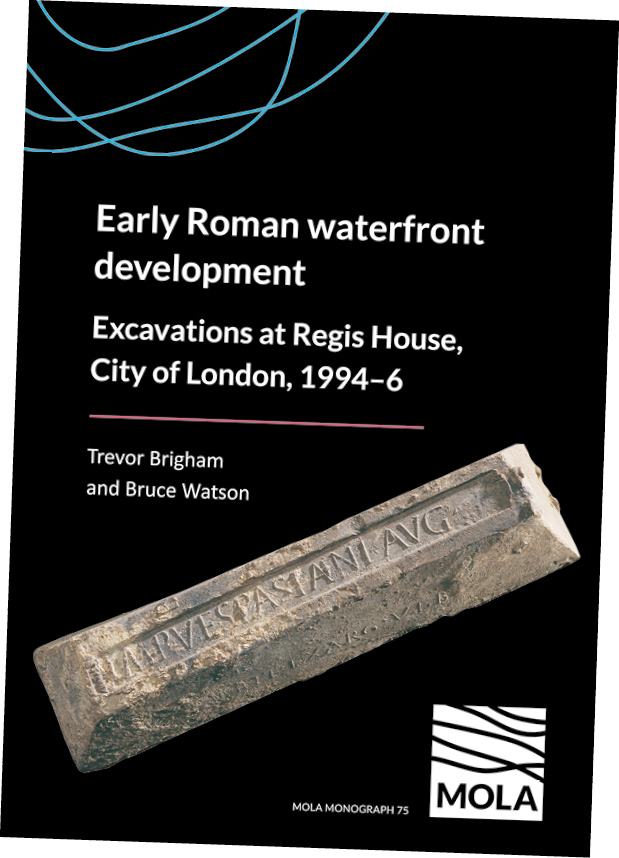
Following the chronological discussion, the report takes a thematic approach for its final chapters, placing Regis House in its Roman context in one section, and diving into the detail of Roman woodworking on the site in another. The specialist appendices are a delight for any archaeologist: helpfully organised into easy-to-find sub-chapters, written by appropriate experts, they categorise the finds into their types, allowing for easy perusal. The treasures of the site are laid out here, from pottery to plant remains to human and animal bone. Of particular interest is the section on the three lead ingots found on the site, written by Martin Dearne and accompanied by isotope analysis from Vincent Gardiner. These being the first lead ingots found in London, they make an appropriate cover image for the report.
While not aimed at the casual reader, the report on Regis House is a comprehensive and fascinating insight into the excavations which will be of interest to any London archaeologist or Roman specialist. The care and attention paid to the organisation of the report makes for easy referencing, and the text is helpfully illustrated with colour photographs as well as the expected plans, illustrations, and data tables.
Early Roman waterfront development: Excavations at Regis House, City of London, 1994-6
Trevor Brigham and Bruce Watson
MOLA (open access via MOLA digital repository: www.mola.org.uk)