
Subscribe now for full access and no adverts
REVIEW BY ROB IXER
This is the second landscape book by Jackson to be published this year and is in many respects a prequel to his earlier Rocks on the Edge of Empire, which is itself a splendid, sometimes stunning, pictorial exploration of the interplay between the Romans, their engineering prowess, and northern England’s rocks and geology.
The expected standing stones, circles, and axe-factory sites are here – Devil’s Arrows, Thornborough, Castlerigg, and Langdale – but so too are lesser known sites: Shap, Carrock Fell, a number of carbonate caves beloved and squabbled over by Victorian antiquarians, and tens of glaciated terrains, bogs, and sea shores where the human touch appears to be slight.
This book is not just a bucolic joy (the photograph of sheep safely grazing in Penrith Henge can be seen as an updating of any number of 18th-century English School paintings), but, throughout, Jackson’s text explains and explores the interplay between, perhaps even interdependence of, geology and archaeology’s more nebulous concerns. He urges a greater degree of directed questioning from both disciplines. This theme is a continuance of his earlier Roman epistle but is here made more cogent, especially in the earlier texts. Notably, later, there is a serious and sustained critique of recent and current lithological work relating to stone circles, including the very recent efforts at Cunyan Crag. Coming from an informed, totally impartial, and highly experienced field researcher, his considered views need noting and acting on. As a grand bonus, Jackson not only notes errors but corrects them. For example, Swinside (Site 49) includes amended lithological identifications of the orthostats from six megalithic monuments.
Prequels to excellent books have a hard act to follow and initially can seem to disappoint, especially as standard bog photographs are just that. They demand more attention from the reader/viewer to see beyond them, and they show more than just green acres. Fortunately (photogenically) this often tenuous relationship depicted between Mesolithic and earlier humans living in a glaciated landscape gives way to the monumental Neolithic when orthostats or stone circles are shown with the expected talent.
The photography is arresting, the text is both informative and thoughtfully provoking. Simply buy both unbelievably cheap books – but read this one first to get the full experience.
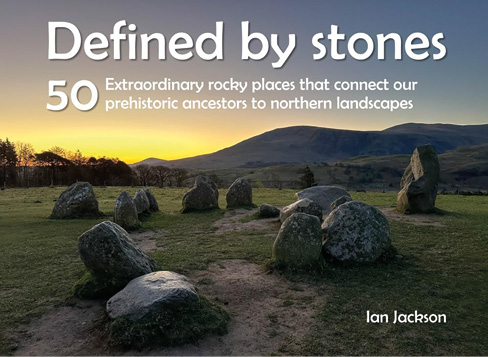
Defined by Stones: 50 extraordinary rocky places that connect our prehistoric ancestors to northern landscapes
Ian Jackson
Northern Heritage, £12
ISBN 978-1739486181