


Subscribe now for full access and no adverts
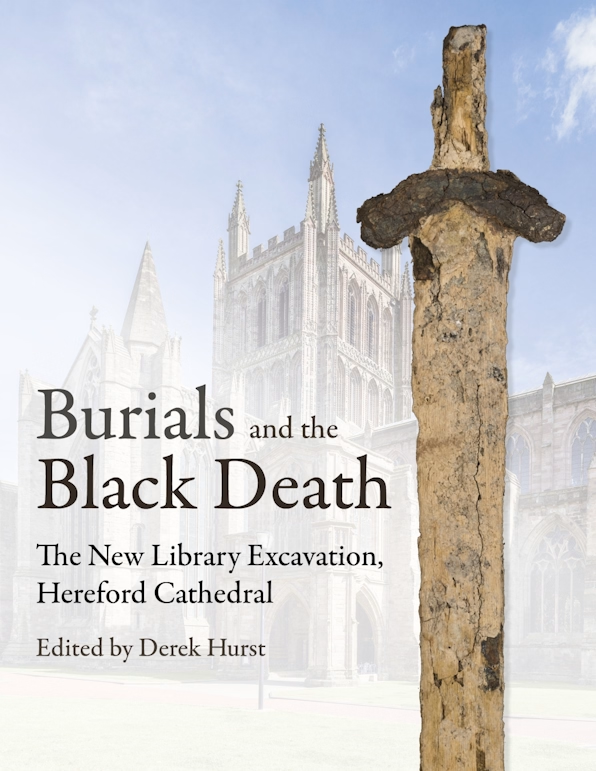
Excavation reports often have a long gestation, and the publication of the City of Hereford Archaeology Unit’s 1993 excavations on the site of Hereford Cathedral’s new Mappa Mundi museum has been eagerly awaited. Yet any frustration at the delay quickly disappears once it becomes clear just how much archaeology this substantial volume has had to accommodate.
Edited by Derek Hurst, Burials and the Black Death runs to an impressive 393 pages and brings together a wide range of specialist contributions. It presents the results of excavations on a site with a complex history, tracing activity from the 9th century through to the post-medieval period. The result is not simply a report on a cemetery excavation, nor solely a study of the Black Death burials highlighted in the title, but a detailed account of centuries of development within the cathedral precinct.
The discussion of the site stratigraphy is thorough, allowing readers to follow the site’s evolution through successive phases of construction, use, demolition, and burial. Particularly fascinating is the discovery of a rare early 11th-century timber building, possibly the bishop’s residence, complete with a stone cellar. The author suggests that this structure may have suffered during the Welsh sack of Hereford in AD 1055, and the subsequent use of the cellar as a convenient rubbish dump further emphasises its diminished status. The Norman rebuilding of the cathedral brought further transformations. A large quarry pit was reused for the deposition of substantial quantities of human charnel, initially disturbed by the cathedral’s rebuilding but supplemented at a later date.
Understandably, many readers will be drawn to the volume for the Black Death burials. These three mass graves provide some of the most important evidence yet found for the impact of the plague in a provincial English city. Although later activity had disturbed them, the excavations revealed the remains of around 200 individuals, some placed as many as 12 deep.
As is often the case with cemetery excavations, the small finds assemblage is relatively modest. Nevertheless, undoubtedly the most significant of these is a near-complete late Saxon sword recovered from the floor of the 11th-century cellar. It was discarded during or shortly after the Welsh attack, and the suggestion that it might not have even been made for combat is one of the more intriguing revelations of the volume.
The largest specialist contribution is devoted to human osteology. This section inevitably represents demanding reading for anyone without a particular expertise in skeletal analysis, but it is also one of the volume’s most important chapters. The dataset presented here will undoubtedly serve as a key resource for future researchers. Readers seeking a more accessible overview will be grateful for Sarah Stark’s clear summary of the osteological findings, which successfully places the technical detail within a broader archaeological context. Additional chapters cover radiocarbon dating, isotopic analysis, environmental evidence, and the aDNA analysis that confirmed the presence of plague in two of the individuals from the mass graves.
The book itself is attractively produced and generously illustrated. It also benefits from a more developed contextual discussion than is often found in modern excavation reports. There are, perhaps, a few minor quibbles such as the repeated use by some (but not all) contributors of the term ‘pits’ to refer to the plague burials. The phrase has become almost unavoidable in populist discussions of the Black Death, but it is misleading as it implies rather haphazard holes into which victims were casually thrown. Instead, the excavated features were, in reality, carefully organised mass graves. Still, this is a very small complaint in the context of an otherwise excellent publication. Detailed enough to serve as a major research resource, yet still accessible for anyone interested in medieval archaeology, it is a fitting culmination of work carried out over the last three decades. Finally, it reminds us that even in a book with ‘Black Death’ in the title, the real story is often much richer than the headline.
REVIEW BY HUGH WILLMOTT
Burials and the Black Death: the New Library excavation, Hereford Cathedral
Derek Hurst (ed.)
Oxbow, £40
ISBN 978-1789258684


