
Subscribe now for full access and no adverts
Earliest archaeological evidence of silk in China
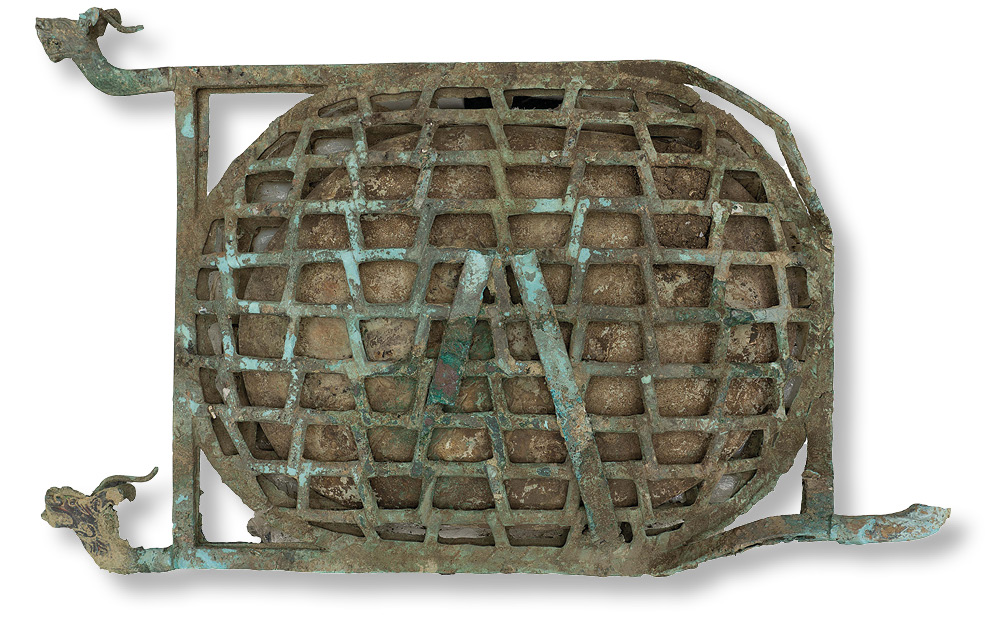
Mineralised fabric remnants found in pits at a Bronze Age burial site in the Sichuan Basin, south-western China, have undergone specialist analysis which has identified them as silk. The Sanxingdui settlement is believed to have been the capital of the ancient Shu kingdom, which was historically associated with silk farming. However, since the fabric rarely survives in archaeological contexts, the find at Sanxingdui is extremely rare. The silk was discovered on a grid-shaped bronze artefact containing a piece of jade, which had been placed in a sacrificial pit. Researchers believe this comprises the first direct evidence for the use of the fabric in rituals on the site. The study has been published in Scientific Reports (https://doi.org/10.1038/s41598-024-78687-7).
Rare archaeological case of virus discovered in Bruges
Analysis of the contents of a 15th- to 16th-century latrine excavated in Bruges in 1996 has identified an egg from the parasite Schistosoma mansoni, a flatworm which causes an acute and chronic disease called schistosomiasis. The parasite is endemic to Africa and the Arabian Peninsula, and, as such, its discovery in a European archaeological context is rare: only one other example has thus far been identified. The location of the latrine in Bruges’ late medieval Spanish nation house has led to the suggestion that the disease may have been picked up by a merchant who had travelled to Africa for business, or by an African individual possibly forcibly relocated during the early Atlantic slave trade.
A mixed grave
Human remains found in a Gallo-Roman inhumation burial unearthed in Pommerœul, Belgium, in the 1970s have recently undergone new analysis. The research revealed that what were originally thought to be the bones of a single individual were in fact the remains of multiple people, spanning thousands of years. The bones of at least four different Late Neolithic people, and a Roman-era cranium, have been identified, and it has been suggested that the remains may in fact represent a Neolithic composite burial that was discovered and reworked 2,500 years later, with the addition of the Roman cranium and grave goods. The research has been published in Antiquity (https://doi.org/10.15184/aqy.2024.158).
Text: Rebecca Preedy