Easter Island, called Rapa Nui by its inhabitants, represents one of the most remarkable cases of ancient monument construction known in the world. Around the 13th century AD, Polynesian voyagers crossed thousands of kilometres of open ocean to colonise Rapa Nui, one of Earth’s most remote islands. Shortly after colonisation, people began constructing megalithic platforms, called ahu, on which they placed the island’s famous stone statues, known as moai. By the time Dutch captain Jacob Roggeveen arrived in 1722, the island’s inhabitants (called Rapanui) had constructed over 200 ahu and carved nearly 1,000 moai, hundreds of which were transported several kilometres over volcanic terrain to ahu sites across the island.

The fact that this tiny island boasted such magnificent monuments was baffling to European explorers, who were quick to note the apparent enigma presented by the disparity between the amount of labour invested in these megaliths and the small human population (estimated at only a few thousand) living on such a remote island with marginal ecology (few trees, no coral reefs, poor soils, limited freshwater). The perceived paradox between this scarcity of resources and the achievements of the Rapanui has become popularly known as ‘the mystery of Easter Island’, with the origins of the moai attracting some truly extraordinary speculations.
Today, scholars recognise that the ancient Rapanui created the moai and ahu. Debates persist, however, as to why they invested such energy into this activity when even survival on the island was challenging. Some scholars have suggested that monument construction was an activity that escalated to the point of self-imposed ecological disaster and demographic collapse (‘ecocide’). Such explanations, however, seem incompatible with a wealth of rigorous archaeological research conducted over the last 10-15 years.
Instead, monument construction was one component of a relatively small, ingenious, and highly adapted society that managed to persist on a marginal and isolated island. Our ongoing research focuses on explaining the community dynamics for such investment in monument construction on this resource-poor island.
Finding freshwater
While Rapanui farming and fishing practices are reasonably well understood from previous research, ancient freshwater use and management are not. Due to the island’s highly permeable geologic surface, it lacks permanent streams and also suffers from frequent droughts, making reliable freshwater sources critical to survival. While there are a few lakes within the volcanic craters, there is surprisingly little archaeological or historical evidence that they were primary water sources or habitation areas, probably due to their inaccessibility. Given the critical importance of freshwater for survival, developing an understanding of ancient water use is essential to increasing our knowledge of ancient Rapa Nui society.
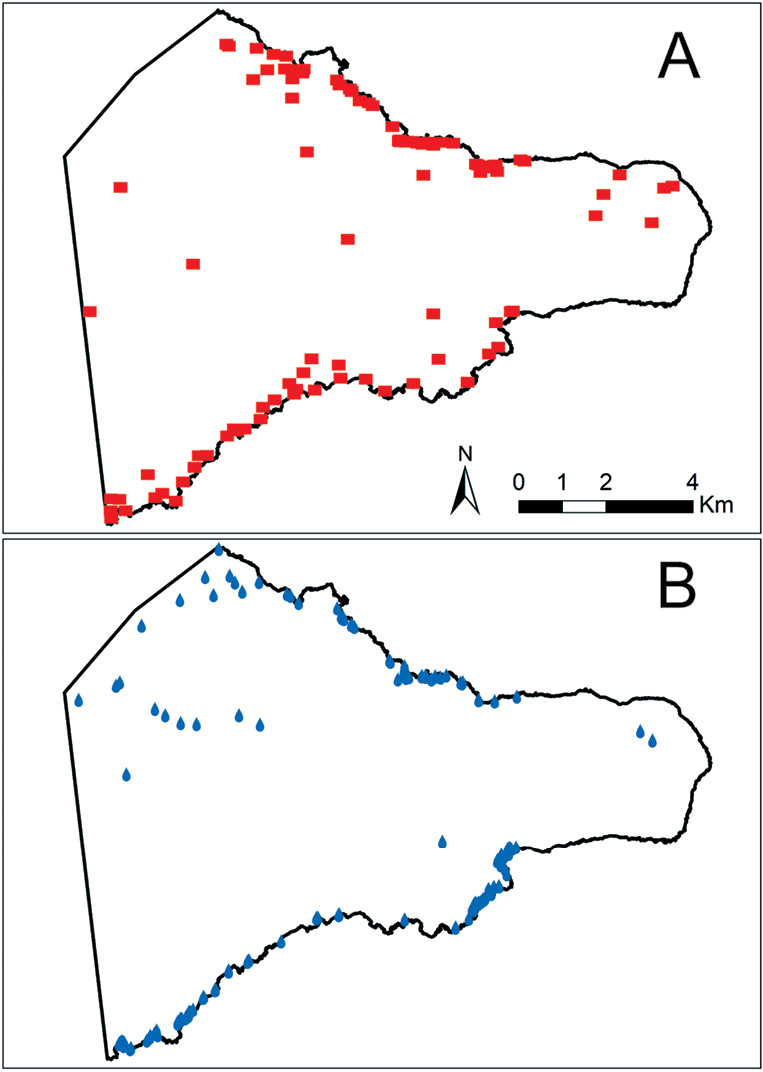
In 2015, we began a project designed to identify freshwater sources used by ancient Rapanui, which uncovered a number of intriguing clues. In an exhaustive review of 18th- and 19th-century European ship logs, team member Sean Hixon from UC Santa Barbara found numerous accounts of the Rapanui ‘drinking seawater’. But early researchers such as Katherine Routledge, Father Sebastian Englert, and Alfred Métraux noted that, rather than ‘drinking seawater’, Rapanui had made ingenious use of coastal seeps where fresh groundwater emerges along the coast. In our fieldwork, we began to document the location of these sources of water. Hydrogeologists Matthew Becker and Tanya Brosnan from Cal State Long Beach mapped freshwater sources available to ancient people, including coastal seeps. For the eastern portion of the island, this fieldwork revealed a pattern of freshwater sources often occurring near ahu locations.
Testing the connection
Rapa Nui’s monuments have been the focus of archaeological research for over a hundred years, yet a basic question remained unresolved: why were ahu (and the moai erected on them) built in certain locations but not others? While nearly everyone agrees that the statue platforms served as sites for religious activities, archaeologists speculated that they also visually marked community access or control over the island’s limited resources, such as prime agricultural land or the best areas for fishing. We wondered whether our findings about the relation between ahu and freshwater might provide a new clue to the island’s history.
Our recent study, published in PLoS ONE, examines this question. We tested different hypotheses about the association between statue platform locations and the availability of subsistence resources. Our analysis focused on a quantitative spatial technique called point-process modelling that allows us to examine relationships between ahu construction locations and different environmental variables, including gardening areas, the best fishing locations, and freshwater sources. Our goal was not to show a simple correlation, but to offer a formal statistical model of which variables best predict – and thus help to explain – the locations of ahu. We exhaustively attempted to falsify our hypothesis that ahu are associated with freshwater. In the end, the results of our modelling and simulations indicate that the locations of ahu are strongly associated with freshwater sources in a way that they are not associated with other previously hypothesised resources. Interestingly, one can essentially predict where ahu will be found based on where freshwater occurs.
Because human settlements are generally found near freshwater sources, and ancient Rapanui communities were centred around ahu, one could argue that our results are not all that surprising. The particular details of how settlements were organised on Rapa Nui, however, are distinctive: domestic areas (houses, ovens, and so on) are generally found several hundred metres inland from the locations of ahu. This is a key component of our conclusions, because it shows that ancient Rapanui built ahu offset from living areas, and directly adjacent to freshwater sources. This finding suggests that the religious and ritual practices centred around the statue platforms involved locations of the island’s limited freshwater sources. To be clear, our hypothesis is not that this was a way of marking water in the sense of a sign so inhabitants could find it, but potentially these were highly visible symbols of a community’s ownership of the limited resources in their territory.

The results of our multidisciplinary study demonstrate a strong association between the places where Rapanui people built their famous monuments and the locations of limited, but vital, freshwater sources. Continuing to explore these issues and delve deeper into the lingering question of why this pattern exists and the processes that led to it is the focus of our ongoing research.
Robert J DiNapoli is a doctoral candidate at the Department of Anthropology, University of Oregon
FURTHER INFORMATION
R J DiNapoli, C P Lipo, T Brosnan, T L Hunt, S Hixon, A E Morrison, and M Becker (2019) ‘Rapa Nui (Easter Island) monument (ahu) locations explained by freshwater sources’, PLoS ONE 14: e0210409.
R J DiNapoli, A E Morrison, C P Lipo, T L Hunt, and B G Lane (2018) ‘East Polynesian islands as models of cultural divergence: the case of Rapa Nui and Rapa Iti’, The Journal of Island and Coastal Archaeology 13: 206-223.
T Brosnan, M W Becker, and C P Lipo (2018) ‘Coastal groundwater discharge and the ancient inhabitants of Rapa Nui (Easter Island), Chile’, Hydrogeology Journal, https://doi.org/10.1007/s10040-018-1870-7.
All images: courtesy of Robert J DiNapoli