Subscribe now for full access and no adverts
Analysis of engraved stone slabs from the 15,800-year-old site of Gönnersdorf, located on the banks of the Rhine in west-central Germany, has identified a set of carvings that appear to depict fish nets or traps.
Gönnersdorf has produced a rich assemblage of Ice Age art, including more than 400 engraved schist plaquettes, which have been re-examined using Reflectance Transformation Imaging (RTI) as part of a recent study by MONREPOS in Germany and Durham University in the UK. The advanced imaging technology – which creates digital images with variable lighting angles in order to highlight subtle surface details – identified 11 plaquettes with engravings of fish, including eight where the fish is associated with a linear grid motif resembling a net or trap. The researchers determined that, in all eight examples, the fish and the grid appear to have been engraved in the same instance – with the fish drawn first, ‘swimming freely’, before being ‘captured’ by the net carved over the top – signifying that these motifs are meaningfully connected to each other.
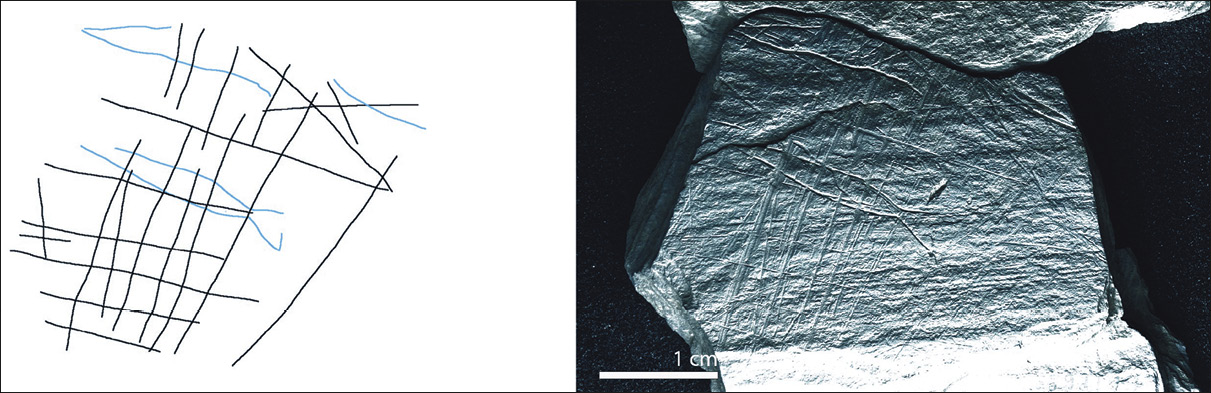
Freshwater fishing is known to have been practised in the European Upper Palaeolithic, with fish bones found at several sites, including Gönnersdorf, and isotopic data from human remains showing that fish were making up a substantial part of the diet by the Magdalenian period (c.19,000-13,000 years ago). We also find various tools and weapons that could have been used in fishing, such as barbed points, harpoons, and arrows. Evidence for fish traps and weirs remains limited, as they would have been made of organic materials, but we do have other signs of textile and cordage production from this period, indicating that such technologies were almost certainly in use.
The new findings from Gönnersdorf are particularly valuable as clear depictions of a fishing technology that is not otherwise found in the archaeological record, providing strong evidence for fishing using nets or traps at this site. The discovery changes our understanding of the cultural significance of fish, too, which are depicted in Palaeolithic art much less commonly than terrestrial animals. The presence of repeated, intentional depictions of fishing on these plaquettes suggests that it had some sort of importance in the collective identities of the Magdalenian people who created them.
The research, which has been published in PLOS ONE (https://doi.org/10.1371/journal.pone.0311302), represents an insightful addition to our knowledge of early fishing practices in Palaeolithic Europe.
Text: Amy Brunskill / Image: Robitaille et al., 2024, PLOS One, CC-BY 4.0