Subscribe now for full access and no adverts
Recent excavations at Brusselstown Ring, a prehistoric hillfort in County Wicklow, Ireland, have confirmed that many of the anomalies found in previous surveys of the site are roundhouse structures. With more than 600 possible examples identified across the hilltop, the monument appears to be unprecedented in size and scale.
Brusselstown Ring forms part of the Baltinglass Hillfort Cluster on the south-western edge of the Wicklow Mountains, a group that includes an unrivalled number of prehistoric complexes, with up to 13 large hilltop constructions spread out across the hills, including at least seven major hillforts and several more enclosures. Collectively, these settlements seem to have been in near continuous use from the early Neolithic through to the late Bronze Age, and Brusselstown Ring appears to be the largest and most densely occupied of the set.
This latter hillfort is formed from two widely spaced ramparts encompassing an area of 41.19ha (102 acres). The outer rampart ties in with an enclosing element that also encircles the neighbouring hilltop, wrapping around a Neolithic enclosure to create a total area of 131ha (324 acres). Over the last decade, extensive surveys on the site have detected a high concentration of structural anomalies, identifying 98 potential roundhouse footprints within the inner enclosure, and a possible 509 more in the area between the inner and outer enclosures (below). If these numbers are correct (or even close to correct), it would make Brusselstown Ring the largest prehistoric nucleated settlement yet found in Ireland and Britain.
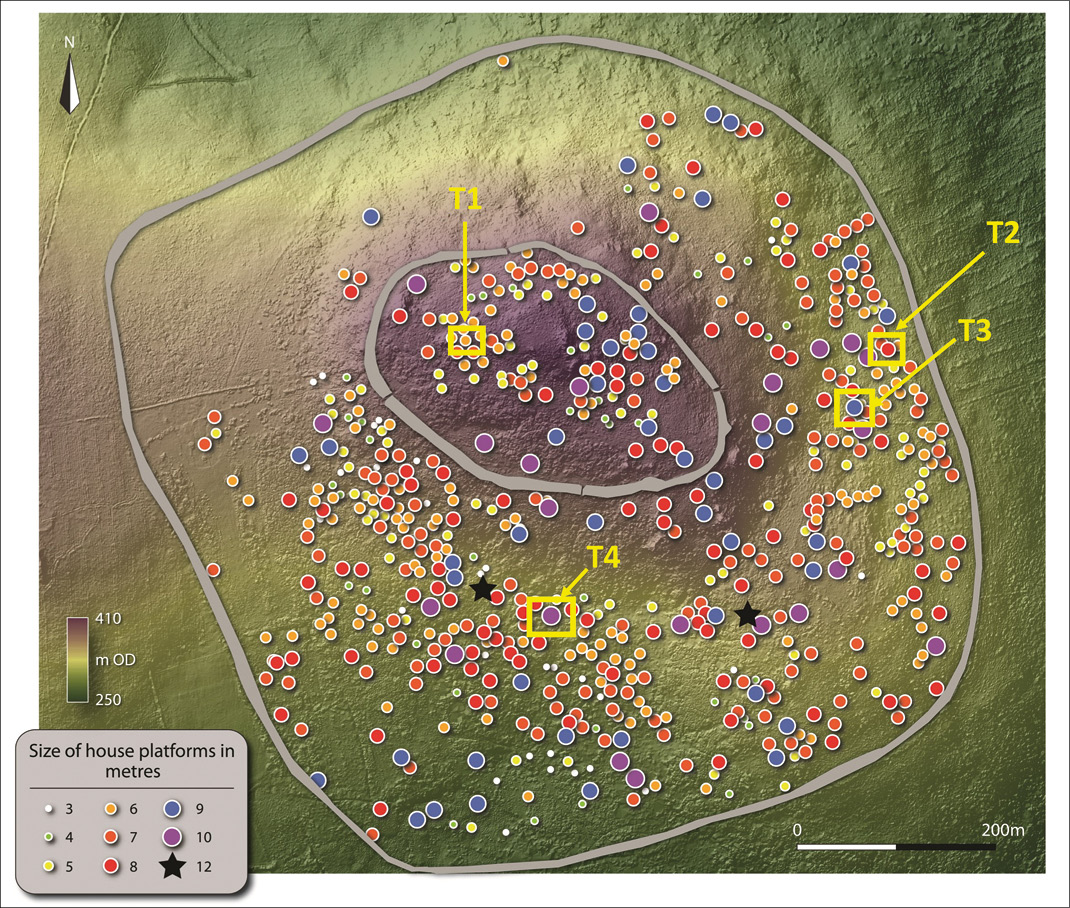
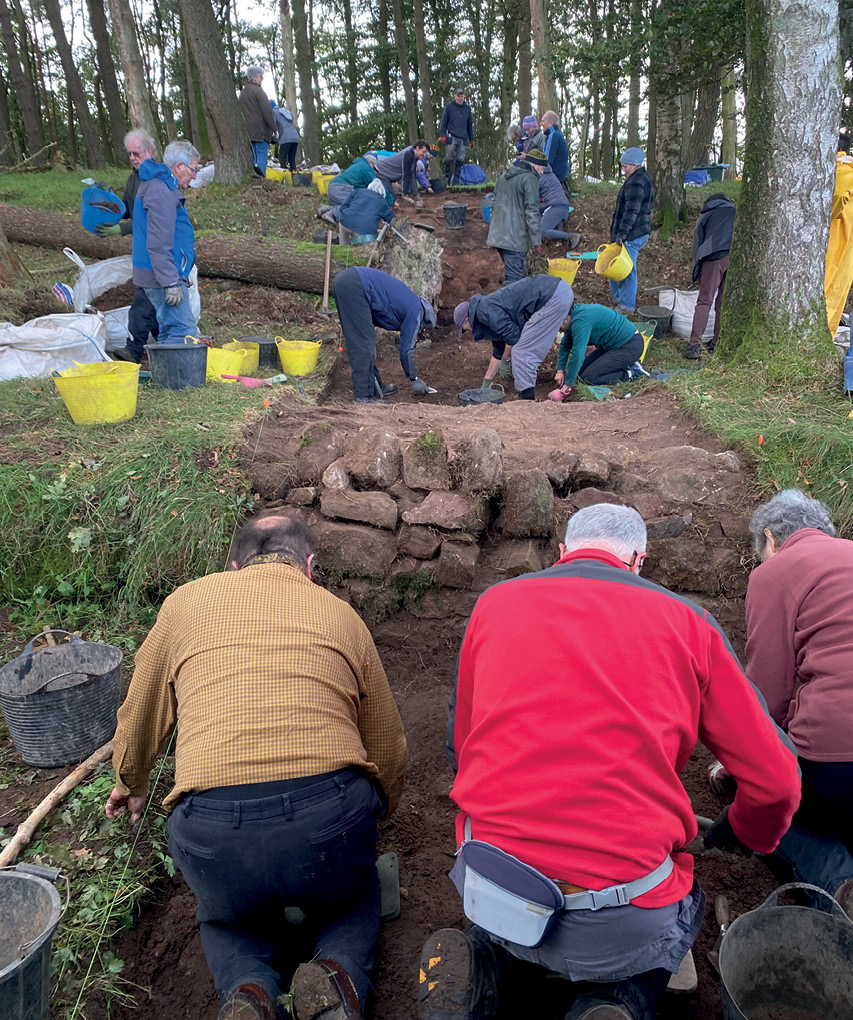
To test these results, in 2024 and 2025 Dirk Brandherm, Cherie Edwards, and Linda Boutoille from Queen’s University Belfast and James O’Driscoll from the University of Glasgow led a series of test excavations on the site. They opened four small (1.5m by 1.5m) trenches in total, locating one in the inner enclosure and three in the area between the inner and outer enclosures, and the team also assessed a boat-shaped anomaly that lay next to one of the trenches. Their results provide clear evidence of prehistoric occupation. In the first trench, located within the inner enclosure, they found cobbles consistent with flooring, as well as evidence for a large burning event. Another trench revealed a hearth surrounded by stake-holes, while the final two uncovered pits and possible stake-holes. Radiocarbon dates from these features indicate that the site was occupied during the late Bronze Age between c.1210 and 780 BC, while a few radiocarbon dates from the second trench indicate continued use (or reuse) during the early Iron Age (750-400 BC).
By contrast, the boat-shaped feature remains a bit of a mystery. The stone blocks that form its perimeter are much larger than those used for the roundhouses, and earlier survey work had found a small stream running into its interior. As the construction’s shape and dimensions are similar to Bronze Age and Iron Age cisterns found in other parts of Europe, the team suggest that this could be a possible explanation but stress that further work needs to be done to confirm its purpose. If this is a cistern, it would be the first from this period identified in Ireland, and would speak to how such a large settlement may have functioned.
The project’s results provide important new evidence to suggest that Brusselstown Ring is a unique site, exceptional in its size and significance. It is hoped that further work will identify more details of the roundhouses, and will shed more light on the nature and chronology of the monument’s fortifications. The full results of the project were recently published in Antiquity (https://doi.org/10.15184/aqy.2025.10247).
Text: Kathryn Krakowka / Photo: Brandherm et al. (2025) Antiquity