
Subscribe now for full access and no adverts
Researchers from the Johannes Gutenberg University Mainz, along with colleagues from Austria and France, have used carbonate deposits recovered from Roman water mills in Barbegal, near the city of Arles in the south of France, to reconstruct the development and use of the structures over their operational lifetime.
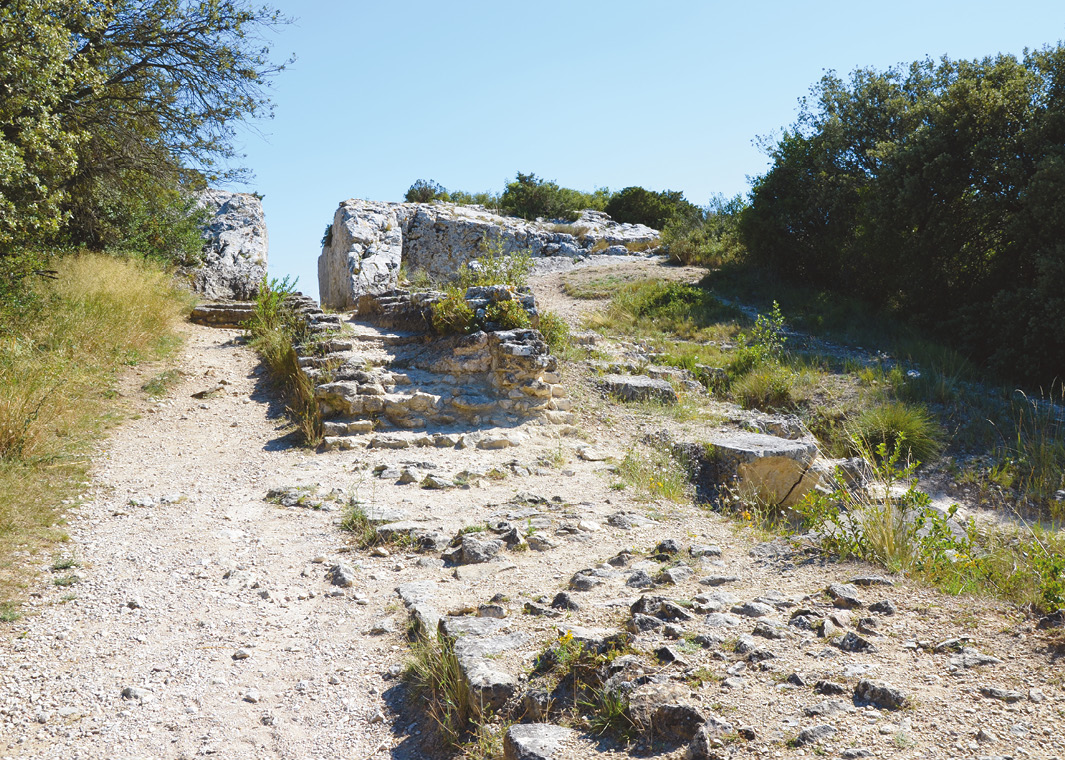
Barbegal’s sixteen 2nd-century AD water mills, which are laid out in two parallel rows of eight, form the largest pre-industrial structure in Europe. Water was supplied from the surrounding low mountains known as the Alpilles hills via aqueducts to Arles and to the mills. The mills are believed to have been in operation for around 100 years, a lifespan that was established by a coin of Trajan found on site. However, the timeline of the site’s operation was otherwise unclear – until very recently.
Prompted by the identification of several fragments of carbonate minerals that could be reassembled into two large slabs originally from the bottom and walls of two of the mill flumes (A and B), the researchers were motivated to reconstruct how the flumes may have been used, and to compare them with one that had been described in an earlier publication by Passchier et al. in Scientific Reports in 2020. By analysing the three flumes together, it was possible to recreate a tentative timeline of the last stages of activity for the mill train in which those flumes were used.
The carbonate deposits were originally discovered during excavations of the mill complex between 1937 and 1939, when they were noted to have wood imprints on their surfaces, indicating that they had formed as a carbonate crust on decayed wooden elements of the mills. The carbonate was found in situ in the preserved elements of the aqueduct channels and mill bases, as well as in loose fragments among the debris covering the remains. More still had been reused as building material in the walls of the aqueducts and mill buildings dating to Late Antiquity. In total, some 140 pieces have been identified, and while they represent only a portion of the original material, there were enough samples to provide the researchers with the data they needed.
The deposits varied in size and shape depending on the slope of the mill flumes during their working lives and the assorted sizes of mill wheels in the different basins, so the researchers began by piecing together some of the fragments and analysing their form, microstratigraphy, and stable isotope patterns . Oxygen isotope ratios in carbonate deposits vary depending on water temperature at the time that they were formed; this results in layers that can be assigned to seasons, and in this case collectively demonstrated a total deposition timeline of around seven to eight years. The mills were found to have started their operations in the winter, following a clear and consistent routine: the stratigraphic formation of the flume deposits were identical in each year until the summer of the seventh.
It is also possible to see that, in the summer of the third year, the mill wheel associated with flume A was changed, possibly due to damage. Similarly, in the spring of year five, flume B was raised to a shallower angle, which indicates that the mill weel there was changed as well, probably to one with a larger diameter. Porous deposits with plant imprints and Roman concrete of the cocciopesto type found in flume A suggest that it ceased running in the summer of year seven. The carbonate deposits were then reused elsewhere in the mill complex as architectural elements or for further industrial purposes. The most recent deposition layer contained mollusc shells and wood fragments, which suggests that water had continued to flow, allowing the carbonate to be formed, but by this point the mill was disintegrating and therefore abandoned.
Previously, it was unclear whether the 16 mills had been run by one operator, or whether they had been managed individually – but the researchers have now teased out some clues as to how the site functioned. The three channels investigated in this study each had carbonate deposits that varied greatly in shape and did not match one another – indicating that they had operated separately, at least in the last seven to eight years of their lifetimes. The accumulation of the deposits also revealed that the western side of the mill complex had been abandoned before the eastern one. This appears to have taken place while the aqueduct was still running, but the changing carbonate micro-fabric reveals a gradual deterioration at this time.
The full study is published in Geoarchaeology: An International Journal; to read an open-access version of the the paper, visit https://doi.org/10.1002/gea.22016.
Text: Rebecca Preedy / Image: Carole Raddato