Subscribe now for full access and no adverts
The remains of a Roman villa have been revealed near Rossett, Wrexham. It is the first site of its kind to be found in north-east Wales, adding to our knowledge of the region during this period.
The first clues to the villa’s presence emerged when Roman artefacts were uncovered by local metal-detectorists. Archaeologists from Wrexham Museum, the University of Chester, and Archaeological Survey West then carried out a ground-penetrating radar survey, which revealed the structure’s outline, confirming its identity as a villa. A subsequent 5ha magnetometry survey, targeted over an area where Roman artefacts had been concentrated, revealed the well-defined footprint of a large structure, the layout of which holds a strong resemblance to a Roman winged corridor-type villa.
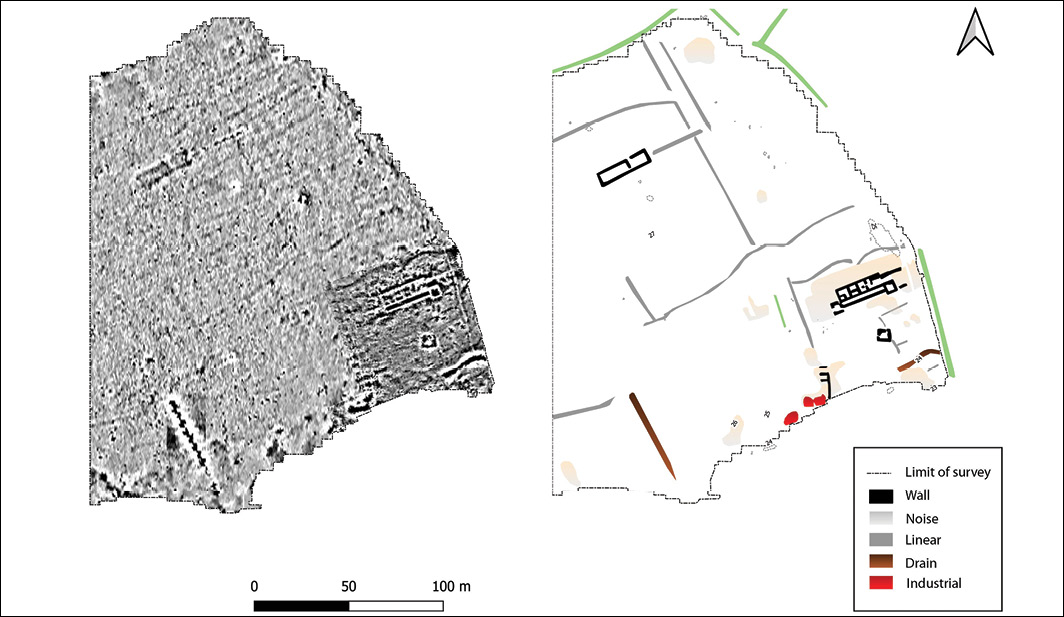
Other buildings were also identified, surrounding a central courtyard, and the survey indicated that this complex had been associated with a field system, a trackway, and other structures. Fieldwalking at the site has yielded artefacts spanning the late 1st century to the early 4th century AD, suggesting that the villa was occupied for the majority of Roman rule in Britain and that its occupants were using a range of imported ceramics (Samian ware, for example) as well as locally produced pots. The discovery of architectural fragments in the plough soil indicates that this villa may have had hypocaust systems (underfloor heating associated with a bathhouse), while rotary quernstone fragments suggest that the estate’s inhabitants were cultivating cereal crops.
Dr Caroline Pudney, who co-directed the project, said: ‘This exciting discovery potentially alters our understanding of north-east Wales in the wake of the Roman conquest. Previous interpretations suggest that most people in this area either lived in settlements associated with Roman military sites or in quite simple farmsteads that continued to utilise Iron Age roundhouse forms. The identification of the villa now questions this narrative.’
Wrexham Museum and the University of Chester are now planning a programme to investigate the site in greater detail, subject to securing funding and appropriate permissions. The work on the project to date has been funded by the Roman Research Trust and supported by Wrexham Museum and the University of Chester.