Subscribe now for full access and no adverts
A summer excavation in the Oxfordshire village of Brightwell-cum-Sotwell has revealed a Roman road lying beneath the local primary school’s field.
Jason Debney, chairman of the local history society, recalled being told by a resident many years ago that the line of the Roman road connecting Silchester to Dorchester-on-Thames, and then on to Alcester, possibly ran through the school. Having gained permission from the headteacher, the society called on the assistance of Wallingford Historical and Archaeological Society to investigate this claim.
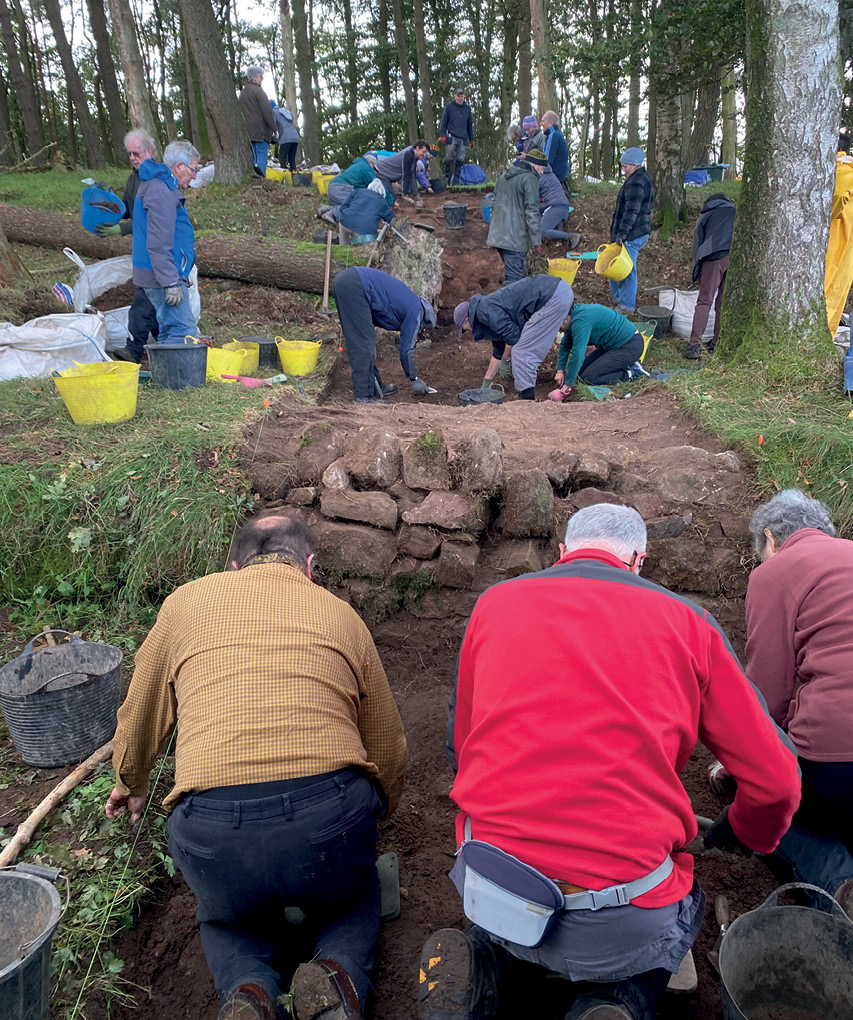
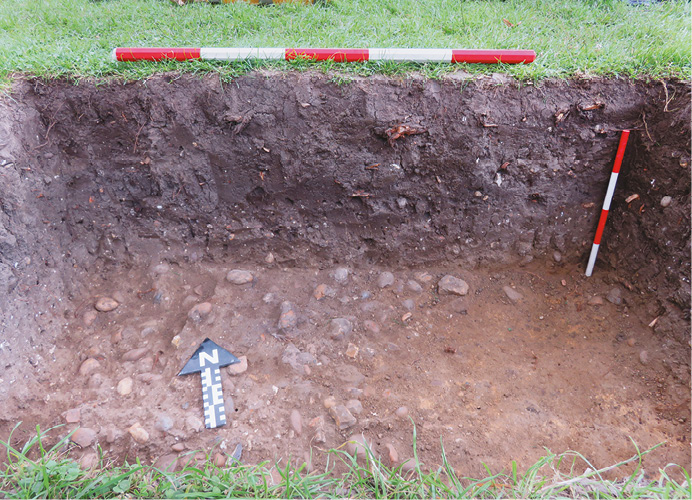
Resistivity and magnetometry surveys took place last December, revealing a clear linear feature running in a north–south orientation – and this summer a two-and-a-half-week excavation took place to examine it in more detail. After determining the depth of the topsoil through smaller trial holes, a 15m-long trench was opened over the linear feature. This uncovered a road surface made up of local cobbles and smaller stones set into clayey sand approximately 0.5m below ground level, and 0.5m beneath this was another, earlier iteration of the route.
Seven coins were discovered in the topsoil, including a Victoriae type, a radiate of Claudius II Gothicus, a Valentinian nummus minted in Siscia (modern Sisak, Croatia), and a Constantinian coin depicting two soldiers and their standards. The project team are confident they have confirmed the alignment of the Roman road. A similar cobbled surface discovered in the grounds of the village pub some 230m to the south, confirms the route as it passes through the village.
Other finds from the excavation such as hobnails, pottery, and a single white tessera indicate that Roman-period occupation took place nearby – perhaps associated with a Roman building that was identified near the south-east corner of the site during building works that took place 30-40 years ago.
As well as the Roman discoveries, the team recovered fragments of medieval and post-medieval pottery. Perhaps the most unexpected object, though, was a broken Chinese coin or token, characterised by Chinese characters and a square central hole – this is thought to reflect a visit to the area by Chairman Hua Guofeng, then Premier of China, in 1979, during which he handed out souvenirs to local schoolchildren.
While there are no immediate plans for further excavation at the primary school, the geophysical surveys did highlight other areas of interest nearby, including a possible building that has the potential for future investigation.
Text: Rebecca Preedy / Image: Wallingford Historical and Archaeological Society