
Subscribe now for full access and no adverts
The discovery of a rare enamelled brooch at an Iron Age settlement site in Curragh, South Ayrshire, has revealed interesting insights into how the Britons of south-west Scotland and the Roman army interacted in the late 2nd century AD.
The brooch’s discovery came as something of a surprise, as when GUARD Archaeology carried out excavations for the Girvan distillery of William Grant & Sons in 2020, they did not recover much in the way of Roman finds, but it is significant because it demonstrates that the settlement post-dated the abandonment of the Antonine Wall in the AD 160s, when southern Scotland had slipped from the Empire’s grasp.
As the recently published results of this investigation attest, however, finding the brooch within the foundations of a timber palisade surrounding a large roundhouse has prompted a reconsideration of its inhabitants’ relations with Rome. The ornament consists of two concentric enamelled circles with coloured roundels against a blue background, and (as Fraser Hunter of National Museums Scotland explains in the excavation report) it is a rare type for Scotland, having originated ‘from eastern Gaul or the Rhineland, most likely via military connections.’
These martial associations raised interesting questions for the project team. ‘It is the only Roman artefact recovered from the site. If the inhabitants had established regular trade with Roman Britain, we might expect to find a greater variety of Roman objects, but this is a solidly native context,’ said Jordan Barbour, an archaeologist with GUARD Archaeology and co-author of the report, adding that the brooch could have been obtained through ad hoc exchanges with Roman troops, or even been taken in battle as a trophy.
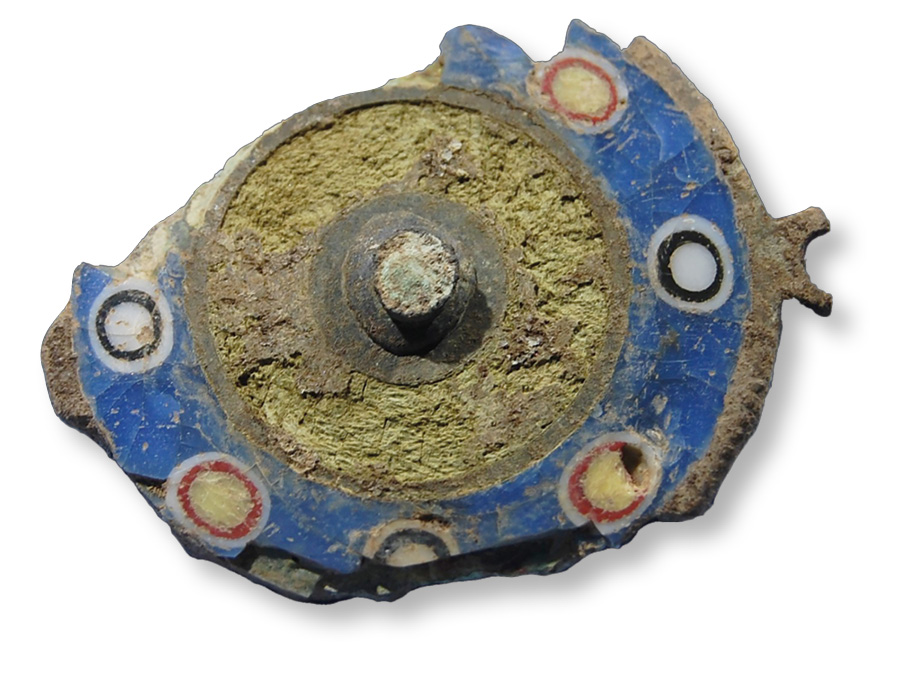
Surrounded by a substantial wooden palisade, the roundhouse was certainly built with defence in mind. It was in the foundations of this palisade that the brooch was found, leading to suggestions that it could have been a ritual deposit intended to protect the house. The dwelling – thought to have been inhabited by wealthy farmers – was also situated on a plateau above a steep drop, making approach from the north particularly difficult.
The combined evidence of the brooch and the defensive features of the house and its location suggest that, although there were no active forts nearby, the settlement was still concerned with protecting itself from potential incursions after the Romans had seemingly left the area. The full project report is freely available online at https://archaeologyreportsonline.com/reports/2025/ARO59.html.
Text: Rebecca Preedy / Image: © GUARD Archaeology Ltd