Subscribe now for full access and no adverts
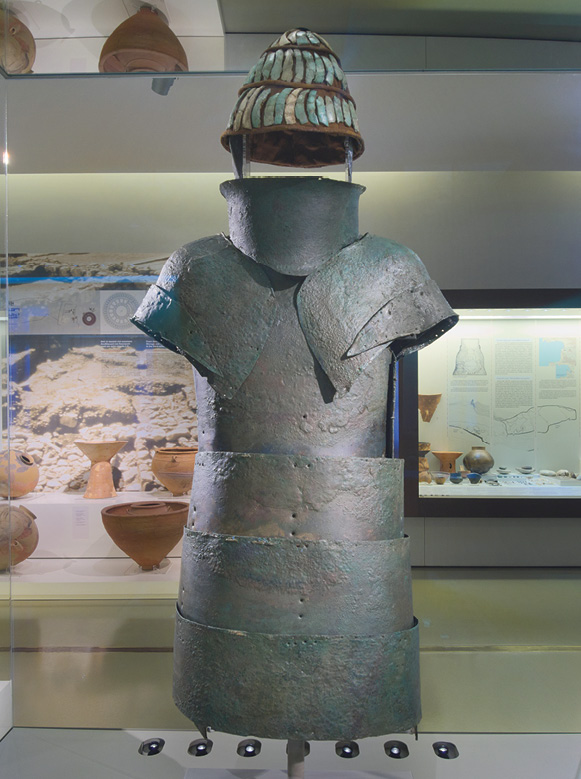
In 1960, a remarkably well-preserved suit of armour was discovered during excavations of a small, chambered tomb near Dendra, in southern Greece, just a few kilometres from ancient Mycenae. The panoply comprised 18 or 19 parts made of bronze plates, originally attached to each other with leather thongs, as well as a boar’s tusk helmet. This discovery remains one of the most complete examples of Bronze Age armour ever found in Europe, but debate persists about its function: could this impressive suit – believed to have weighed 18-20kg in its original condition – have been worn in battle? Was it, perhaps, restricted to warriors riding in chariots? Or was it too cumbersome for anything except ceremonial occasions?
To answer these questions, researchers developed an 11-hour-long simulation that replicated a day of battle for an elite Late Bronze Age warrior, to see whether the armour was suitable for extended use in such a context. Sources of information on warfare in this period are limited, so many of the decisions were informed by accounts of fighting in Homer’s Iliad, as the events of the Trojan War narrated in the epic poem are supposed to have taken place in the Late Bronze Age. The team recognised that this source, first written down 500 years after the period it describes, was by no means a precise account, but hypothesised that it could provide a reasonable jumping-off point for evaluating the nature of early warfare in the Mediterranean.
The study used a replica of the Dendra armour and helmet created in 1984 in Birmingham, UK, for the exhibition Homer’s Heroes. New replicas of a Mycenaean cruciform sword believed to have come from the Dendra tomb, as well as other Bronze Age weapons, were also created specifically for this study. To carry out the simulation, 13 volunteers were recruited from the Marines of the Hellenic Armed Forces. These men, all in their 20s or 30s, were in strong physical condition and fairly tall, as the Dendra armour was custom-made for an individual with a height of at least 1.77m.
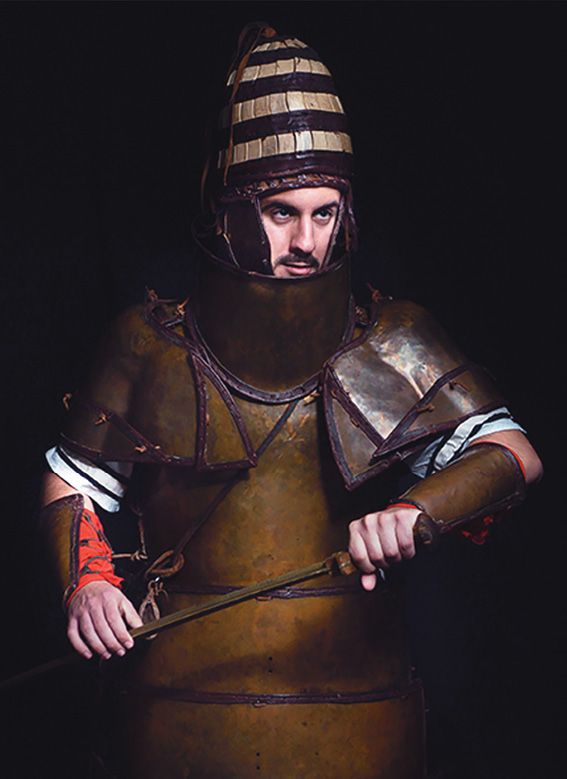
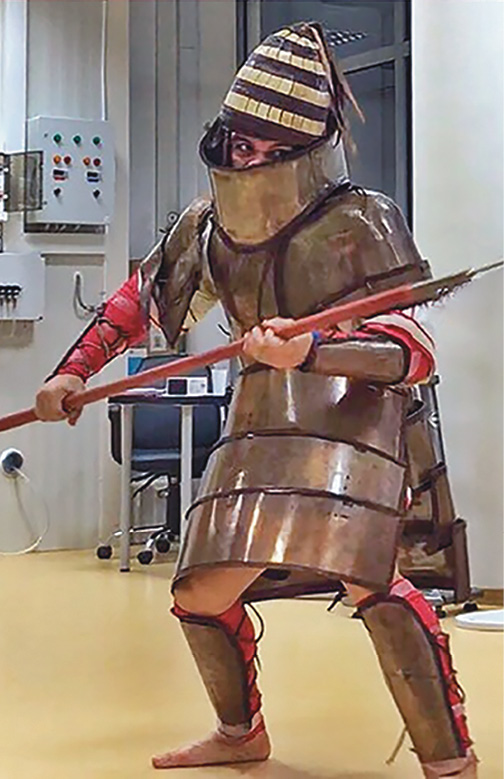
Following two days of training in Late Bronze Age combat equipment, technology, and fighting techniques, the volunteers were each requested to arrive at the laboratory the day before their simulation. There, they were given dinner according to a weight-adjusted nutrition plan – mostly consisting of red meat and red wine – before going to bed at 10pm. The next day they were woken at 5.30am and given a breakfast consisting of dry bread, goat’s cheese, and green olives, before undergoing weight, blood, and urine tests, and having sensors placed. The simulation began at exactly 7am and ended just before 6pm. Throughout this time, the volunteers carried out various activities in the lab including ‘encounters’, most commonly one-on-one combat, but also ‘foot warrior versus chariot’, and a few ‘chariot versus chariot’ and ‘chariot versus warrior on a ship’ encounters. A large part of the day was also spent ‘manoeuvring’ (moving around the battlefield), both on foot (treadmill) and chariot (a replica connected to a motor to simulate the motion of the vehicle). The participants were given time to rest and opportunities to rehydrate and snack on bread, cheese, and onions. The study was performed in controlled environmental conditions intended to replicate summertime in the Late Bronze Age Mediterranean, which palaeoclimate data indicate would have averaged around 24-29°C and 70-85% humidity.
A number of variables were tested before, during, and after the simulation, including the participant’s heart rate, oxygen consumption, core temperature, fluid loss, muscular function, reaction time, and more, as well as self-perceived levels of exhaustion and thermal comfort. The results revealed that volunteers were able to carry out all of the required activities safely, and that the armour did not impede their fighting ability or cause undue strain on the user, even over a full day of intense action.
Due to the limitations of replicating the exact conditions of an ancient battlefield in a modern laboratory, researchers developed a numerical model to test how different conditions, such as air temperature, wind speed, and solar exposure, would affect the core temperature of a virtual model wearing the armour. Again, they found that in almost all tested conditions the virtual model was able to complete the simulation wearing the armour without their body temperature rising to a dangerous point.
The results of this study therefore strongly suggest that heavy Dendra-type armour could have been used effectively by elite warriors in battle. The research has been published in PLOS One (https://doi.org/10.1371/journal.pone.0301494).
Text: Amy Brunskill / Images: Wikimedia Commons, C Messier; Andreas Flouris and Marija Markovic´