
Subscribe now for full access and no adverts
A new model of Robert the Bruce, produced from a cast of his skull, has gone on display for the first time to mark the 750th anniversary of his birth.
The 3D reconstruction of the medieval Scottish king is the most realistic of its kind to date, and was created as part of a collaboration between Glasgow and Liverpool universities.
Born in 1274, Bruce was the King of Scotland from 1306 until his death in 1329. His most significant military victory was at the Battle of Bannockburn in 1314.
The defeat of a much larger army under English King Edward II confirmed Scotland’s status as an independent nation – and made Bruce a national hero.
The model is based on a skull cast taken from Bruce’s remains, which were discovered in a tomb at Dunfermline Abbey in 1818.
It was first constructed a few years ago by Liverpool John Moores University Face Lab, in collaboration with Glasgow University.
A 3D laser scanner was used to create a replica of the skull, which is held at Glasgow’s Hunterian Museum. Muscles and realistic textured skin were then layered over this replica.
The king is depicted wearing a helmet surmounted by a crown, as worn by Bruce at Bannockburn. The nose, however, required some guesswork during construction due to the skull’s deterioration.
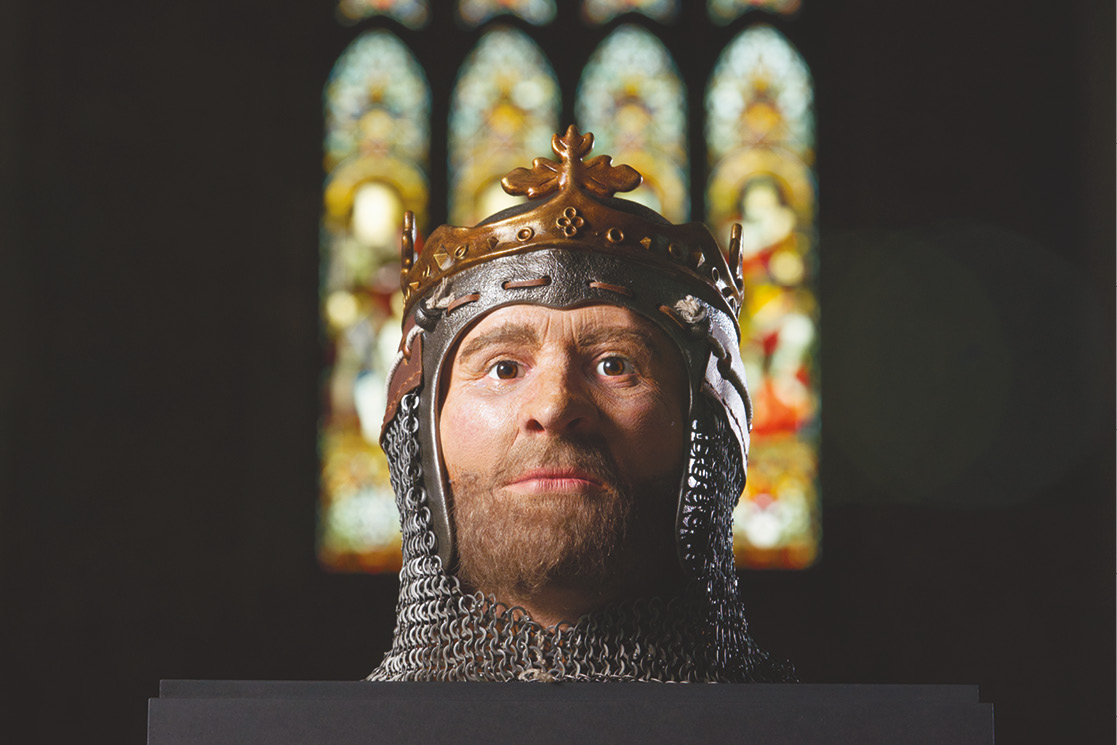
‘We are delighted to host the most accurate model of Robert the Bruce’s face to date,’ said Alasdair Campbell of Historic Environment Scotland (HES), which is in charge of maintaining Dunfermline Abbey.
‘Bruce’s story is an important part of the Abbey, and we are excited for visitors to be able to visualise this story in a new way, particularly as we celebrate his 750th birthday.’
The model will be on display at the abbey until 7 December 2024.