
Subscribe now for full access and no adverts
A rare early medieval cemetery containing the remains of several women has been found near Fonmon Castle in South Wales.
The remains, estimated to be of roughly 80 individuals, were buried around 1,500 years ago and are believed to have been interred in a special funeral ceremony.
Fonmon Castle, situated just north-west of Cardiff Airport, was built as a defensive keep and administrative centre around 1180. Owned originally by the St John family, descendants of Norman knights, it was later used as a mustering point before the Battle of St Fagans in 1648, during the British Civil Wars.Ten years later, the castle was converted into a grand home by Colonel Philip Jones, then the richest man in Wales.
Geophysical surveys of the site began in 2021, when a team led by Dr Andy Seaman of Cardiff University was invited to survey the castle grounds.
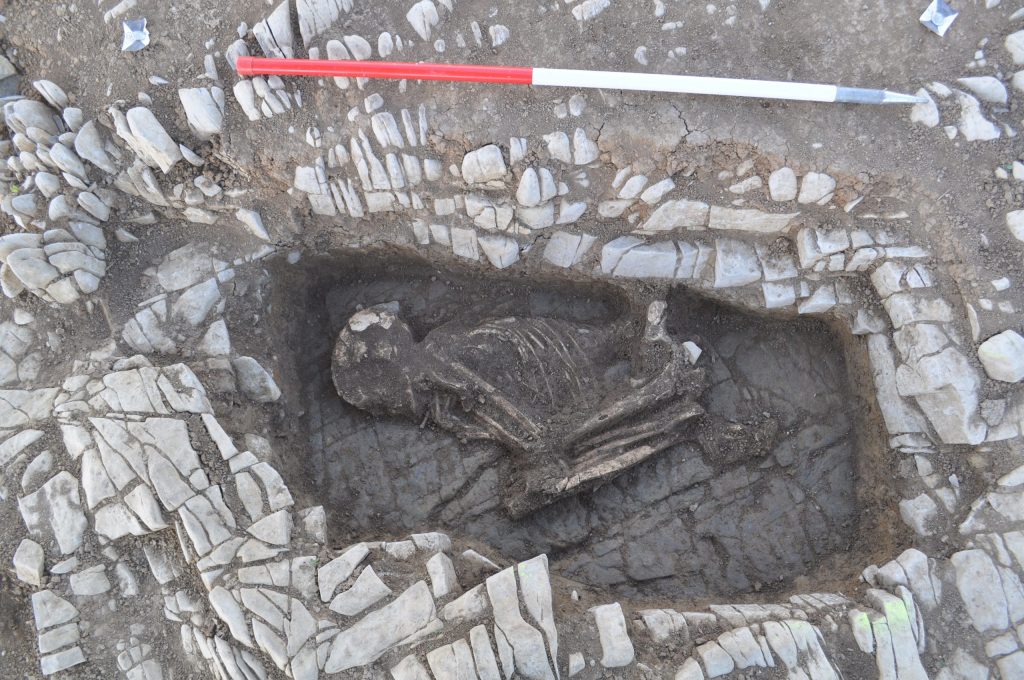
The survey revealed a series of enclosures, where, following further evaluation, the burials were uncovered: these were subsequently dated to around the 6th and 7th centuries. A further excavation across half of the cemetery took place last summer.
So far, 36 sets of remains have been uncovered, some of which were buried in an atypical, crouched position facing the south – indicating a burial rite.
Along with the human remains, fragments of animal bones, metal debris, and pieces of glass drinking vessels were uncovered. The vessels, imported from western France, are similar to other examples found at Tintagel in Cornwall and Dinas Powys, nine miles east of Fonmon, indicating some sort of ritual feast that coincided with the burials.
‘This is a really exciting discovery,’ Dr Seaman said. ‘Sites of this date are extremely rare in Wales, and often do not preserve bone and artefacts.’
‘It’s a period of Welsh history about which we know comparatively little,’ he added. ‘It will help us expand and enhance our understanding of this post-Roman period.’
Excavation work around the castle, which in recent years has become a popular tourist attraction, is set to continue for several years.