Subscribe now for full access and no adverts
Previously undiscovered markings identified as apotropaic symbols (protective carvings sometimes referred to as ‘witch marks’), as well as a rare ‘curse’ inscription, have been revealed during volunteer research at English Heritage’s Gainsborough Old Hall in Lincolnshire.
The hall was originally founded as a medieval manor house, but surviving structures date to the Tudor period.
Within its walls, around 20 carvings have now been mapped and recorded by long-time English Heritage volunteer Rick Berry over the last two years. The symbols include hexfoils or hexafoils, believed to trap demons; pairs of overlapping Vs called ‘Marian marks’, intended to invoke the Virgin Mary; and five-pointed protective pentangles.
Markings like these are commonly found in churches (see CA 315), but the high number of marks found at Gainsborough Hall – as well as over 100 burn marks believed to safeguard against fire – puts it among the most ‘protected’ buildings in the care of English Heritage. As the highest concentration of marks was in the servants’ wing, might this suggest that the staff at Gainsborough were particularly superstitious?
Establishing a secure date for markings like these can be challenging, but a rare ‘curse’ inscription is easier to interpret: written upside-down, it names William Hickman, who purchased the property in 1596.
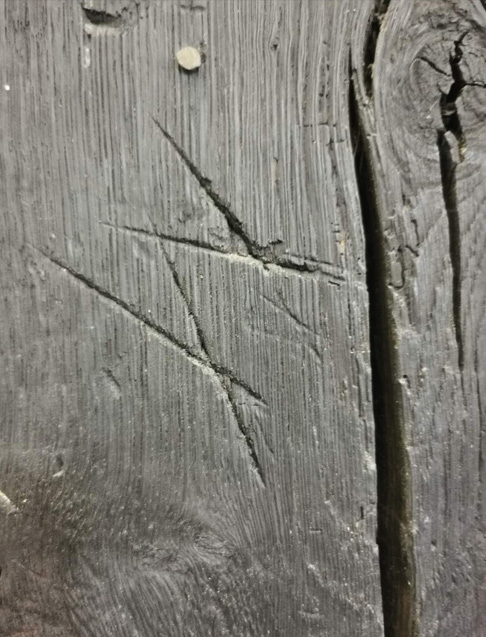
Why might Hickman have attracted such negative attention? He purchased Gainsborough from the debt-saddled Burgh family, who would surely have been unhappy at being forced to sell their home, and was also known as a ruthless businessman, contesting local market rights and levying tolls on river goods among other manipulations as manor owner. The curse inscription’s value, however, transcends its possible motivators: while common in the Roman and Anglo-Saxon periods, these carvings are extremely rare in the later Tudor period, and no examples are known from other English Heritage properties.
‘It is astonishing that, centuries on, the amazing old buildings in our care still have secrets waiting to be discovered,’ said Kevin Booth, English Heritage’s Head of Collections. ‘We have a great team of volunteers across the country, and it is testament to Rick’s passion for the place that these incredible protection marks have been found at Gainsborough.’
Rick’s research at Gainsborough continues, and he is currently conducting tours of the marks.
Text: Rebecca Preedy / Photo: English Heritage