Subscribe now for full access and no adverts
New interdisciplinary research from the University of Aberdeen has suggested that Holme I – a Bronze Age timber circle in north Norfolk that is also known as ‘Seahenge’ – was created as a response to a period of climatic deterioration.
The monument – comprising 55 closely fitted oak posts and a central upturned trunk – was first identified in 1998, when shifting sands on Holme Beach revealed some of its remains (CA 167). Following excavation, some of its timbers are now displayed at the Lynn Museum in King’s Lynn, but Seahenge’s purpose has long been the subject of debate. It has previously been suggested that Holme I and its sister-site Holme II (a contemporary but more complex monument that was found 100m away and remains in situ; see CA 294) had a funerary role, but recently published research by Dr David Nance proposes an alternative interpretation.
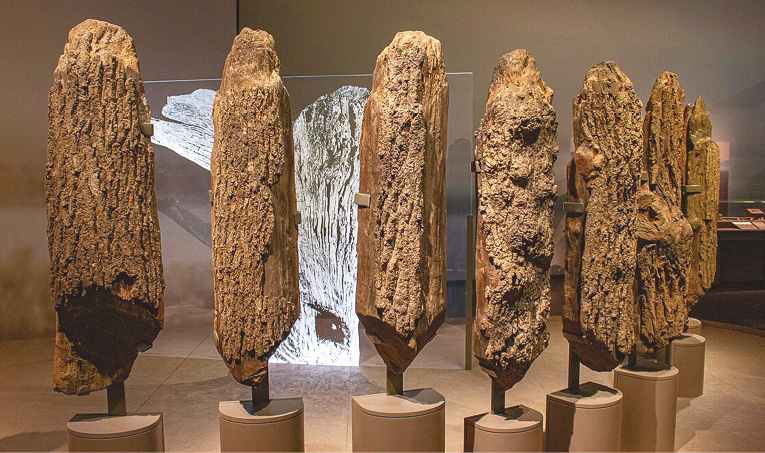
Writing in GeoJournal, Dr Nance combines archaeological, climatic, and environmental data to argue that Holme I and II were created as independent ritual responses to contemporary climate concerns. ‘We know that the period in which they were constructed 4,000 years ago was a prolonged period of decreased atmospheric temperature and severe winters and late springs, placing these early coastal societies under stress’ he explains, suggesting that the wooden posts (which were built from trees felled in the spring of 2049 BC), could therefore have been a part of rituals designed to incite a return of warmer weather.
The climatic deterioration throughout the Bronze Age was widely and continuously felt: while Dr Nance’s work focuses on the early Bronze Age, the late Bronze Age saw landscapes of prime farmland in places such as the west of Ireland being transformed into bogs, and communities in south-west Britain are known to have abandoned upland areas during sustained periods of extreme wet conditions at this time.
As for what the rituals at Holme I and II may have involved, Dr Nance’s paper delves into folkloric beliefs relating to the changing of the seasons, linking these to the solid wall formed by the original arrangement of Holme I’s posts, and explores ideas of the symbolic significance of the penned cuckoo, and of sacral kingship. He also highlights the monument’s alignment with the sun during the summer solstice. The full paper is published at https://link.springer.com/article/10.1007/s10708-024-11088-5.
Text: Rebecca Preedy / Image: -JvL-