Subscribe now for full access and no adverts
A Bronze Age anvil, the earliest-known coin issued by a Viking ruler in Britain, and a remarkably realistic Roman knife-handle shaped like an asparagus spear all feature in annual reports recently issued by the British Museum, documenting recent Treasure cases and other finds recorded by the Portable Antiquities Scheme.
The latest PAS report covers 2023, revealing that this was a record year for the Scheme. Some 74,506 finds were reported by the public that year in England, Wales, and Northern Ireland (Scotland is covered by the Treasure Trove Unit; see ‘Further information’ below), a steep increase from the previous report, which counted 53,490 public reports in 2022. The majority of 2023’s finds were made by metal-detectorists (95%), followed by people field-walking or mudlarking (3.74%); the remainder are described as chance finds discovered during gardening, controlled archaeological excavations, and construction or agricultural work.
The 2022 Treasure Annual Report was released at the same time, providing details of 1,377 Treasure finds. This figure makes 2022 the highest year on record for Treasure finds overall, while new milestones were also achieved for each constituent nation covered by the report, with 1,291 from England, 76 from Wales, and 10 from Northern Ireland. Again, metal-detecting was the most common source of discovery (94.12%), followed by archaeological finds (3.85%), chance finds (0.58%), and mudlarking (0.15%); examples where the circumstances are still to be determined make up another 1.3%.

Illuminating artefacts
What, then, can be learned from this eclectic array of archaeological insights? The 2023 PAS report includes a detailed breakdown of discoveries by period, the earliest of which are 55 Lower Palaeolithic (c.500,000-180,000 BC) hand axes. Among the prehistoric finds, a particularly enigmatic item is a siltstone pebble, found in a garden in Palgrave, Suffolk, which has a series of regular notches running down one side. Its entry on the PAS database (search for NMS-D432F7 at https://finds.org.uk) suggests that it may have been a tally stone, but the report wonders if an alternative interpretation might be some form of musical instrument played by running a stick over the lines, like a guiro.

Moving into the Bronze Age, some 1,552 finds for this period were reported by the public in 2023, including axe heads (261), spearheads (79), chisels (29), and swords (13), as well as personal adornments (76). A significant example of this last category was a lunula – a kind of flat, gold crescent – found at Grassington in North Yorkshire (SWYOR-C95954 on the PAS database). Only around 100 such objects are known from north-west Europe, mainly in Ireland, and there are just four on the PAS database. Now adding a fifth to this group, the Grassington lunula is also important due to its completeness: apart from one example from Tarrant Rushton in Dorset (see CA 293), the other PAS lunulae survive only as small fragments.
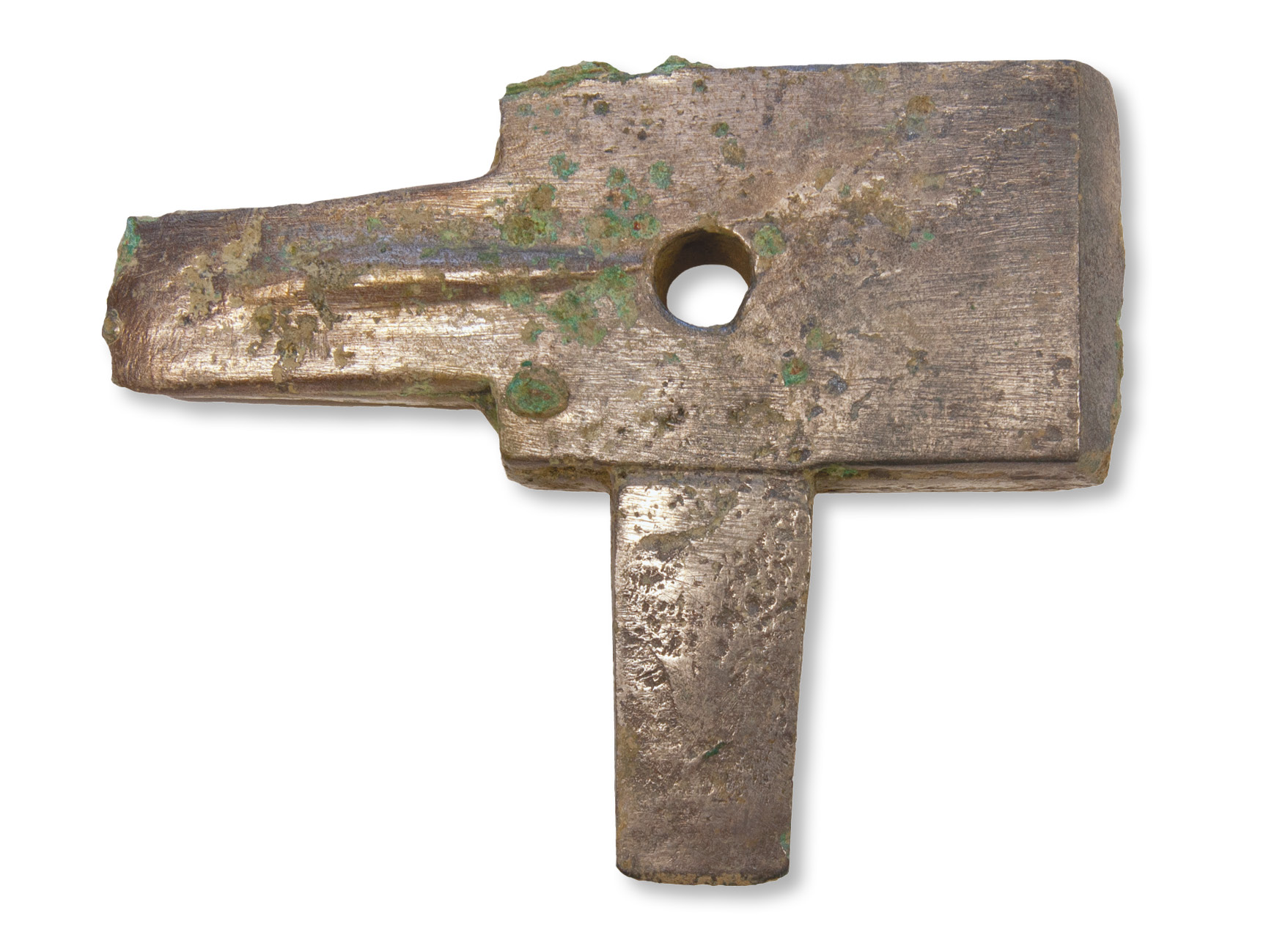
Another unusual Bronze Age find from 2023 is the Hambleden Hoard (HAMP-BDFD5F), a Middle Bronze Age cache of metalwork, discovered in Hampshire, that does not contain the expected mix of tools and weapons but is instead dominated by bracelets, torcs, necklaces, and finger-rings. A more recent discovery of this period was showcased at the reports’ launch, too: another Bronze Age hoard, this time from Urchfont, Wiltshire, which was discovered in 2024 (WILT-C97E23), and whose copper-alloy contents include a very rare object: a possible Bronze Age anvil.
A total of 1,249 Iron Age finds were reported to the PAS during 2023, 500 of which were coins. Some of these were very unusual, including a far-travelled silver denarius, dating to 150-115 BC, which was found at Poulton in Cheshire but had been minted at Konterbia Karbika (Cuenca in Spain; WREX-4240BF). Similarly far from home was a plated gold quarter stater of the Trinovantes who lived in the North Thames region (CORN-8F4E6D); it was found at St Anthony-in-Meneage, Cornwall. We have no evidence of minting in Iron Age Cornwall, meaning that each new coin find sheds valuable light on the area’s external contacts, and raises questions about why such items appear in an area that apparently did not use money.
Romans and royals
Roman finds are particularly prominent within 2023’s report, with 32,301 items representing 44.53% of the total. Brooches (1,992) and finger-rings (219) were common discoveries, but the most frequent finds were coins: over 12,000 in all, including 50 coin hoards that collectively contained over 7,300 items. Again, the report picks out some uncommon examples, including two coins of Augustus (r. 28 BC-AD 14), which were found at Rotherhithe in London (PUBLIC-543CF1) and Hayling Island in Hampshire (HAMP-753937). Both depict a chained crocodile, representing Augustus’ victory over Antony and Cleopatra, and Egyptian imagery could also be seen on a rather later copper-alloy nummus of Constantine II (r. AD 337-340; SUR-A3A374), showing the god Anubis. It was found near Basingstoke in Hampshire, and is one of only four British examples known, and the only one recorded by the PAS.
Divine depictions were represented by figurines, too, including a copper-alloy example from South Cave in East Yorkshire (FAKL-0C66BB). Interpreted as the goddess Spes (Hope), the figure is a first for Britain. It is impressively detailed, with the draped fabric of the goddess’ Greek-style chiton expertly rendered. Virtuosic artistry can be seen as well in a copper-alloy knife handle shaped like an asparagus spear, which was found in Misson, Nottinghamshire (SWYOR-3E8C66). Similar objects are known from the area around Trier in Germany, but are otherwise unprecedented in Britain.

Above & below: Minted by Guthrum of East Anglia, this silver penny is the earliest-known coin issued by a Viking ruler in Britain. Images: The British Museum
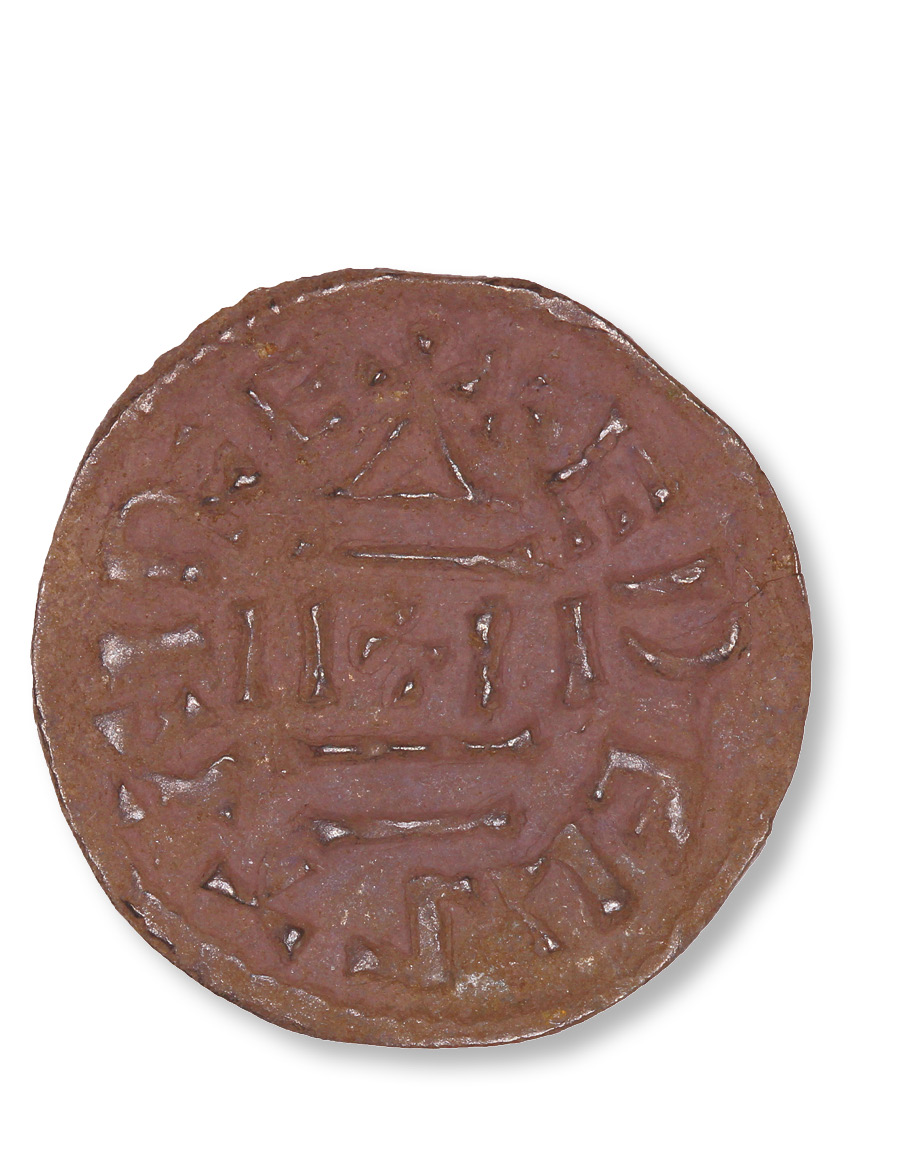
Coins make up 950 of the 3,213 items reported for the early medieval period (including 637 coins in 11 hoards), and one with particular historical significance is a silver penny of Guthrum of East Anglia, which was issued under the Viking ruler’s baptismal name: Æthelstan. Originally from Denmark, Guthrum was a leader of the Viking Great Army that conquered swathes of Anglo-Saxon England until his defeat by Alfred the Great at the Battle of Edington in 878. Under the Treaty of Wedmore, Guthrum submitted to Alfred and was baptised, before being installed as king of East Anglia.
This watershed moment in Anglo-Scandinavian relations is reflected by the silver penny (PAS-D68238), which was minted c.879-mid-880s, and was found in the Thetford area of Norfolk. It is not only the earliest-known coin issued by a Viking ruler in England, but also names a previously unknown moneyer: Æthelwine. The coin was the first find to be declared Treasure under the new significance criteria that were added to the legislation in 2023, which state that an object may be potential Treasure if it is made at least partially of metal, is at least 200 years old, and provides exceptional insight into an aspect of national or regional history, archaeology, or culture.
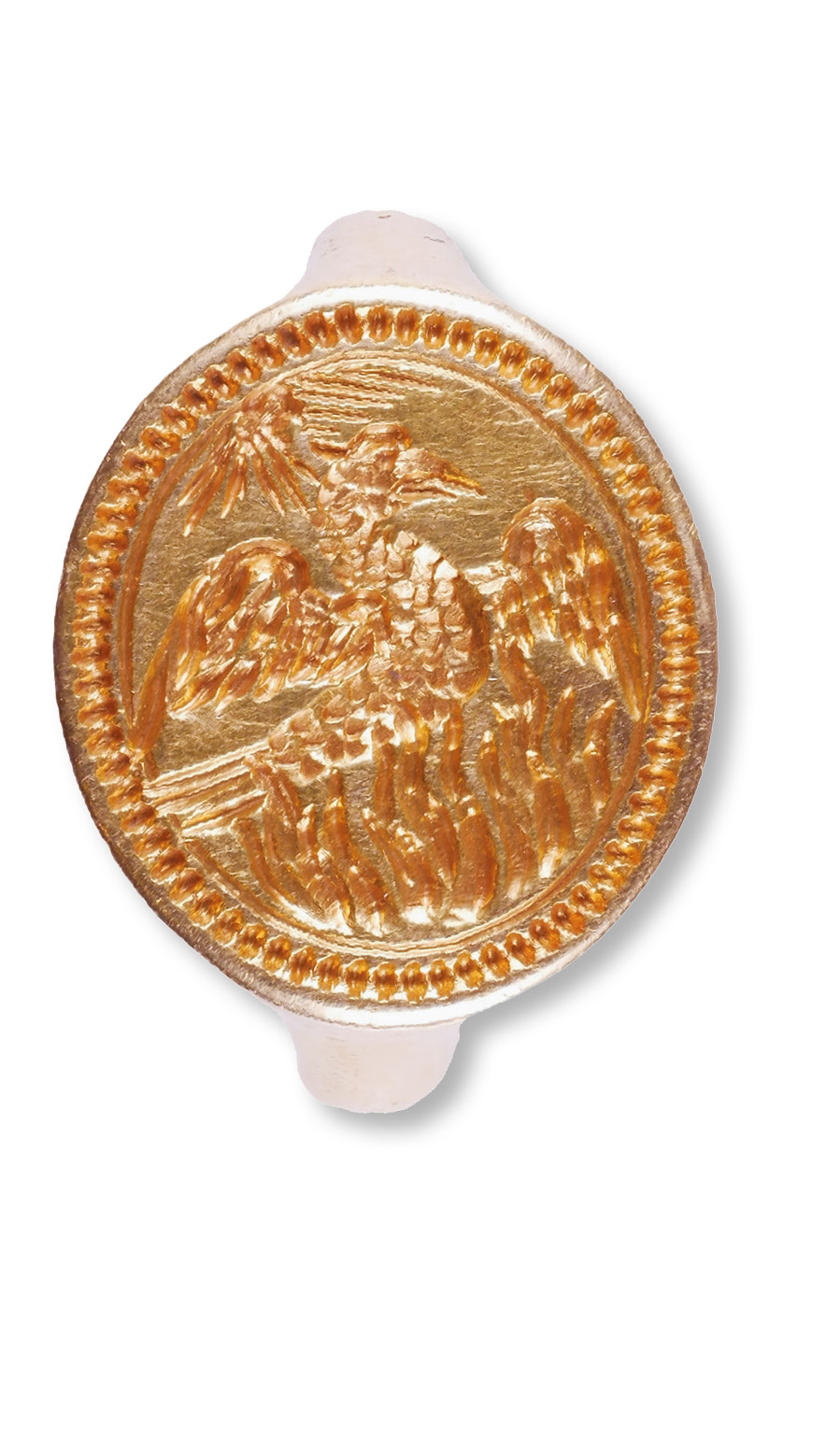
Was this phoenix signet ring, found in Bedfordshire, worn by a supporter of Elizabeth I? Image: Portable Antiquities Scheme
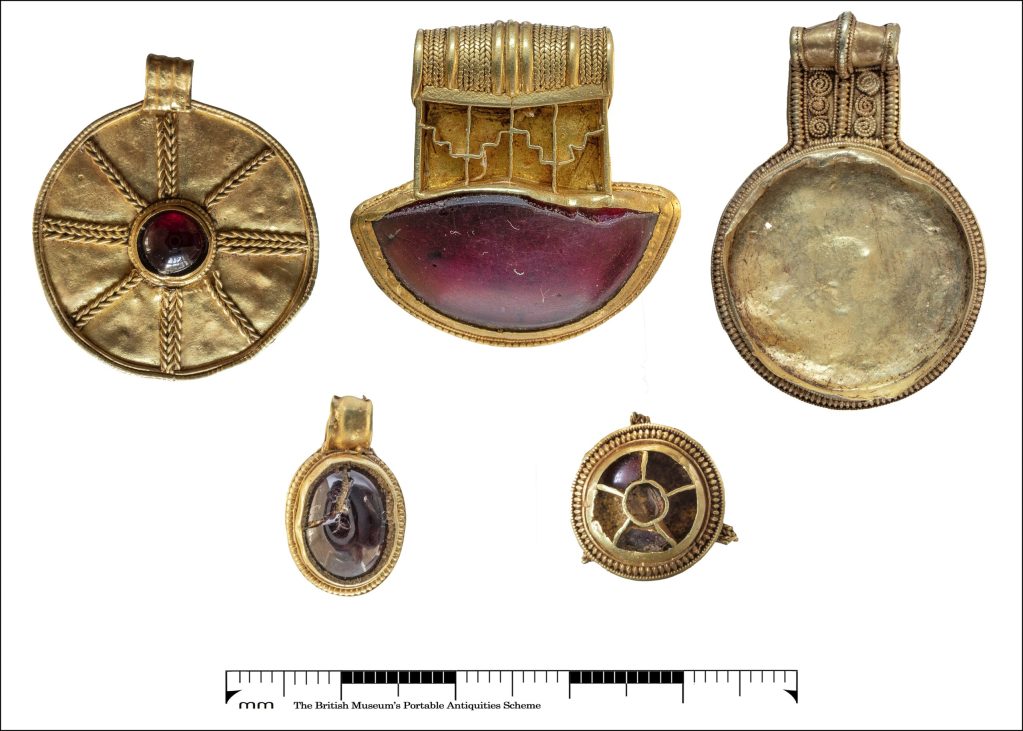
Another early medieval Treasure find was a group of four pendants and a boss or mount, which have been interpreted as grave goods from a ploughed-out Anglo-Saxon burial near Donington on Bain in Lincolnshire (LIN-1DABA5). Variously decorated with beaded gold wire and cloisonné, and set with dark gems (probably garnets), the oval, circular, and D-shaped pendants are typical of components from high-status 7th-century necklaces (see CA 395), while the mount is thought to be part of a composite brooch – if so, it would be the first example from the Lindsey area.
Later medieval finds made up 20.44% of the recorded finds for 2023 – 14,810 items in all, among them 5,600 coins (including just over 500 in 44 hoards), 1,754 buckles, 405 spindle-whorls, and 66 pilgrim badges. The final ‘star find’ highlighted by the British Museum, however, comes from the post-medieval period: a gold signet ring dating to c.1570-1600 (BH-AC29D6), which was discovered in Bedfordshire. It is adorned with an image of a phoenix, which was an important motif in the later Elizabethan period, associated not only with Christian resurrection and eternal life, but with Elizabeth I herself. Given this symbolic link, and the fact that the ring was found close to the location of two royal parks, it is thought that this item may have been worn by a supporter of the Tudor queen.
Further information: For more information about the Portable Antiquities Scheme, definitions of Treasure, and the legal obligations of finders in England and Wales, see https://finds.org.uk/treasure; advice for Northern Ireland is available at http://www.communities-ni.gov.uk/articles/advice-finders-treasure-northern-ireland. Scotland is covered by the Treasure Trove Unit; see http://www.treasuretrovescotland.co.uk.