Subscribe now for full access and no adverts
Further analysis of the ‘Trojan War’ mosaic, first discovered at Ketton, Rutland, in 2020 (see CA 383), has revealed more details about its imagery, suggesting that Roman Britain was not as isolated from the Classical world as has been previously assumed.
Like many other examples, the Ketton mosaic had adorned a dining room – but its composition, comprising three rectangular panels, is more unusual. These decorative surfaces were usually arranged so that diners could appreciate them from various angles around the room, but the Ketton mosaic was meant to be seen in a strict vertical line. Its wide panels are reminiscent of framed manuscript illustrations from the late Roman period, and it has been suggested that the mosaicist could have been intentionally mimicking these to associate the villa owner with high literary culture.
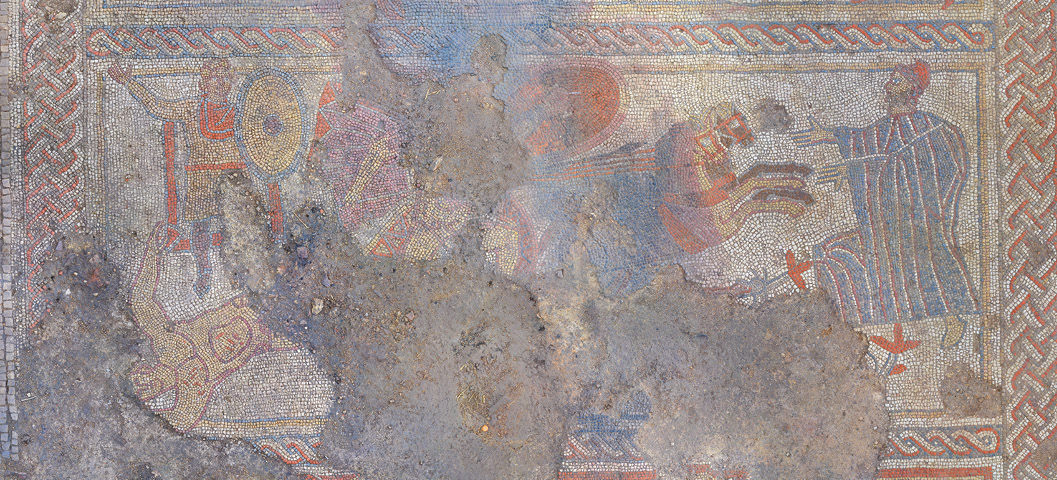
Early analyses of the mosaic had interpreted its imagery as a depiction of Aeschylus’s dramatic version of the Trojan War, Phrygians, because of its inclusion of the ransom of Hector, when the Trojan prince’s body was held for ransom until King Priam paid its literal weight in gold. As this Greek tragedy was written some 800 years before the mosaic was laid, however, how had its story come to Roman Britain? Dr Jane Masséglia, Associate Professor in Ancient History at the University of Leicester, has led the research on the Ketton find. She notes that, while the Ketton design may have been trying to imitate a codex, there is no evidence that a similarly illustrated version of the play existed at all, let alone so long after it was first performed. Rather, her research indicates, the story’s popularity had endured through later retellings. There are also several similarities between the mosaic’s design and examples of ancient art from across the Mediterranean world. In particular, the dragging of Hector in the second panel (above) of the mosaic is almost identical to an image on an Attic vase made in Athens in the early 5th century BC and currently housed at the Museum of Fine Arts in Boston, USA.
Jane said: ‘Once I’d noticed the use of standard patterns in one panel, I found other parts of the mosaic were based on designs that we can see in much older silverware, coins, and pottery from Greece, Turkey, and Gaul.’ She believes that the mosaicist may have taken inspiration from many of these works, and that the Ketton mosaic is in itself a mosaic of different works of art. If this is the case, it would mean that the Roman West was well-acquainted with Classical art, that this knowledge had travelled to Britain, and that ancient artisans were passing their designs down the generations.
Text: Kathryn Krakowka / Image: ULAS