Subscribe now for full access and no adverts
Researchers from Canterbury Christ Church University have developed a novel method for visualising Roman footwear, even in cases where the leather has completely disintegrated, by using radiography on soil-blocks containing hobnails.
The study was based on a Romano-British (late 3rd century AD to mid-5th century AD) cemetery in Canterbury, known as 5-5a Rhodaus Town. When the Canterbury Archaeological Trust had led excavations there in 2019, they found that 51 of the 215 people buried there showed evidence of footwear, as attested by the presence of hobnails, but that no leather survived. To see if the scatters of hobnails could still prove useful, whenever they were found arranged in a shoe-like pattern during the excavation, they were block-lifted and fully encapsulated in order to immobilise them. In all, eight soil blocks from five graves were taken for analysis; each was imaged using a digital radiography system while still in their packaging, and the arrangement of hobnails was then recorded and measured.
Based on these results, it was possible to determine approximate dimensions for five of the shoes, which appear to be in keeping with the size of the person they were buried with. It was also possible for distinct patterns to be identified using this method, with several of the shoes appearing to have a single line of nails running around the edge of the sole – a style which is known to have been prevalent in the Roman period from the late 2nd century to the end of the Roman period, which is when many of these individuals would have been buried.
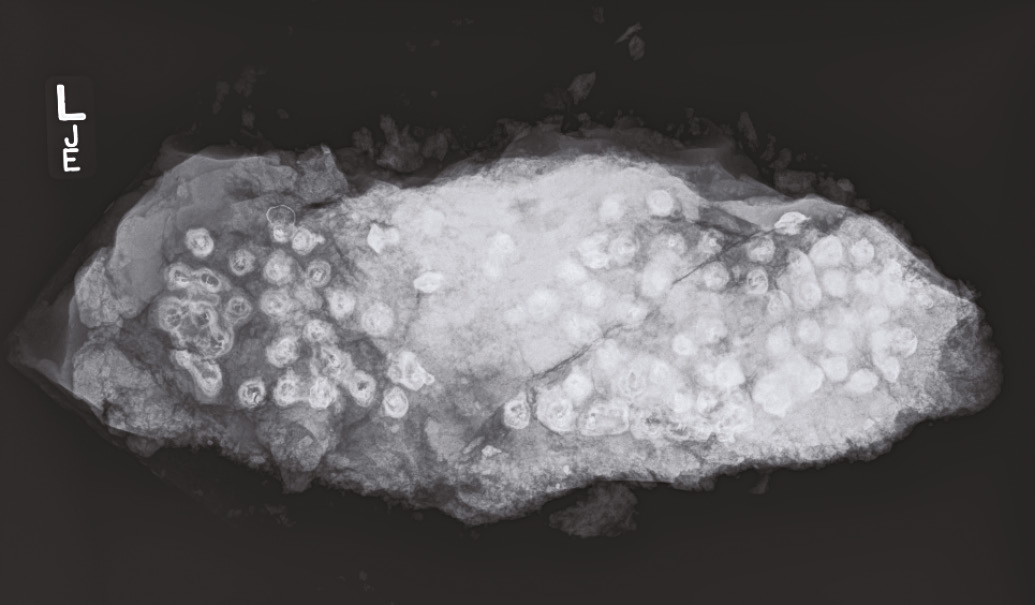
It is hoped that this promising technique could help us learn more about shoe patterns and their prevalence in the past. The team suggest that the preservation of hobnails could also be used as a proxy in helping to determine the stature and biological sex of an individual, even in cases where no human remains have survived. There are limitations to this method, however, as the smallest alteration to hobnail distribution – either through decay, disturbances during excavation, or environmental changes during post-excavation analysis – will skew the results.
The full results of this project were recently published in the Journal of Archaeological Science: Reports (https://doi.org/10.1016/j.jasrep. 2025.105400).
Text: Kathryn Krakowka / Image: James Elliott and Adelina Teoaca (2025) Journal of Archaeological Science: Reports