Subscribe now for full access and no adverts
New Kingdom fortress found
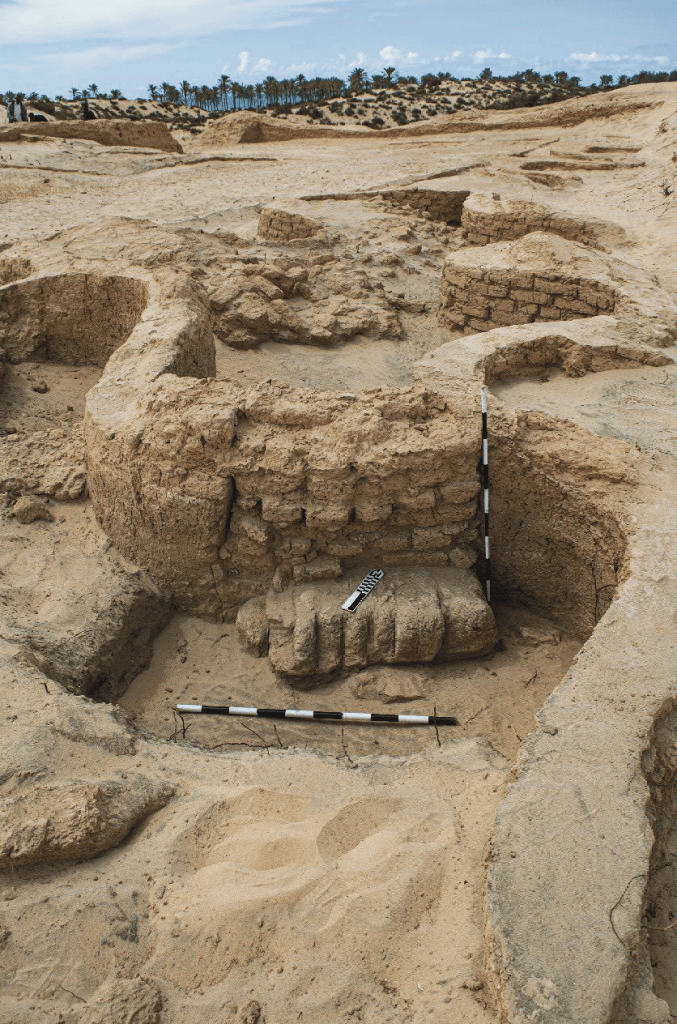
Excavations at the site of Tell el-Kharouba in North Sinai, Egypt, have uncovered the remains of a large military fortress dating to the New Kingdom period, c.1550-1070 BC. The fortification’s southern wall and narrow entrance, as well as 11 defensive towers, parts of the northern and western walls, and an area that is thought to have housed soldiers have been revealed so far.
This discovery adds to a series of fortifications that are known to have been built by New Kingdom rulers to protect Egypt’s eastern border and secure an important route, known as the ‘Way of Horus’, which connected the Nile delta with other areas of the eastern Mediterranean. Measuring c.8,000m2, the most recently discovered fortress would have been one of the largest, and perhaps one of the most important, defensive structures on this route.
Pondering platforms in China
Three large platforms, made of carefully compacted soil in various colours, have been discovered during excavations at the site of Qianzhongzitou in Gaomi, Shandong province. The site is believed to have started as a small farming village around 3100-2600 BC, before developing into a ritual centre.
The earliest platform dates to the Western Zhou period (c.1046-771 BC), while the other two were constructed during the Warring States period (c.475-221 BC). They also differ in shape, with the earlier platform having a trapezoidal shape and, of the later two, one is rectangular and the other circular. With no evidence of post-holes or other construction features, it is likely that these were open spaces, and they may have been specifically designed for ritual gatherings. This idea is strengthened by the discovery of numerous marine remains, including oyster and clam shells, as well as various animal bones along with cooking vessels, suggesting that the platforms may have been used for large-scale feasting.
Identifying early indigo
Analysis of 34,000-year-old stone tools from Dzudzuana Cave in Georgia has found the earliest-known evidence for the production of blue dye. The research, which was recently published in the journal PLOS One (https://doi.org/10.1371/journal.pone.0321262), identified traces of indigotin, a type of blue dye compound, on the surfaces of the stones, and further investigations were able to confirm that the tools had been used to grind the leaves of the plant Isatis tinctoria, more commonly known as woad. Since woad has no nutritional value, it is probable that the plant was processed for its colour.
Text: Kathryn Krakowka / Image: courtesy of the Egyptian Ministry of Tourism and Antiquities