
Subscribe now for full access and no adverts
The largest-ever geophysical survey undertaken by the National Trust has revealed two probable Roman villas among other archaeological features on the Attingham Estate in Shropshire.
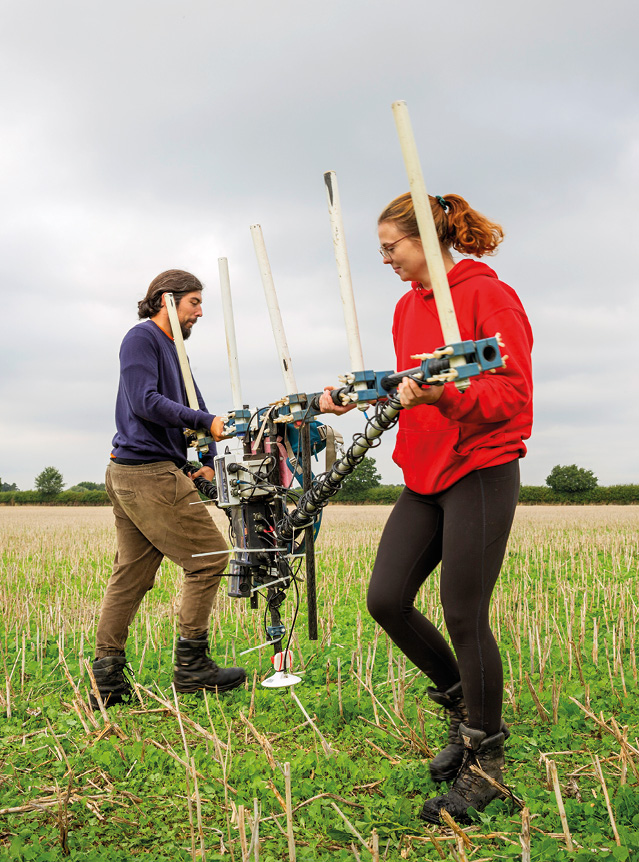
The work, carried out by Magnitude Surveys in July, covered an area of more than 1,000ha, including part of the site of Wroxeter Roman City (Viroconium). The Attingham Estate was already known to be of archaeological interest, with geophysical mapping originally commissioned to help the National Trust develop its nature recovery plans for the area. Cutting-edge magnetometry surveys were used to record subtle changes in the local magnetic field, allowing the work to be carried out in a relatively short time – revealing extensive previously undiscovered archaeological features.
Among the newly identified structures are two probable Roman villas, identifiable by their regular floor plans (the survey revealed internal room divisions) and their location on routeways to and from Wroxeter. Until now, only six Roman villas had been known from Shropshire, although evidence of Roman activity from around Viroconium has been uncovered periodically (CA 289).
Other features that are now on the map include a network of Roman roads, which has allowed archaeologists to confirm the course of the road heading west from Wroxeter, as well as traces of other routes connecting various rural settlements to the major road network and Wroxeter itself.
In keeping with Roman funerary customs, which forbade burial within urban centres, the route leading to Wroxeter had a roadside cemetery, which is of particular interest to the research team. A variety of funerary practices can be identified in the geophysics: circular anomalies suggest burning in situ, indicative of possible funerary pyres, and a rectangular feature could be a mausoleum. Echoes of much earlier interments can be seen in the area, too, with evidence of possible prehistoric burials showing up on the mapping.
As for traces of the living, eight Iron Age or Romano-British ditched enclosures (four of which were previously unknown) have been identified as probable farmsteads that may have supplied the nearby city with crops cultivated in a coherent Romano-British field system to the west of Wroxeter. This is also evidenced in the mapping data.
While initial analysis of the survey results only allows for a broad dating of each of the newly discovered features, the National Trust hopes that – through comparison with other similar sites in the Midlands – they may be able to narrow this down to a more accurate time frame. The findings have already helped the National Trust to gain a better understanding of the area, which they hope to disseminate to the general public. Janine Young, National Trust Archaeological Consultant for the Midlands and East, explained that the scale of the survey has given a clearer view of the development of the landscape over time, identifying individual sites as well as highlighting patterns in the surrounding area. Although no excavations of these features are planned, the enhanced understanding achieved through the geophysical survey will be vital to achieving the conservation aims of the work: the National Trust will now be able to protect these areas by working with farm tenants to ensure the archaeology is managed correctly, as well as highlighting these spaces as places to avoid for future woodland-planting or water-habitat creation.
Text: Rebecca Preedy / Photo: National Trust, James Dobson