
Subscribe now for full access and no adverts
A project aiming to recover the remains of three crew members from a B-17 Flying Fortress bomber that crashed after a mid-air collision near Thurston, Suffolk, in 1944 has located aircraft wreckage and personal objects connected to those on board.
Suffolk’s airfields hosted many US air squadrons during the Second World War, and on 19 July 1944 the B-17 ‘Little Boy Blue’ was setting out on a bombing raid of Schweinfurt in Germany when it collided with another aircraft and crashed just outside Thurston. Of its ten-strong crew, only two survived: five were confirmed dead, and three remained unaccounted for. These were the pilot, Walter Malaniak (26, of Pennsylvania), co-pilot Aaron Brinkoeter (24, of Texas), and radio operator Ronald Grey (27, of New York).
Cotswold Archaeology was commissioned by the US Department of Defence to search for the crash site as part of an initiative intended to bring closure to the families of the airmen who had perished, and excavations began in September last year, when a team of volunteers including UK miliary veterans, serving US military personnel, and members of Suffolk Archaeology Field Group, as well as Operation Nightingale, joined forces to map the debris field using geophysical survey, field-walking, test-pitting, and metal-detecting. Years of ploughing in the area meant that any surviving wreckage and human remains would have been displaced, but the team was nonetheless able to recover many objects associated with the crash.
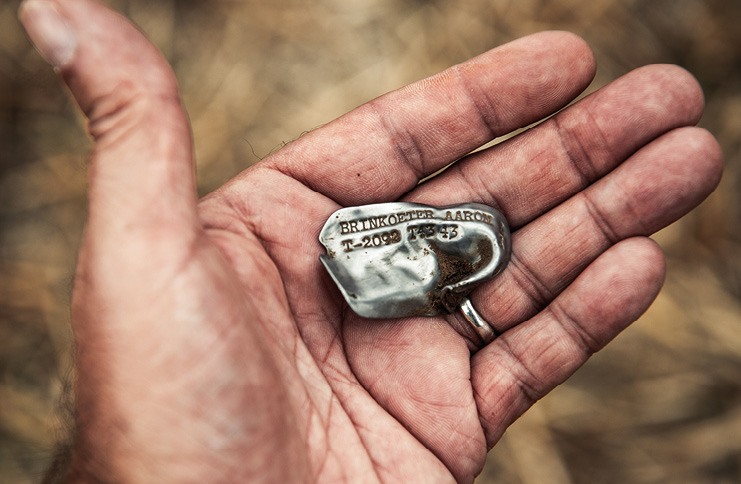
These included fragments of the aircraft itself, such as a the rim of a landing-gear wheel, engine parts, machine-gun casings, and data plates. The most moving find, however, was the dog tag of Aaron Brinkoeter, which was recovered by a local metal-detectorist – coincidentally, on the co-pilot’s birthday, 12 September.
As for the missing men themselves, some small fragments of osseous material have been recovered from the site and are currently undergoing histo-logical analysis to determine whether they are human and, if so, whether they are viable for DNA testing to provide a possible match to any of the crew.
Rosanna Price, Engagement Manager at Cotswold Archaeology, explained the poignancy of the site for all involved: ‘To say I’m proud of the whole team, and the use of our professional expertise to attempt this work, and to shed light on the bravery of these young men and the freedoms they fought for, keeping that fresh in the public’s mind at a time of notable global unrest, would be a genuine understatement.’
Text: Rebecca Preedy / Photo: Harvey Mills