Subscribe now for full access and no adverts
The skeleton of an Iron Age woman found in Winterborne Kingston, Dorset, has revealed rare material evidence of possible human sacrifice from this period.
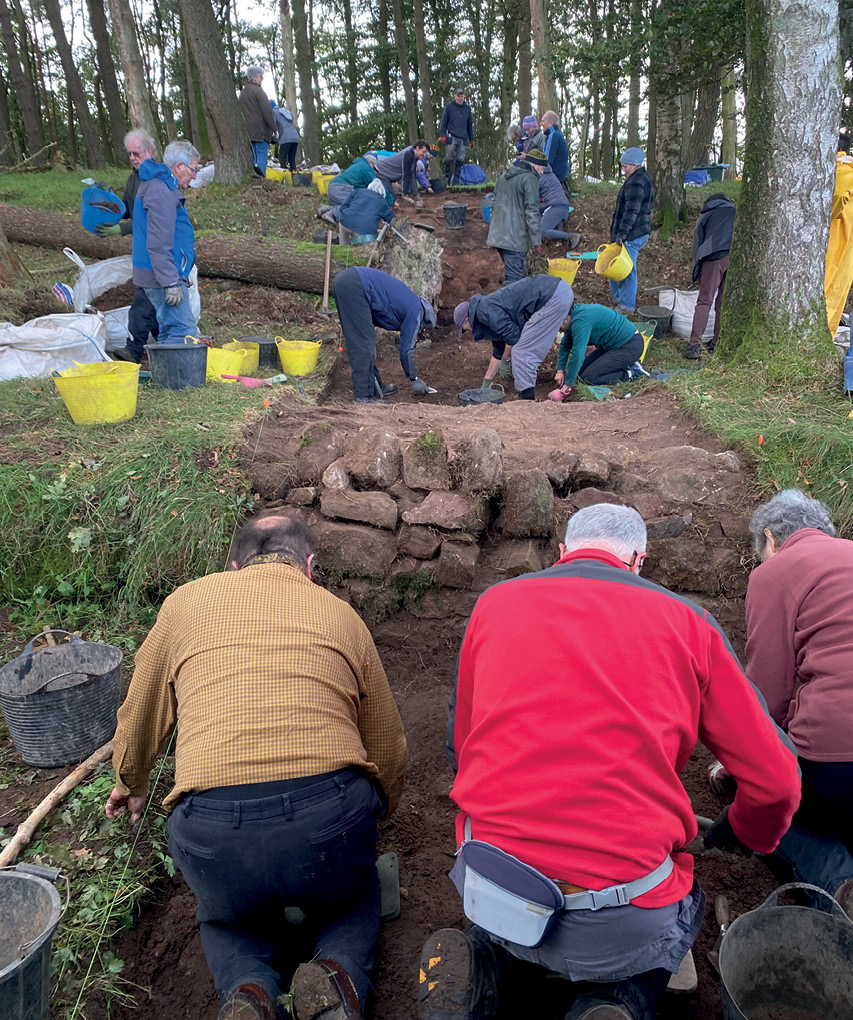
The site has been extensively excavated by Bournemouth University teams for more than 15 years, owing to the number of prehistoric settlement structures in the area. However, recent research published in The Antiquaries Journal (https://doi.org/10.1017/S0003581524000143) has revealed that a skeleton discovered in 2010 is of considerable significance. Found in a banjo enclosure on the site (see CA 281), the woman was killed by the insertion of a single blade between the first and second vertebrae, a method consistent with ritual killing.
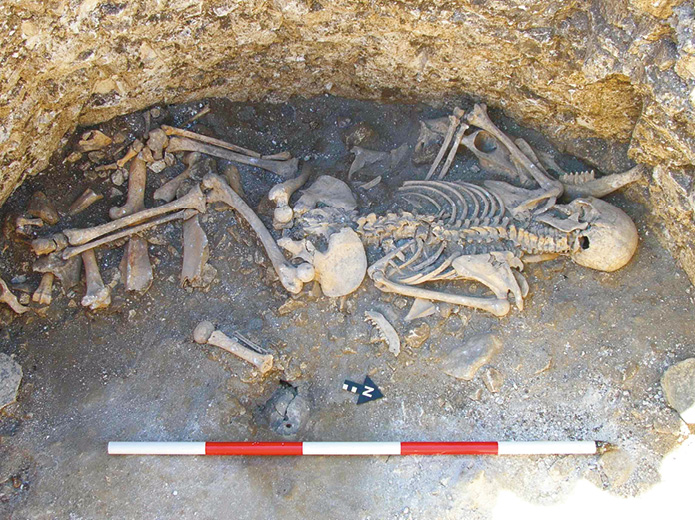
The physical placement of her remains also signposts potential human sacrifice. The skeleton was found face down on a pile of animal bones, suggesting some kind of ceremonial activity. Though canine teeth-marks on the animal bones appear to show that they were killed some time before the sacrifice victim, the bones were separated into heads, forelimbs, and hindquarters, which were arranged appropriately at the respective head and feet ends of the female burial. Dr Martin Smith, associate professor in biological anthropology at Bournemouth University, says this adds to the human-sacrifice identification. ‘Votive deposits comprising animal remains or human artefacts were commonly placed at the base of pits once they went out of use – in this instance, the human individual appears to have been part of such a votive deposit, rather than having been buried with care and respect.’
This lack of care and respect may have been a part of the woman’s life as well as her death: a fractured rib that was in the process of healing at the time she was killed suggests that some kind of physical attack took place some time before her possible sacrifice. Furthermore, although she was estimated to have died in her mid- to late 20s, the wear on this woman’s bones tells the story of a hard life at odds with her young age. Lesions on the spine, known as Schmorl’s nodes, along with arthritic growths are indicative of repetitive strenuous activity, while rugged muscle attachments likewise suggest the woman was leading a physically demanding life.
Isotopic analysis has revealed, too, that the woman was not a local – she had grown up at least 5km away from the location of her death, with a forthcoming genetic study further revealing that she was unrelated to others living at the site. This, Dr Smith says, sets her apart: ‘Generally, this was a closely interrelated community, which originated locally, and so this individual stands out as an outsider’.
However, it is unclear whether her status as an outsider was the reason this woman was killed. Indeed, the intentions behind the purported sacrifice are shrouded in mystery; the woman was perhaps offered as appeasement to subterranean gods or ancestors, or could even have been intended to continue her physically demanding life as a servant to another deceased community member in the afterlife.
Therefore, while this skeleton is an exciting find in revealing potential evidence of human sacrifice in Iron Age Britain, there is still much to learn about such practices. As Dr Smith said, ‘the find raises several questions, including how we should approach other Iron Age burials in general’, commenting that the woman may be a sign that it is time to look again at the record for this period.
Text: Rebecca Preedy / Photo: Bournemouth University