Subscribe now for full access and no adverts
Excavations near Skipsea Castle in East Yorkshire have uncovered a series of high-status early medieval buildings, suggesting this site may have been a ‘lordly centre’.
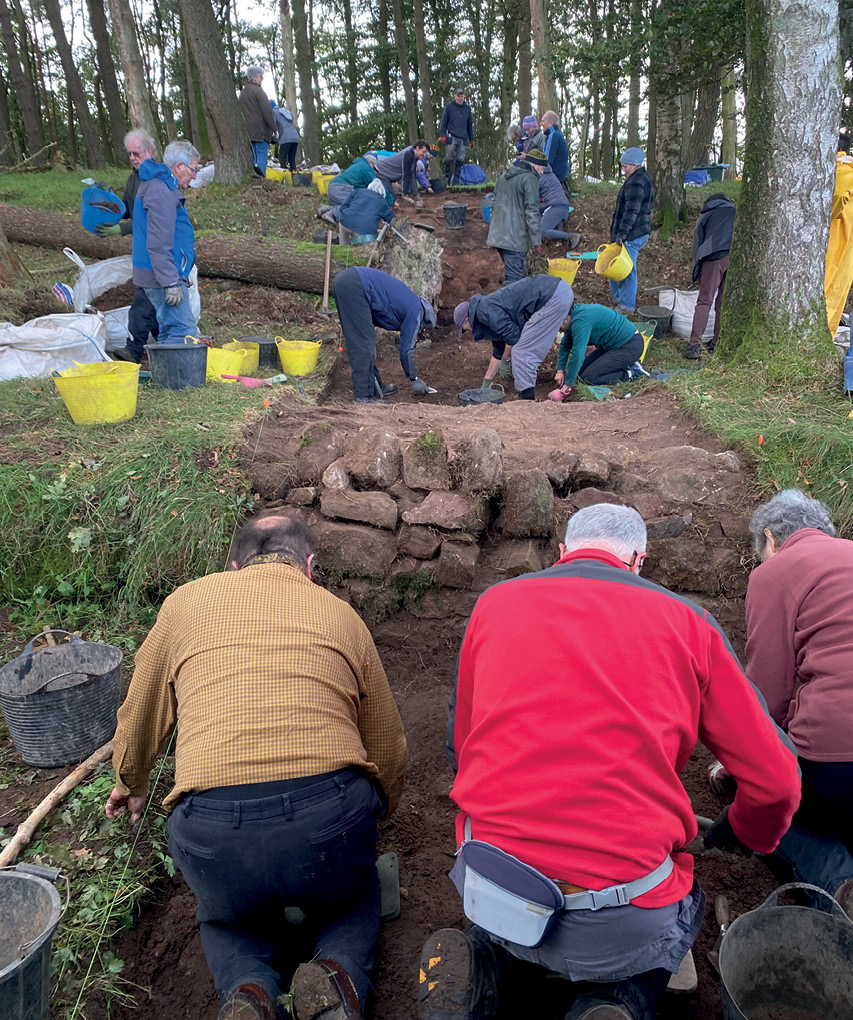
The project, which is led by Dr Elaine Jamieson and Dr Jim Leary from the University of York, has been running since 2023 and is set to run for six years in total. So far, the team have uncovered evidence of a malthouse, a large hall (see CA 413), and a timber tower in a field located about 225m (740ft) from Skipsea Castle.
The malthouse, which has been dated to AD 750-850, is represented by the remains of a long, timber-framed, wattle-and-daub building containing an oven at one end. While its purpose was initially unclear, the discovery of charred cereal grains, most of which had just started to sprout, on an adjacent clay floor has led to this surface being interpreted as a germinating floor and the oven as a drying kiln. This is only the second early medieval malthouse to be excavated in the country, the first having been found at Sedgeford in Norfolk (CA 379).
On top of the remains of the malthouse were a series of post-holes marking out the footprint of a large timber hall, measuring 6.2m (20ft) by 16.4m (54ft) (below), which was surrounded by an extensive ditched enclosure. While the exact date of this hall, which may have been used for feasting and political gatherings, is currently unknown, it clearly post-dates the underlying malthouse. Its construction, however, pre-dates that of Skipsea Castle (which was built after the Norman Conquest, albeit on a ‘motte’ that Jim and Elaine’s previous research has dated to the Iron Age; see CA 337), placing its use between the 9th and 11th centuries.

Identified nearby was a square, sunken-feature building that had been lined with timber and mortar, indicating that it was quite substantial in scale. Based on its fairly compact footprint (4.3m by 3.4m/14ft by 11ft), it is thought that this might have been the cellar of a wooden tower, perhaps a watchtower, bell tower, or even a tower-nave church.
The apparently elite nature of this site adds to its high-status history: the surrounding lands are known to have belonged to Harold Godwinson (Harold II, d. 1066), before becoming part of the estate of the Lords of Holderness. Elaine said: ‘We are about halfway through our work on the site, so there is still so much more we could potentially find that would help us reveal more about how power, industry, and daily life were organised in eastern England in the centuries leading up to the Norman Conquest.’
Text: Kathryn Krakowka / Image: University of York