Subscribe now for full access and no adverts
For the past two years, Cotswold Archaeology – led by their Senior Heritage Consultant Clive Meaton – have been working with the Tamara Landscape Partnership to survey a series of mining sites in the Tamar Valley of Cornwall and Devon, and establish a new conservation plan.
Four mining sites are being surveyed in total: Gunnislake Clitters, New Consols Mine, and Holmbush Mine on the Cornish side of the Tamar; and Gawton Mine in Devon. All are currently listed on the Historic England Heritage at Risk Register, and funding from both Historic England and the National Lottery Heritage Fund have helped to support this project, with the aim of ultimately removing these sites from the endangered list.
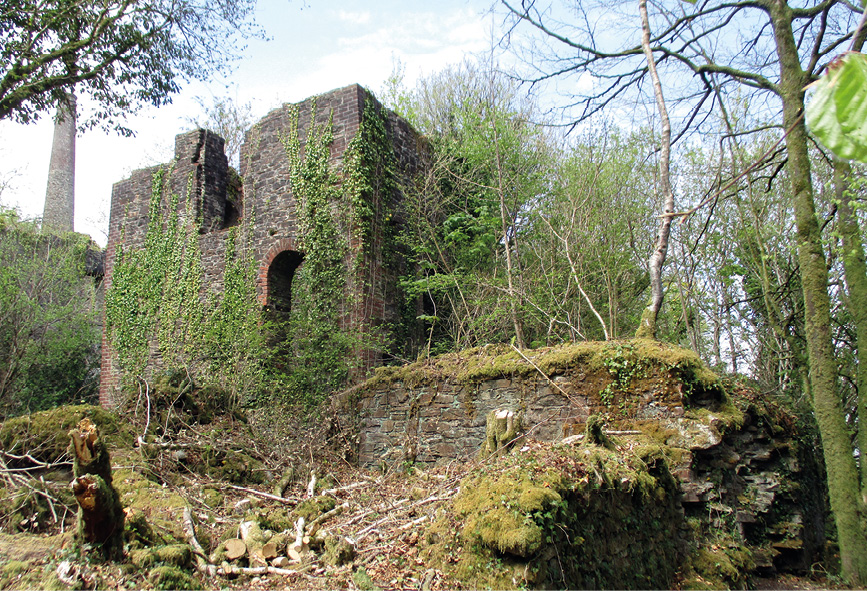
Surveying and conserving these sites is not a straightforward task, however. While during the second half of the 19th century the mines were primarily used to extract copper and tin, once these metal ores had been exhausted, operations then turned to arsenic production. Due to its toxic nature, the refinement of arsenic was a delicate process, requiring the ore to be roasted in a large oven called a calciner, with the fumes drawn out along a series of connecting flues to finally be released – ideally – as far away from people as possible. This aim was not always successful, however, as there are reports of vapours from the New Consols Mine making children at a nearby school very ill. These vapours, once cooled, also deposited crystals along the walls of the flues and chimney, with much of this residue still present – a particular health and safety challenge for the Cotswold Heritage Consultants.
In addition to the flues and calciners, many other features of the mines survive, including engine and boiler houses, storage buildings, reservoirs, smithies, mine captains’ houses, processing floors, spoil heaps, administrative buildings, and crushing- and grinding-houses. These last two structures appear to be particularly vulnerable to deterioration, as the buildings had to be constructed using a greater proportion of wood in order to mitigate the vibrations associated with their heavy equipment.
Drone and photogrammetry surveys of each site have enabled the team to create 3D models of the structures – available at https://sketchfab.com/ cotswoldarchaeology – and it is hoped that these models will be able to track how the sites are weathering, and which aspects need to be targeted first for conservation. As so much of the area has been reclaimed by woodland, conservation work can be difficult and costly, so it is also hoped that funding can be secured to make sure these mines are preserved well into the future.
Text: Kathryn Krakowka / Image: Cotswold Archaeology