Subscribe now for full access and no adverts
The latest Annual Report from the Portable Antiquities Scheme reveals that, in 2022, 53,490 finds were recorded by the initiative, including 1,378 Treasure cases – the highest ever reported in a single year. The county producing the largest number of finds was Lincolnshire with 5,101, followed by Norfolk (4,265), and then Suffolk (2,727), while the largest number of Treasure finds came from Norfolk (95), Hampshire (83), and Kent (81).
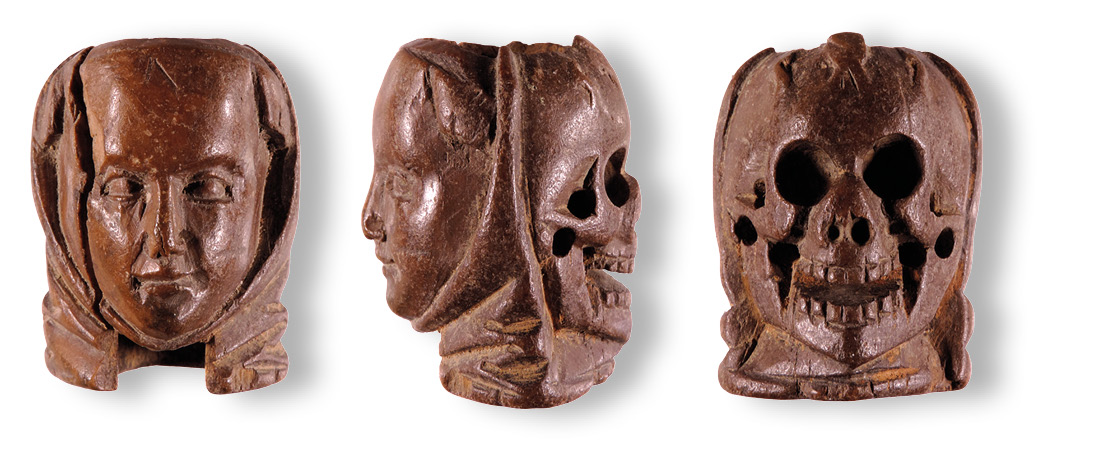
One of the most significant artefacts highlighted in the report – in fact, featuring on its cover – is a rosary bead, intricately carved in a memento mori style (above). While one side depicts the face of a young woman (thought possibly to represent the Virgin Mary), the other side features a skull, representing mortality. The bead was discovered by Caroline Nunneley while she was mudlarking on the Thames foreshore near Queenhithe in the City of London; search for LON-78B66F on the PAS database (https://finds.org.uk) for more details.
Other key finds for 2022 include a Bronze Age gold ‘dress’ fastener from Staffordshire (DENO-A4D394) and an Iron Age coin hoard found at East Garston in West Berkshire (BERK-EE5FDB). The fastener was examined by British Museum scientist Laura Perucchetti and curator Neil Wilkin, who confirmed that it was made of a solid cast with the bow-shaped body connecting two raised cone-shaped terminals. It is thought that it may have either been made in Ireland or inspired by Irish designs, reflecting cultural links between Ireland and Britain over 3,000 years ago. It is one of only seven such fasteners ever discovered in England or Wales, and is one of the best-preserved examples.
The East Garston hoard comprised 26 coins, found tightly packed inside the hollow interior of a naturally occurring flint nodule. This appears to have been a common method of coin storage during this period, as several other hoards have previously been found concealed in this way, including one from Westerham in Kent, which is now part of the British Museum’s collection. All of the coins were gold staters of a type locally produced in East Wiltshire during the late Iron Age (c.50-2 BC), with one side featuring an abstract design of crossed wreaths, and the other depicting a horse running to the right with a spiral motif above and a wheel below.
Text: Kathryn Krakowka