Subscribe now for full access and no adverts
‘You’re an archaeologist? That’s what I wanted to be when I was younger!’ Every archaeologist has heard this response when talking about their job. However, many people know little about the nature of the work underpinning archaeological research, be it conducted in the field or behind the scenes in laboratories and offices. This is now changing in Denmark, where Videnskabsklubben (Science Club) concluded the successful first run of their archaeology programme in winter 2024.
Science Club’s programmes give easy access to children interested in science and discovery. Participation is free of charge. By fostering curiosity and hands-on learning, the programmes aim to inspire young minds to explore the broader world of research and history, encouraging critical thinking and a lifelong love for discovery.
The archaeology programme is aimed at schoolchildren between the ages of 10 and 12, and is hosted at schools across Denmark. Instead of schoolteachers, a group of high-school students, who have been trained by university researchers and educators, guide the ‘mini researchers’ through a seven-week course. Rather than simply learning the year that Vikings first set sail for the British Isles or when Rome’s Colosseum was built, the focus of the programme is on the questions archaeologists ask when they study material culture, as well as the way they work in the field, offices, and laboratories to find the answers.
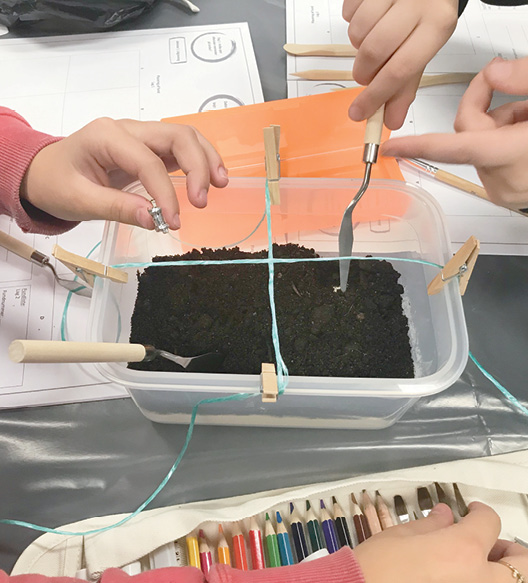
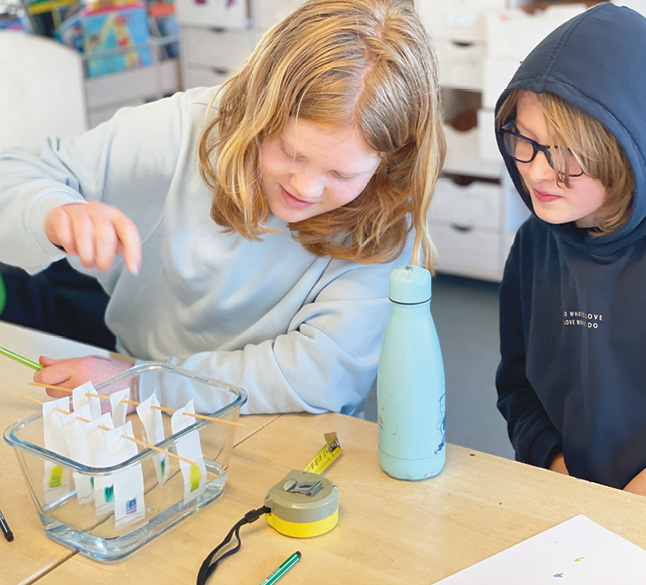
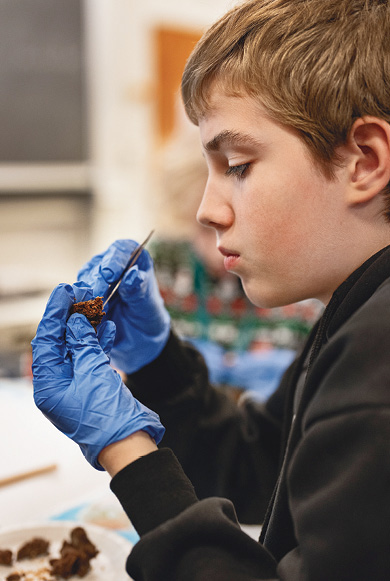
Each afternoon of teaching is structured around a question: for example, ‘What did people eat in the past?’ Based on zooarchaeological and archaeobotanical methods (the study of animal and plant remains), the mini researchers will, at the end of the day, be able to answer this question. The methodologies they are presented with and the results they come up with are then, in turn, embedded into wider contexts such as the resource management of past societies, as well as those employed today – adding awareness through a humanities-based approach. The focus of another afternoon is climate. By using annual growth rings from trees and an ice core, the mini researchers explore changing weather patterns in the past and learn how trees and ice can preserve excellent records. Instead of real ice, the layers are recreated with modelling clay, while a straw is used to extract an ‘ice core’. The study of past climates leads to discussions about how today’s climate change affects us and our environment, but it also shows the resilience of past societies when faced with shifting circumstances.
Each of the seven topics covered embraces hands-on activities and encourages the mini researchers to explore, discover, and discuss what they do and see on the basis of hard evidence. Of course, they must formulate a hypothesis at the beginning of these activities, because archaeology, like any other science, is based on questions and theories that we try to prove or disprove.
The mentors, who are volunteers from the host high schools, attend a workshop to gain the necessary skills, confidence, and tools to lead the mini researchers through the activities and discussions, while also creating an inclusive environment.
The archaeology programme was developed by researchers at the Centre for Urban Network Evolutions (UrbNet), with topics chosen based on the centre’s wide areas of world-leading expertise. As archaeology is a discipline that exists at the intersection between the humanities and the natural sciences, it is a perfect addition to Science Club’s goal of bringing science and research into the classroom. UrbNet has proven to be an ideal collaboration partner, as the centre’s research expertise covers a variety of regions, time periods, and methodologies. For more than a decade, the centre has been a leading force in contextualising cultural historical research questions in much broader debates about past and modern societies. By bringing this background to Science Club, the programme is promoting the importance of the humanities as an essential research field in a rapidly developing world, providing critical insight into human values, ethics, and culture.
DETAILS:
The archaeology programme is funded by the Novo Nordisk Foundation, the Beckett Foundation, and the Queen Margrethe and Prince Henrik Foundation. The Centre for Urban Network Evolutions is funded by The Danish National Research Foundation under grant DNRF119. For more about UrbNet, see https://urbnet.au.dk.
More about Videnskabsklubben can be found at http://www.videnskabsklubben.dk.
Text: Amy Brunskill