Subscribe now for full access and no adverts
A structure, dating to the 6th century BC, discovered three years ago by an Egyptian mission at the Temple of Buto (in modern-day Tell el-Faraeen) is now thought to be Egypt’s first and largest astronomical observatory, where priests could monitor and record the movements of the sun and stars to track time and calculate dates for royal, religious, and agricultural events across the year.
The large L-shaped mud-brick structure, covering an area of about 850 square metres, was found in the south-west corner of the temple area. It has an east-facing pylon-like entrance leading to a columned hall, inside which was a stone platform inscribed with details of different astronomical events. The team also discovered an inclined stone sundial, known as a ‘shadow clock’. This simple device, made from large limestone blocks, was the main tool used to track time, monitoring the movements of the sun’s shadow to determine sunrise, noon, and sunset.
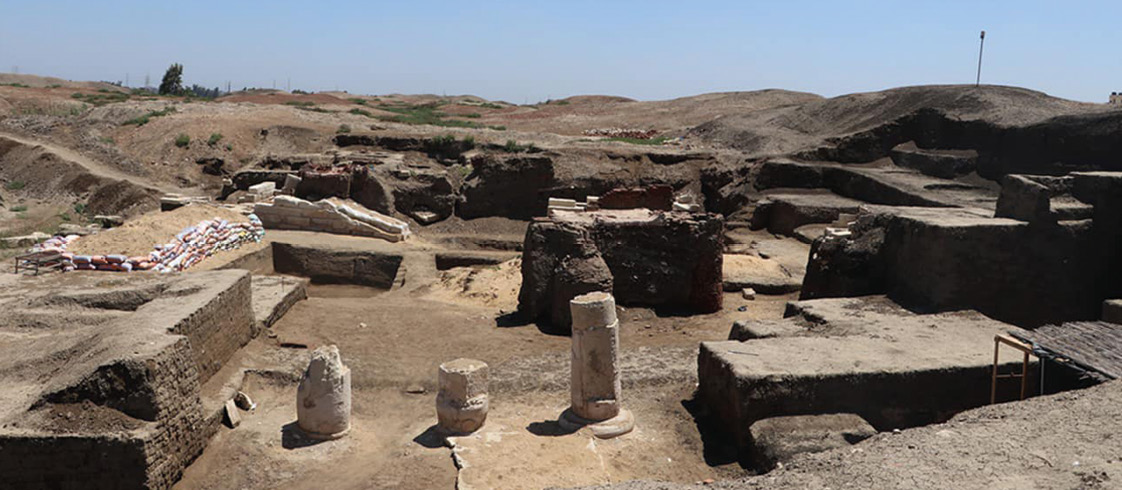
The team uncovered several mud-brick storage rooms, too, and a large hall containing a scene depicting a ritual boat with an image of Horus and a Wadjet eye – symbols of cosmic order associated with two of the main deities of Buto. Other finds include inscribed fragments, offering tables, amulets, pottery, seals, measuring tools, and the lower part of a statue of a priest holding an image of Osiris (dating to the Twenty-sixth Dynasty).
Text: Sarah Griffiths / All images: Ministry of Tourism and Antiquities, unless otherwise stated