Subscribe now for full access and no adverts
Sacred baboons
Baboons were long venerated in ancient Egypt and their mummies have been found in several cemeteries. A new study published in PLOS ONE (https://doi.org/10.1371/journal.pone.0294934) has analysed a collection of 36 such mummies from the site of Gabbanat el-Qurud, near Thebes, to find out more about how these animals were treated. The results reveal that nearly all individuals show signs of some sort of metabolic disorder, which are believed to be related to poor diet and a lack of sunlight. The prevalence of these issues, combined with the presence of juveniles and infants, and the equal numbers of male and female adults, suggests that most baboons at Gabbanat el-Qurud were born and raised in captivity. Two species are present: Papio anubis, which is known to have been imported from the Sudanese Nile Valley, and Papio hamadryas, which originated from either the Horn of Africa or the southern Arabian Peninsula. It is hoped that further analysis might shed more light on their provenance.
Coin hoard at Mohenjo-Daro
A ceramic jar filled with hundreds of copper coins has been found at Mohenjo-daro, in Pakistan, buried beneath a collapsed wall west of the stupa. The famous site, which was once an important city of the Indus Valley Civilisation (c.2600-1700 BC), was initially excavated in the 1920s and underwent further investigations throughout the 20th century, but this is the first significant find there in almost 100 years. The pot was discovered during conservation work and excavated by a team led by Director of Archaeology Dr Syed Shakir Shah. The find weighs c.5.5kg in total; the coins, which are currently all stuck together, have now been taken to a laboratory for treatment and analysis. It is suspected that they are associated with the later reoccupation of Mohenjo-daro during the Kushan Period (2nd-5th centuries AD), like several thousand other coins uncovered during the 1920s excavations.
Faces of Tartessos
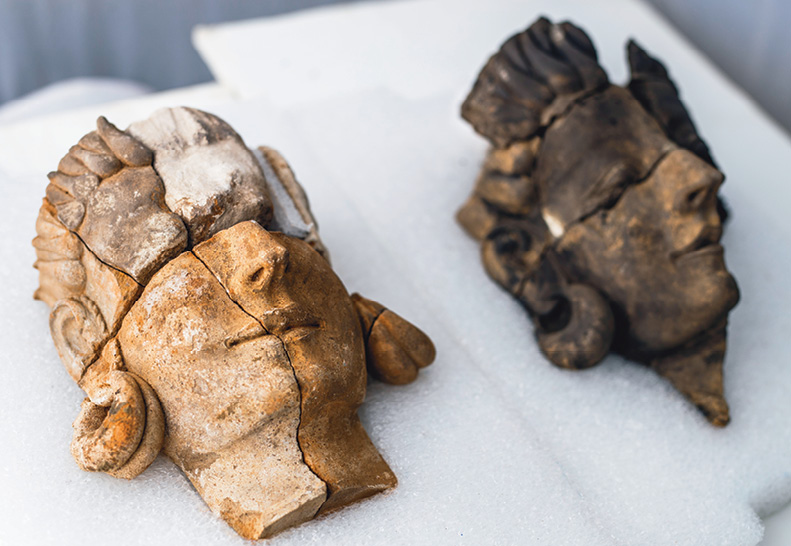
Archaeologists from the Spanish National Research Council (CSIC) have discovered five life-size stone busts created by the Tartessos people who lived in Spain between the 8th and 4th centuries BC. The reliefs, which are the first known human depictions from the Tartessos culture, were discovered in a sealed pit dated to the 5th century BC in a temple at the site of Casas del Turuñuelo in Extremadura, southern Spain. The pit also contained animal bones believed to be the result of a mass sacrifice. Three of the busts are only fragmentary, but the other two are nearly complete, and depict female figures with earrings that resemble gold objects found at other Tartessian sites. They are believed most likely to represent deities from the Tartessian pantheon: a surprising discovery, as the Tartessos civilisation was, until now, believed to be aniconic.
Text: Amy Brunskill / Image: © Samuel Sánchez (El País)