Subscribe now for full access and no adverts
Aakheperenra Thutmose II is not one of the better-known pharaohs, overshadowed by his father Thutmose I, his half-sister Hatshepsut, and his son Thutmose III. Aakheperkara, the first Thutmose, had ascended the throne c.1504 BC as successor to the apparently childless Amenhotep I. Nothing is known about Thutmose’s claim to the throne, but he may have been a descendant of an earlier king, perhaps via the mysterious Prince Ahmose-Sipair, a possible brother of Ahmose I. The length of his reign is unclear, but Thutmose I was responsible for extending Egyptian control up to the Euphrates in northern Syria, and between the Fourth and Fifth Cataracts in Upper Nubia.
Thutmose I had at least two wives, both of uncertain antecedents. Ahmose gave him two daughters, Hatshepsut and Neferubity, and another wife, Mutnofret, bore him a son, Thutmose (II). He had at least two other sons, Amenmose and Wadjmose, but their mothers are unknown. It was Thutmose II who became king on his father’s death, with Hatshepsut as his Great Wife. The length of Thutmose II’s reign, like that of his father, is also unknown, with most Egyptologists agreeing that it lasted no more than three years. The only attested events during his reign seem to be the suppression of a Nubian rebellion in Year 1, and a campaign against shasu-nomads in Palestine. A number of structures were begun at the Temple of Karnak, too.

With Hatshepsut, Thutmose II had a daughter Neferura and, with a secondary wife Iset, a son Thutmose. The latter, still only a child, became king as Menkheperra Thutmose III on his father’s death (c.1479 BC), Hatshepsut becoming regent. Seven years later, Hatshepsut promoted herself to pharaonic status, ruling alongside Thutmose for 14 years, at which point she is assumed to have died. Two decades later, Hatshepsut’s memory was attacked and her monuments mutilated, for reasons that remain a matter for debate.
The royal tombs of the early Eighteenth Dynasty
From the reigns of Thutmose III onwards, we have an almost-unbroken sequence of royal tombs down to the end of the New Kingdom, with exceptions or uncertainties concerning Smenkhkara, Neferneferuaten, and Ramesses VIII. However, before this, matters remain problematic, although it is clear that Ahmose I had a pyramid complex at Abydos, and that a plausible candidate exists for the burial-place of Amenhotep I, and also for a Theban reburial-place for Ahmose at Dra‘ Abu el-Naga, north of the Mortuary Temple of Amenhotep I. Although for a while this tomb was reattributed to his mother Ahmose-Nefertari, it is now thought that her burial place was Theban Tomb 320, the tomb that later became the Royal Cache. Therefore the attribution of the Dra‘ Abu el-Naga site to Amenhotep I is seemingly secure.

The burial site of Thutmose I, however, is more problematic. The construction is described by his architect, Ineni (TT81), and two tombs (KV20 and KV38) have been found containing sarcophagi bearing his name. But it remains unclear whether either was actually cut for him, or whether both were successive reburials, first by his daughter Hatshepsut, and then his grandson Thutmose III.
The search for Thutmose II
For Thutmose II, the situation was worse in that nothing had been found that could be assigned to him on an objective basis. A number of Egyptologists had proposed KV42 in the Valley of the Kings, but this possesses the foundation deposits of Thutmose III’s wife Meryetra, and had in any case never been used for a primary burial.
In 2022, however, all this began to change. In that year, I published a study suggesting that the Tomb of Thutmose II might lie on or near an extension of the axis of his mortuary temple (marked in red on the map opposite), which was built near Medinet Habu. This line runs through the South-western Wadis of the Theban necropolis, where the pre-kingship tomb of Thutmose II’s wife Hatshepsut (A1) had been found in 1916, as well as that of three wives of Thutmose III (D1). My proposal was on the basis that the tombs of Amenhotep I (blue), Thutmose III (green), Hatshepsut (as king – pink) and Amenhotep II (purple) all lie close to the axes of their associated mortuary temples, although such no link was apparent for later pharaohs.


That royal mortuary temples and tombs are coordinated in some way should not come as a surprise, since the mortuary temple and burial chamber had been closely integrated in the pyramid-complexes of the Old and Middle Kingdoms. In the last of the royal pyramid complexes, that of Ahmose I, the subterranean burial place had been separated from temple and pyramid by a kilometre of desert, but still lay on the axis of both of these elements, with a further part of the complex beyond it – a terraced temple against the western cliff. Thus, the first kings to abandon the old customs are highly likely to have tried to tie the burial and temple elements of their tombs together in some way. It may be noted that the temples of Amenhotep I, Thutmose III, and Amenhotep II have varying orientations, with that of the first Amenhotep having been strictly arranged north– south – as had the pyramid complexes of old. While none of the temple axes pass directly through the sites of the associated tombs, this is not a real concern, given pre-modern problems of surveying over major rocky ridges between temples and tombs. Interestingly, the deviations in the cases of Amenhotep I, Thutmose III, and Amenhotep II are all of the same magnitude, in the same direction. Thutmose II’s deviation is slightly greater, when compared with the subsequently discovered location of his tomb, and in the opposite direction. But the much greater distance involved, and the nature of the intervening terrain, makes the coordination seem quite remarkable.

Tomb discoveries
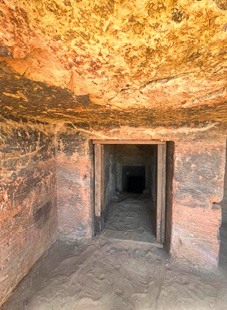
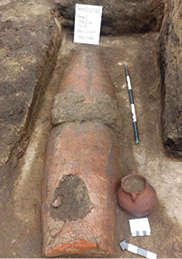
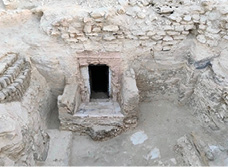
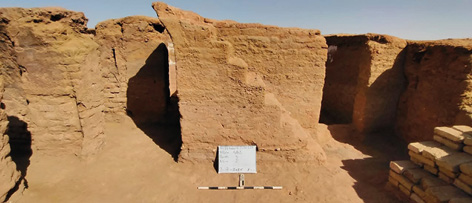
Then, at the end of October 2022, an Anglo-Egyptian team led by Piers Litherland, which had been working in the South-western Wadis for a decade, found a large tomb (C4) in what has been designated Wadi C, some 500 metres to the north-west of the Tomb of Hatshepsut in Wadi A. The new sepulchre was found while a search was being made for the foundation deposits of the nearby tomb C1, which has been proposed as that of Neferura, daughter of Hatshepsut and Thutmose II, on the basis of a cartouche on a block found nearby. The entrance to the new tomb, via a wide staircase, resembled that of Hatshepsut’s kingly tomb in the Valley of the Kings and had similarly been terribly damaged by repeated flooding.

One of the two sarcophagi found in KV20 which was originally made for Hatshepsut, but later reinscribed for her father Thutmose I. It is held in the Museum of Fine Arts, Boston. Image: Keith Schengili-Roberts, CC By 2.5 via Wikicommons
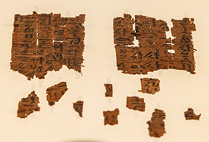
As Judith Bunbury describes in her article, the tomb comprised four chambers, three main ones, and a small storeroom. The innermost chamber had been decorated with the Book of Amduat (‘What is in the Underworld’), the composition that formed the adornment of the burial chambers of all kings from Thutmose III and Hatshepsut through to Amenhotep III, and featured in many of the kings’ tombs of the Ramesside Period.
The only non-kingly tomb to have the composition was that of the vizier User, a contemporary of Thutmose III and Hatshepsut, at which time the Amduat had not yet become exclusively royal. It began to be used more generally in private burials on papyri only from the Third Intermediate Period onwards. The material initially recovered from the tomb made it quite clear that it belonged to the early Thutmosid period; final proof that it was indeed the lost tomb of Thutmose II came during the 2024-2025 season, as well as confirmation that the tomb had been evacuated soon after the original interment, at which time a secondary corridor was cut to join the entrance corridor to the innermost chamber.

The excavation team currently speculate that, after evacuation from C4, Thutmose II’s mummy was reburied in a new tomb nearby, and have identified a site that is now being investigated. They have further suggested that the king’s body might still rest there intact
A mummy labelled anciently as that of Thutmose II was recovered from the TT320 cache in 1881, but may be too old to match what is known about Thutmose II’s ephemeral rule. The question of the age-at-death of a number of the royal mummies remains an open one, however, with (for example) the body named as Thutmose III being apparently far too young. Yet this mummy was found enclosed in the king’s original shroud, and its features closely match contemporary sculptures. Also, the final form of the name written on the coffin within which the alleged Thutmose II was found was the prenomen used by him, although altered from what may have been that of Thutmose I. This would seem to indicate that those preparing the coffin believed (rightly or wrongly) that they had the body of Thutmose II before them, and accordingly that his tomb had been robbed – and was thus not lying undisturbed in Wadi C.

Royal burials
Whether or not a further Thutmose II tomb has been found – with or without his body – the identification of tomb C4 as having been made for Thutmose II sheds important light on the history of the royal necropolis of Thebes. While the South-western Wadis had been recognised since the earlier part of the 20th century as being the burial places of royal women of the first part of the Eighteenth Dynasty, it is now clear that kings were interred there as well. Indeed, the team that discovered C4 have also found other sets of tombs of both royalty and nobility, including an important group of burials of members of the family of Amenhotep III, some two kilometres further north-west of Wadi C.

The burial of Thutmose II in this area indicates that the usual view that the Valley of the Kings became the regular burial place of kings under Thutmose I is most certainly wrong, and that switch came only under Hatshepsut and Thutmose III. Prior to the time of these two pharaohs, the choice of kingly burial place was unfixed. Ahmose I followed ancient precedent (and some Second Intermediate Period kings) in being buried at Abydos (although probably transferred to Thebes by Amenhotep I or Thutmose I), while Amenhotep I chose Dra‘ Abu el-Naga, the cemetery of the rulers of the Seventeenth Dynasty.
The consolidation of kingly burial in the Valley of the Kings coincided with the Sheikh Abd el-Qurna hill becoming the preferred place of interment for senior members of the nobility and priesthood. This was probably influenced by the hill’s location overlooking the mortuary temples of Hatshepsut and Thutmose III – whose placement seems to have been directly linked to their decision to be buried in the Valley of the Kings.

Aidan Dodson is Consultant Editor to AE magazine. He is Honorary Professor of Egyptology at the University of Bristol, and the author of Thutmose III and Hatshepsut, Pharaohs of Egypt: their lives and afterlives (reviewed here), and The Royal Tombs of Ancient Egypt (updated edition published in 2022).