
Subscribe now for full access and no adverts
Located just 2.5 miles from the present Anglo-Scottish border, Berwick-upon-Tweed in Northumberland has a long and often turbulent history. The town’s origins stretch back at least to the Anglo-Saxon period, when it probably gained its name from bere, meaning barley, and wic, most likely referring to a farming settlement involved in coastal trade. However, occupation here may have begun even earlier, possibly associated with supplying another frontier far to the north – namely, the Antonine Wall – but of that, more later.
For now, let us focus on Berwick’s medieval story. From 1018, when the border was set at the River Tweed, the town was part of Scotland, and while the impact of the Norman Conquest on the Borders is well documented, by Domesday in 1086 the growing settlement had become a prosperous and populous gateway market town and port. During the 12th and early 13th centuries, Berwick flourished further, developing as a Scottish royal burgh and incorporating religious houses and a royal mint (1153) – additions that confirmed an economic status built through the vigorous and expanding North Sea wool trade.

This success proved a double-edged sword, however. Berwick’s enviable strategic position and ready access to lucrative markets made it vulnerable, too – and in 1296 Edward I of England invaded Scotland, capturing Berwick and fortifying the town with a curtain wall and tower defences that can still be seen in places today. Incredibly, the town would change sovereignty a further 13 times before finally being secured by the English in 1482, doubtless causing two centuries of unimaginable disruption in the lives of Berwick’s inhabitants.
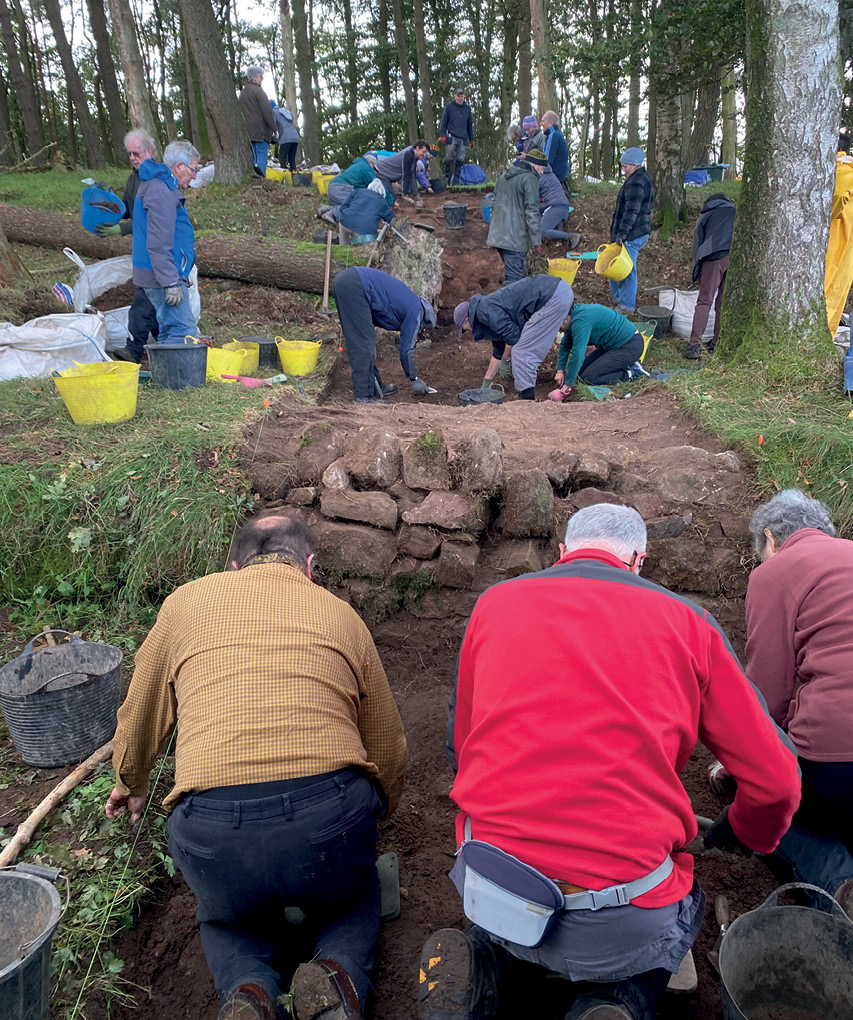
In recent years, large-scale excavations carried out by Cura Terrae have shed vivid light on these experiences, and how Berwick was defended at a time of bloody Anglo-Scottish frontier wars. Undertaken ahead of the construction of a new hospital by the Northumbria Healthcare NHS Foundation Trust, our fieldwork has unearthed a stunning array of archaeological remains. The site’s potential quickly became clear when evaluation trenches produced a complete medieval pot, wall foundations, rubbish pits, burgage plots, and trackways, prompting a fuller investigation of the entire area. What followed, between April 2021 and July 2022, was Berwick’s largest and most enlightening archaeological excavation in the modern era – and, while post-excavation analysis of our findings is ongoing, intriguing insights into a previously poorly understood period of the town’s past are already emerging.
Digging the defences
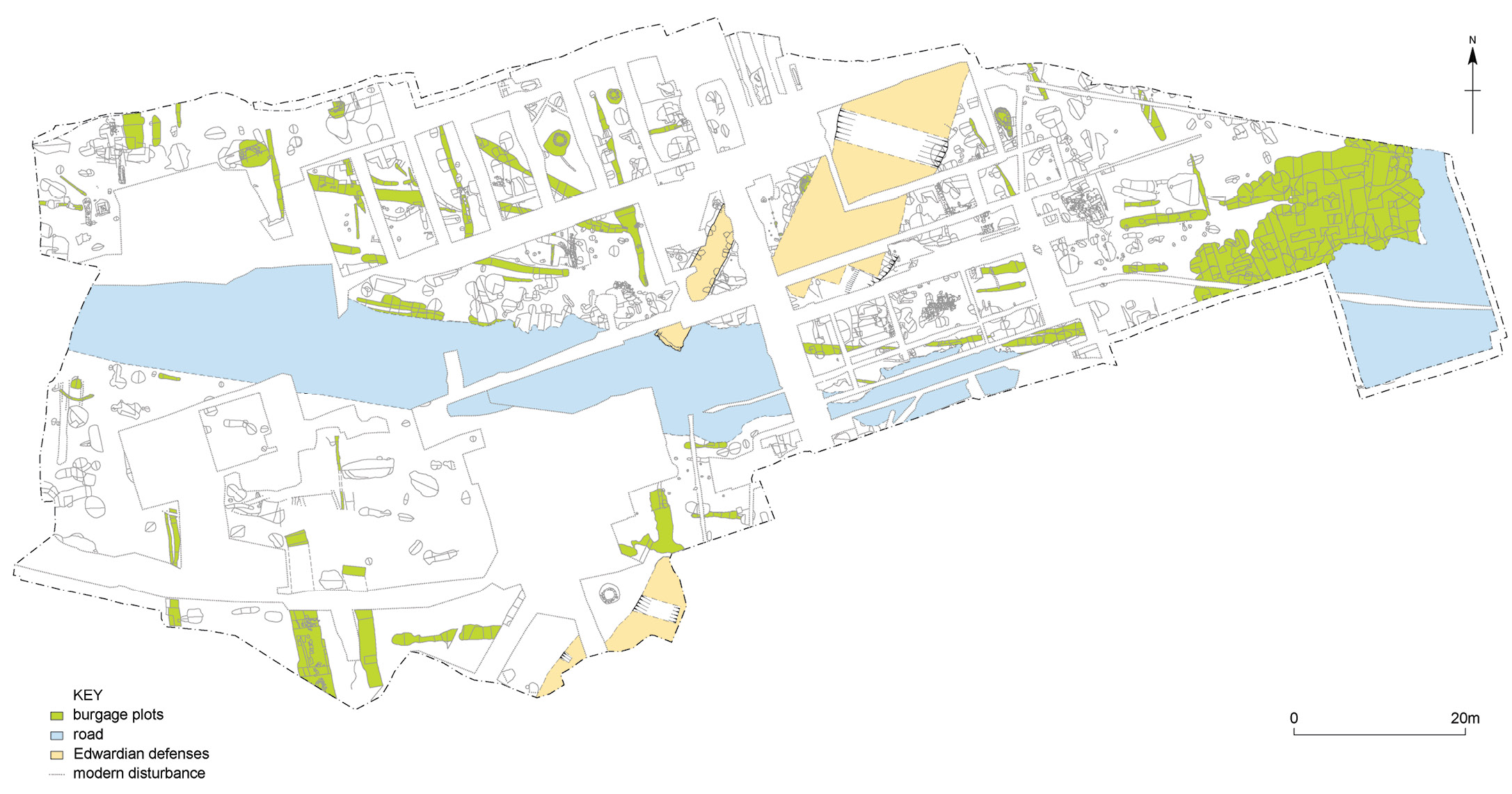
The infirmary site lies within the circuit of Edward I’s town walls – and, remarkably, our investigations exposed a previously unknown section of this late 13th-century stronghold. Comprising a 3m-wide wall and a parallel 12m-wide ditch, these features may represent an outer bailey of the castle, or an additional circuit of defence within the walled town. These surprise discoveries are of considerable significance, adding to our understanding of the town’s development during a particularly violent and chaotic historical era, and we hope that analysis of material recovered from these features will afford further insights into the character of these defences, while scientific dating will place them in a more precise historical context.
Contemporary with the Edwardian defensive layout, we also uncovered a c.120m stretch of one of the main east–west routeways connecting the castle with Edinburgh. Within our excavations it survived as a slightly curved trackway, 6m wide, with ditches running along each side. It was flanked by burgage plots that may have been occupied from the 12th century or even earlier; some of them were subsequently built over during construction of the new defensive features.
Another dramatic shift in circumstances came during the Elizabethan era, when the site clearly underwent an expansive programme of reconfiguration and fortification in the trace italienne style, responding to the development of heavy artillery. These structures were sited on top of the earlier Edwardian defences on the south, west, and east sides of the town, but to the north the circuit was reduced, leaving the infirmary site outside its embrace. There, the earlier medieval settlement was abandoned, and the area, now known as The Greens, became marginal to the newly fortified Elizabethan town.
Evidence of occupation
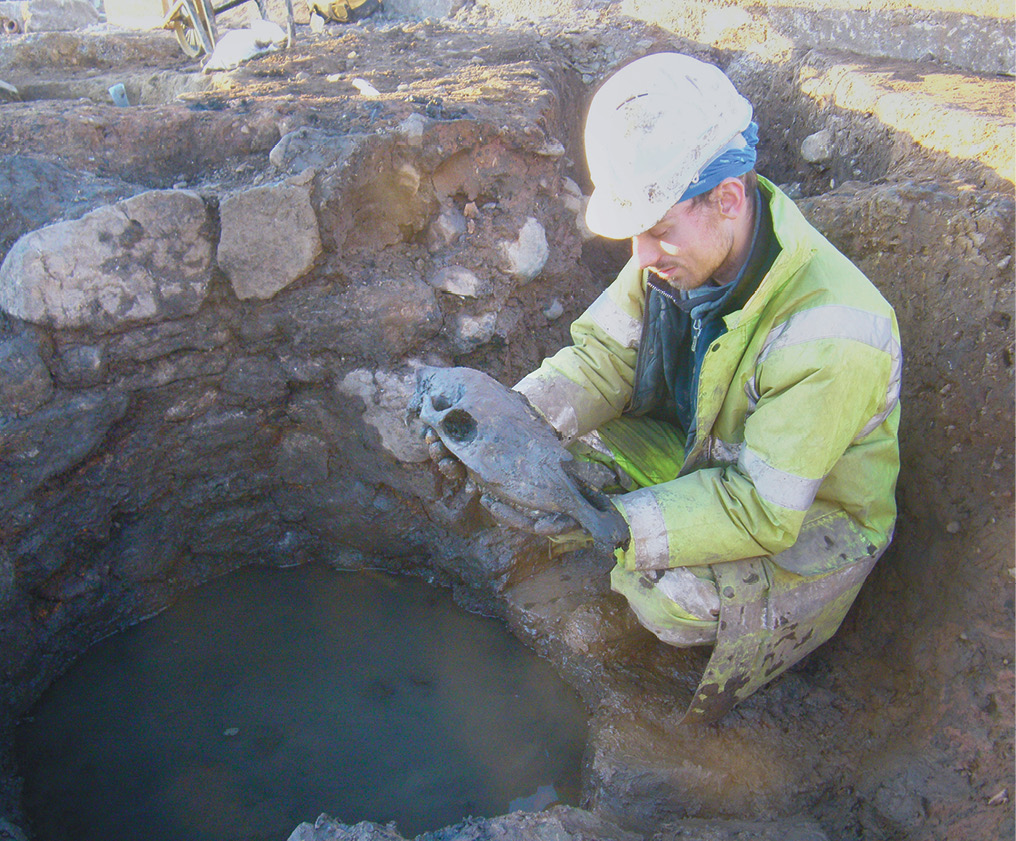
What can be said about the occupants of this first intra-, then extra-mural zone? The burgage plots were associated with a number of draw wells, a buried barrel that had been repurposed as a latrine, and a kiln, and these, together with the area’s numerous pits and boundary ditches have yielded a treasure trove of evidence for how the land was used. Recovered artefacts speak of small-scale industrial processes, animal husbandry and butchery, marine fish-processing, grain-malting to produce beer, leather- and wood-working, and animal horn processing. We have counted more than 18,000 sherds of medieval pottery spanning the reigns of Edward I to Elizabeth I, giving an indication of how densely occupied the site had been. Dominated by Scottish white gritty ware, but also containing smaller amounts of some potentially earlier types (notably Northern gritty ware), this assemblage offers an invaluable opportunity to help refine pottery typologies, vessel origins, and chronologies for these poorly understood regional wares.
Other medieval finds include personal ornaments like brooches, pins, and buckles, as well as more practical items including household utensils and tools, horseshoes, and six padlocks. Waterlogged deposits have preserved fragments of leather, including the remains of shoes, and possibly textiles, and it is hoped that these wet contexts may also produce environmental evidence to tell us more about the local economy and the landscape in which medieval Berwick lay. Meanwhile, possible human waste has been recovered from the barrel latrine, analysis of which may provide direct information about the diet and health of the town’s population at this time.
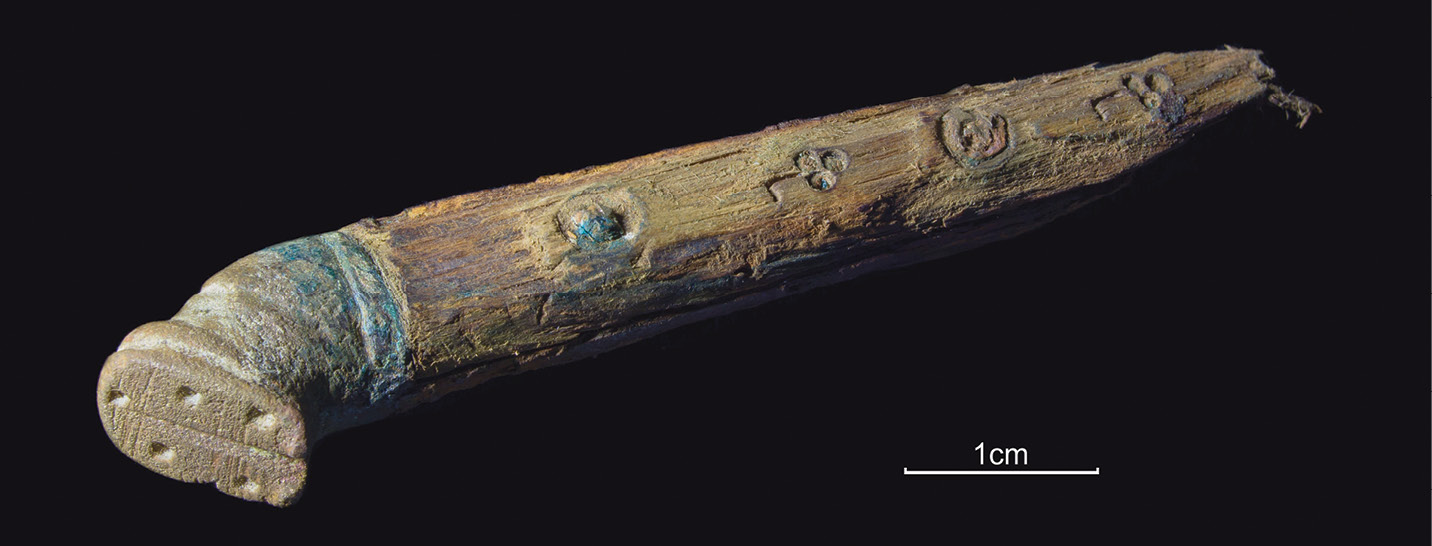
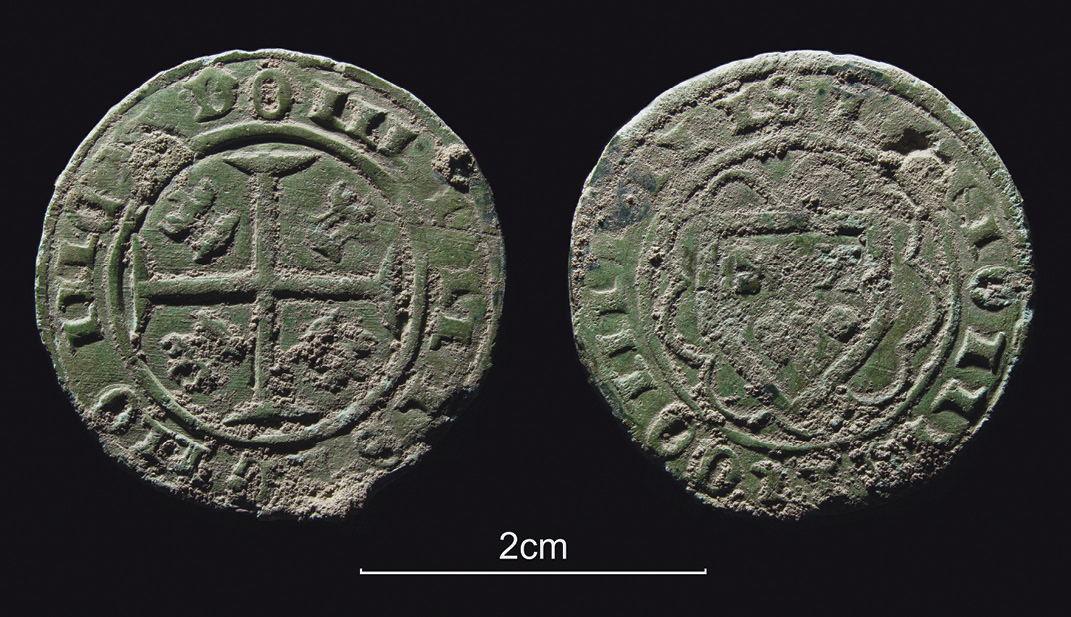
As might be expected from Berwick’s historic international trading connections, links to the Continent were evident among our finds. They included a jetton, or accountancy token, which had been minted in Tournai (now in Belgium) c.AD 1497-1521, as well as a late 15th- or 16th-century decorated knife handle. This latter artefact has a distinctive hoof-shaped endcap – a design that was influenced by Flemish cutlers. Sherds of two medieval anthropomorphic jugs represent a very characterful style that was popular across medieval Europe (see CA 358 for more about medieval ‘face pots’), whereas a silver penny minted in 1174-1195 for William I of Scotland reminds us that there were two sides to the sovereign conflict over Berwick, with fluctuating fortunes experienced on both sides of the disputed frontier.
Pushing the boundaries
Although medieval archaeology represented the most substantial remains uncovered during our investigations, it was not only material of that period which emerged from the infirmary site. Our team discovered fleeting traces of prehistoric activity, too: seven finds in all, in the form of two worked flints, a stone object, three waste flakes from flint-knapping, and a single sherd of pottery. All of these were apparently residual finds recovered from chronologically later contexts, but they nevertheless offer interesting insights into a largely unrecognised period of Berwick’s past, long before the town was founded.

Roman finds were rather more prevalent, with 132 pottery sherds recovered from pit fills and medieval or later contexts. Despite the residual nature of these finds, they are deemed to be regionally important. Initial assessment of the fragments suggests that they may date to the mid-2nd century, something that could suggest a Roman presence on the north bank of the Tweed, possibly dating to the Antonine period, and potentially military in character (the make-up of the assemblage is unusual for a rural site). While further analysis is required to understand these finds fully, and thereby the nature of the settlement that they might represent, it is tempting to interpret them as echoes of much earlier occupation than the town’s known early medieval origins, perhaps with a role in the Roman system of military supply and communication to the Antonine Wall. If so, they could add interesting information to our understanding of Roman pottery supply to the north of Hadrian’s Wall.
Berwick’s modern community has played an important role in our investigations as well. There has been considerable local media coverage of the project during the excavations, and the people of Berwick and surrounding regions have been generous hosts who have enthusiastically attended open days and presentations. We are particularly grateful to the Northumbria Healthcare NHS Foundation Trust, whose representatives have made this work possible; it is certain that recent discoveries will elucidate the story of medieval Berwick and promote the history and archaeology of Northumberland to a national audience. To this end, we are planning a range of community-engagement events including the production of school learning packs to support the study of History at Key Stage 2.
Above all, our medieval discoveries have provided invaluable evidence for understanding how the town developed, and what daily life was like for its medieval population. Berwick’s fortifications are a key aspect of the town’s identity, so the discovery of a previously unknown portion of its medieval defences is an intriguing development – establishing a fuller understanding of the date and function of these new features will add greatly to our knowledge of the history of this heavily contested border town.
Post-excavation analysis of the finds is now under way; we plan to publish the results of the excavation in fuller form at a future date, and will bring you an update in CA to tie in with the release of this monograph – watch this space!
Source: David Fell is Operations Director for Cura Terrae.

All images: Cura Terrae