Subscribe now for full access and no adverts
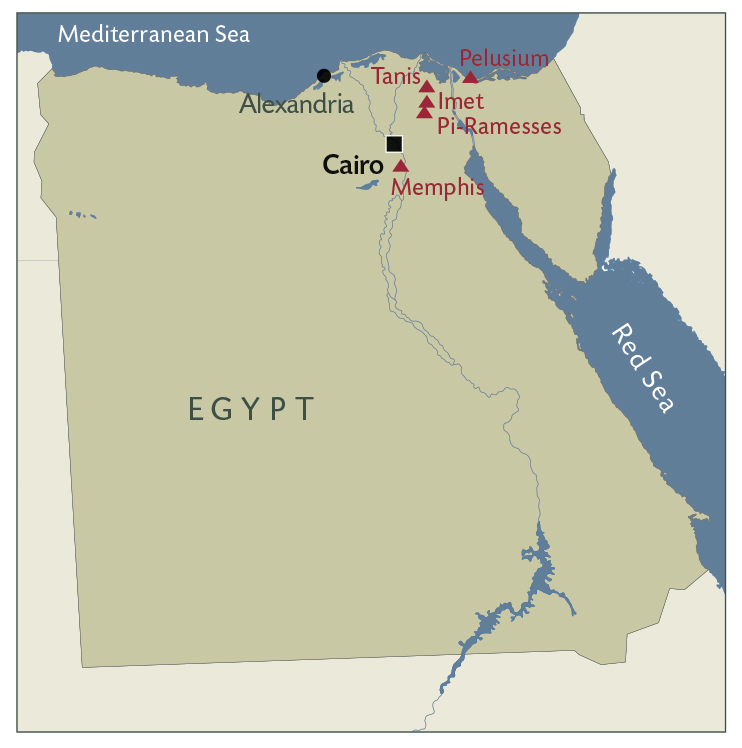
They call them ‘turtle-backs’. No more than gentle sand hillocks, these modest mounds occur naturally in the Nile delta. Back in the days of the annual inundation of the river, such knolls assumed a new prominence when they were periodically transformed into islands. The lands around them, meanwhile, were left blanketed in fertile silts after the flood waters receded. Unsurprisingly, many of the ancient Egyptian cities founded in the delta were perched on top of these sandy knolls, allowing them to take full advantage of the agricultural opportunities bequeathed by the river, while also avoiding immersion themselves. As the mud-brick forming most of the structures in these settlements degraded and was built over, so too these turtle-backs grew higher and higher, developing into fully fledged tell sites. Today, one of these is known as Tell Nabasha. It lies in the eastern part of the delta, and has been partially subsumed by agriculture and the town of el-Hosayneya. Although the site lies about an hour and a half from the coast using modern transport, it was once connected to the Mediterranean via the Pelusiac branch of the Nile: a major navigational channel. It was also home to Imet, a prominent city in the region.
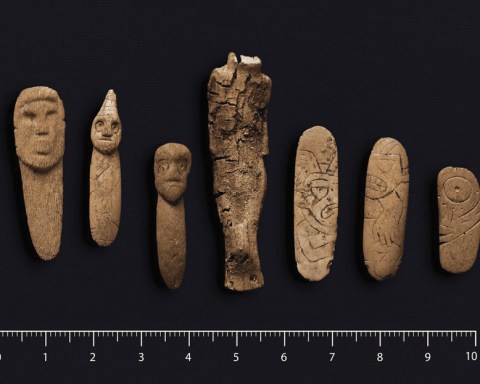
In the ancient world, Imet enjoyed renown as the main cult centre of Wadjet. This powerful deity was the goddess of Lower Egypt, and was depicted in various guises. Sometimes she was styled as a lion-headed woman, but more often Wadjet appeared as a coiled cobra, ready to strike. It was in this form that she featured as one of the ‘Two Ladies’ on the crowns of the pharaohs, alongside the vulture representing the goddess of Upper Egypt. As well as rubbing shoulders with the highest in the land, Wadjet dominated religious life at Imet. Surviving texts speak of an annual festival when a great gilded statue of Min-Osiris – Wadjet’s consort – would be driven around the city in a chariot, while the goddess’ potency drew pilgrims to the site. Many were attracted by Wadjet’s association with fertility, and left offerings of figurines, in the hope that the goddess would help them to conceive. While such details conjure a vivid impression of the temple in its pomp, until recently rather less was known about its death and afterlife. The end of ancient Egyptian religion is often linked with the spread of Christianity, a time when monks chiselled away those elements of the ancient imagery that they found particularly troubling. Now, though, ongoing excavations are painting a very different picture of the end of the temple, and the nature of life in and around its shell.

Burials and beverages
‘The name “Imet” probably refers to both the city and a wider territory, a bit like modern Luxembourg,’ says Nicky Nielsen, senior lecturer in Egyptology at the University of Manchester and director of the Tell Nabasha Project. ‘It appears in textual sources as far back as the Old Kingdom (c.2575-2125 BC), with some of the earliest mentions preserved in 5th Dynasty tombs known as mastabas. These texts talk about the “wine of Imet”, and that makes a lot of sense, as wine production seems to be something of a feature of this super-fertile region. Thanks to the archaeology, we also know that the site is likely to have been occupied in some way, shape, or form from an even earlier date. Some of the earliest finds from the area are Early Dynastic graves. These were discovered back in the 1970s, when they were digging the foundations for a new school and found a number of burials. They belong to the 1st and 2nd Dynasties (c.2950-2650 BC), and again that makes sense. We know that there were some really big Early Dynastic settlements and cemeteries within a 50km or so radius of Tell Nabasha. Clearly there was a lot of activity in the area. What we don’t have is any solid evidence for settlement at Tell Nabasha dating to this period. In fact, we don’t really have evidence of settlement before the Late Period (c.664-332 BC). It must be there, but I suspect it’s buried so deep beneath the layers of later buildings that it’s probably going to take us a life-time of digging even to get close to it.’
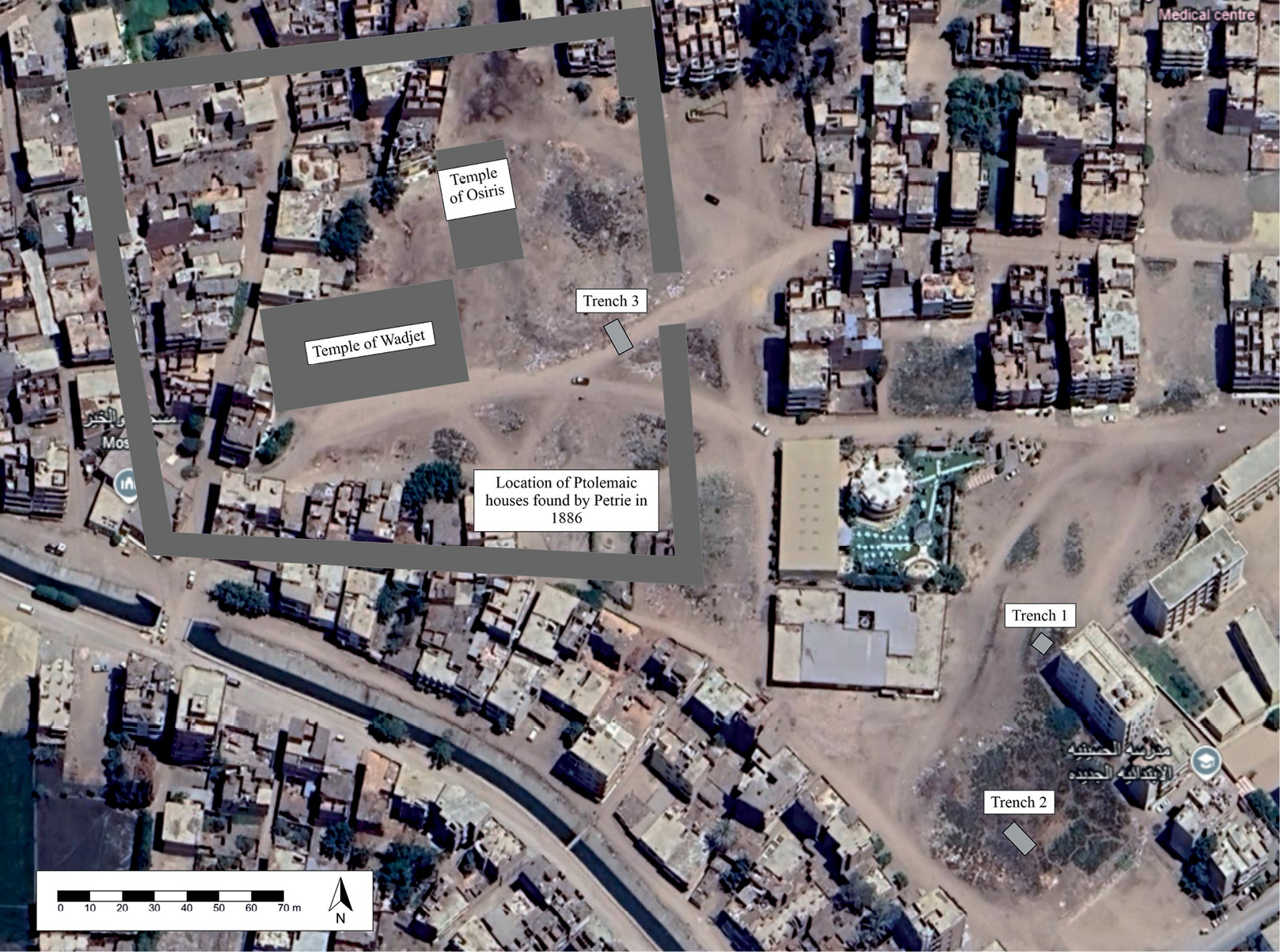
The site of Imet has been attracting study for over 200 years. One early visitor was Jean-Jacques Rifaud, whose initiation into Egyptology came via an unorthodox route. In 1807, Rifaud was press-ganged into the French army and sent to fight in the Napoleonic Peninsular War. Once he reached Spain, though, he fled and spent 15 years in the eastern Mediterranean, on the run from his desertion charge. While there, he became captivated by the archaeology of Egypt, and worked – oddly enough – for the French Consul General, a military veteran. In 1825, Rifaud’s interest took him to Tell Nabasha, and he wrote a couple of pages about it in a subsequent book. He did not undertake any digging, though. Instead, it was left to Flinders Petrie to become the first real excavator of the site in 1886. His involvement came about by chance, after he overheard a conversation among some of the workmen digging for him at nearby Tanis. They were discussing a big stone that was standing in fields to the south, so Petrie visited on the off-chance that it was something interesting. His curiosity was rewarded by the upstanding remains of a monolithic shrine erected by Pharaoh Amasis II (c.570-526 BC). Suitably encouraged, he initiated four months of digging.

‘It was a typical Petrie excavation’, says Nicky. ‘He identified three areas of the site: the temple area and the temple itself, a big cemetery containing thousands of graves, and the settlement. Because he was hunting for sculptures and statuary, he basically said, “Well, there isn’t going to be anything worth anything in the settlement. So I’m going to excavate the cemeteries and the temple.” He was only at the site for about three weeks. The rest of the time, he left the excavations in the hands of his assistant Francis Griffith. Meanwhile, Petrie toured around the delta looking for other archaeological sites and even getting into trouble with the police who were a little confused about this random British guy on a donkey in the middle of nowhere.’
After Petrie’s involvement at Tell Nabasha, there were periodic excavations at the site. These were often led by the Egyptian antiquities authorities, in response to the burgeoning city of el-Hosayneya incrementally encroaching on the archaeology. The Egypt Exploration Society also visited the site in the 1980s, as part of their survey of sites in the delta. More recently, it was fieldwork at Pi-Ramesses, a major New Kingdom settlement about 15km from Imet, that prompted a new programme of work: the Tell Nabasha Project.
‘I was working at Pi-Ramesses in 2014,’ remembers Nicky. ‘I’d read some of the reports about Nabasha, and I’d read Petrie’s book about it. And I hadn’t really put it together that it was the same site. So, on a day off, we basically jumped in the back of a pickup truck and decided to go and have a look at it. And as we were walking across the tell area, the whole place was absolutely littered with Late Period pottery. By that, I mean fully preserved vessels. There were enormous amounts of stuff just lying on the surface. There was even a Late Period mud-brick wall that was literally sticking out of the side of the tell. We quickly realised that Petrie hadn’t found everything. We also worked out that, by complete chance, the ancient settlement is the part of the site that is best preserved today, and, of course, that was the area that Petrie largely ignored, too. So we thought that we could fill in that gap in our knowledge.’
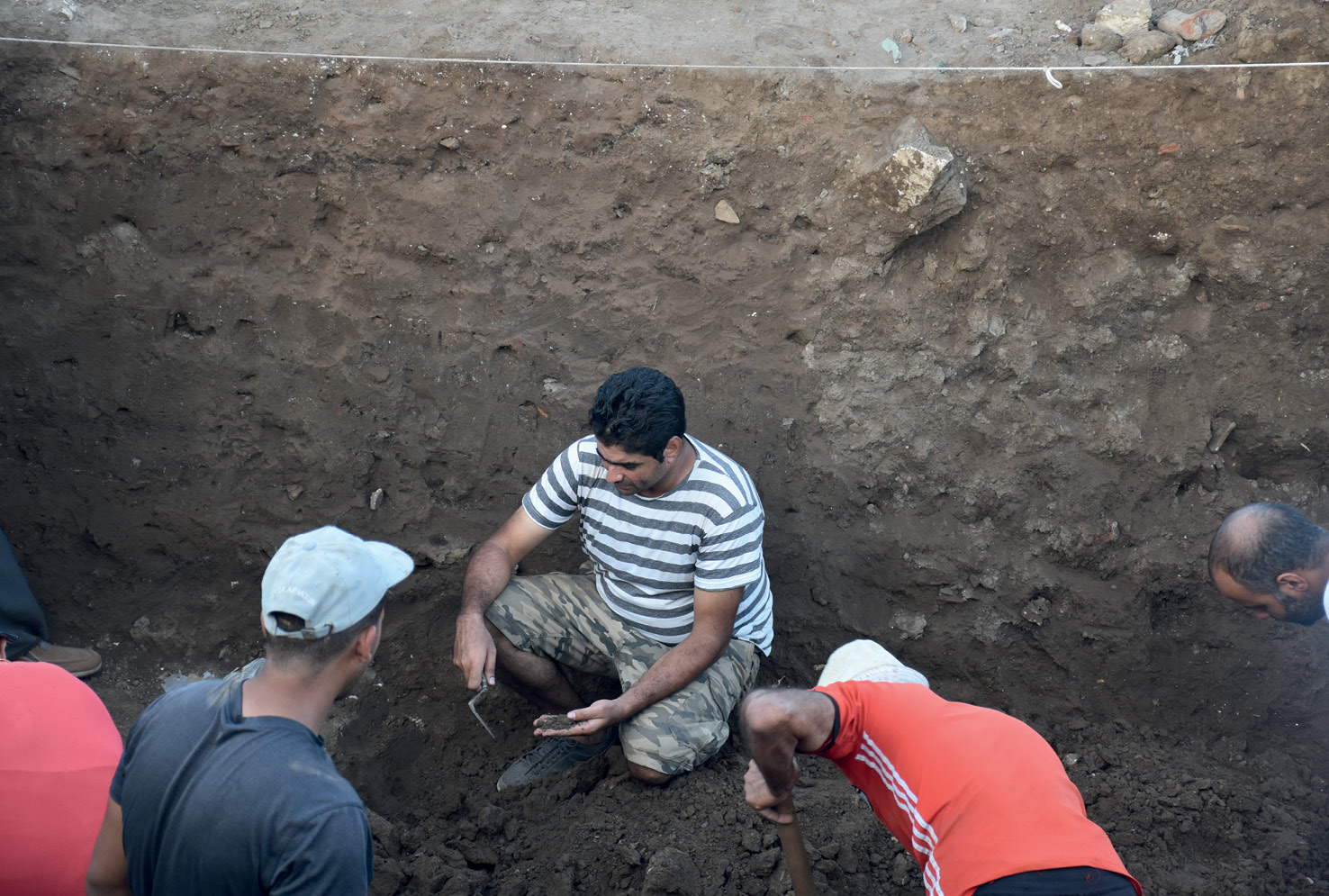
Excavations were undertaken in 2015, followed by a remote-sensing survey in 2017, and further digging in 2024. As part of this, trenches were opened in both the temple of Wadjet compound, and areas of the settlement lying roughly 100m distant. These revealed that the site had suffered from looting, especially during the upheaval following the 2011 revolution. During that period, a highly organised gang targeted the area where Petrie found most of the statues. As well as using a mechanical digger, they had a group of people working by hand, and there are even signs that they wet-sieved their spoil to ensure they did not miss anything. Such was the scale of the devastation that the Tell Nabasha Project archaeologists tackling the looters’ backfill initially despaired. Eventually, one of the Egyptian excavators pointed out that they could use the cuts made by the mechanical digger to work out where it had been parked, and open a trench there, as it would not have dug under itself. Sure enough, that approach allowed the team to strike intact archaeology.


Delta dwellers
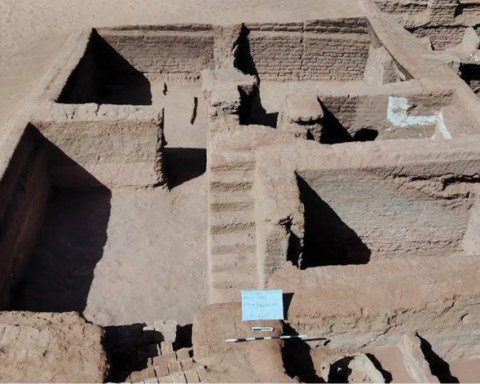
When it came to seeking the remains of the mud-brick structures forming residences in the ancient settlement, a type of vegetation known as halfa grass proved to be a boon to the team. This is because the remains of the mud-brick walling present a more nutritious habitat for the plant than the surrounding earth, prompting greater growth. Thanks to this, variations in the density of halfa grass allowed the walls of ancient structures to be traced on high-resolution satellite images. Among the findings were the remains of a tower house, built around 400 BC, with walls about 1.2m wide at the base. Such structures are typical of the Nile delta, where the annual floods limited the ways in which cities were able to grow.
‘You have to create a type of architecture that expands upwards rather than outwards,’ says Nicky. ‘That’s why tower houses were so popular in the region. It allowed you to have multi-generational families living on a fairly small footprint, because the house could keep rising upwards. There is some evidence that when a child got married and needed their own place, they would simply add another storey to the tower house. It’s kind of genius, really. Funnily enough, in el-Hosayneya, where we were staying, a lot of the modern apartment blocks also have unfinished roofs. The beams are just left pointing upwards. So I asked our landlord, who’s a structural engineer, why this is. He said, “Well, it’s because they just add another storey when the family expands. Then you can gift your son or your daughter a new flat.” And that’s funny, because it’s exactly the same principle, even though the modern inhabitants no longer need to worry about the Nile flooding.’
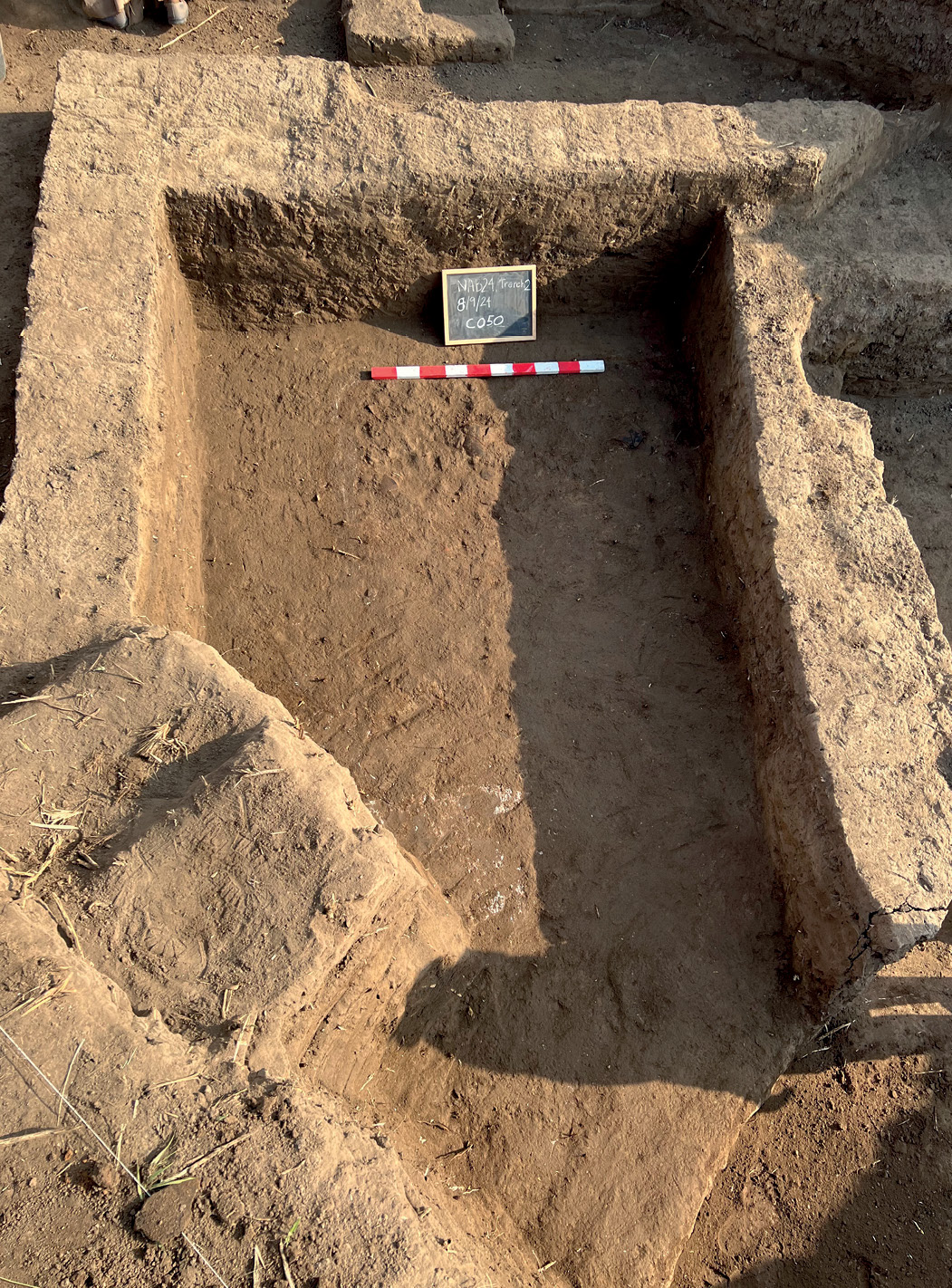
Ancient Egyptian tower houses were usually associated with satellite structures, and in this case animal pens and a grain-processing area were found nearby. Activities also took place in narrow streets that were only about 80cm wide and ran between the tower houses. The height of these structures made these alleys a valuable area of near-permanent shade, except when the sun was directly overhead. Among the ancillary structures, the grain-processing area was notable for being paved with irregular limestone and granite slabs. This stood out, because one thing that cannot be found in the delta is stone. Instead, the nearest natural source lies about 50 miles away on the edge of the desert. Lifting some of the slabs in the grain-processing area, though, revealed that this stone had been found rather closer to hand: portions of temple relief decoration were preserved on the other side. Another of the paving stones was round, revealing it was part of a sawn-up pillar. Clearly, then, parts of the Temple of Wadjet had been recycled to make the floor. This fits well with the results of the recent excavations in the temple precinct, which show that the main temple had fallen out of use by about 400 BC. That places its demise in what is known as the Late Period (664-332 BC), and more specifically an era when the Persians had conquered Egypt. The abandonment of this temple and the pilfering of its stone had, then, occurred long before the advent of Christianity.

Another intriguing set of finds associated with the tower houses were cooking pots that still lay where they had been placed on fire pits, as well as bread platters that had been put out for leavening flatbread. Undertaking bucket flotation on the contents of one of the pots revealed tilapia bones, suggesting it was a fish stew. Curiously, though, these were mixed in with mammal bone fragments, most likely from sheep. Today, a dish combining such ingredients would be considered unconventional.
This stone had been found rather closer to hand: temple relief decoration was preserved on the other side.
‘I’ve been having some interesting conversations with a colleague about whether this could be an ancient stockpot,’ says Nicky, ‘sort of like a Viking stew, which they would keep going all through the winter by continually adding in whatever they had to hand. So, if they had a little duck, they’d chuck it in; if there was some fish, in it went, and so on. It makes you wonder if this is essentially providing basic flavouring for whatever flatbread they were baking, so they could dip it in, and it wouldn’t taste quite as boring. I think it gives you a real insight into the ordinary people living there. Not the ones who could afford to build enormous tombs with biographical inscriptions, but the 95% of the population that we know next to nothing about.’
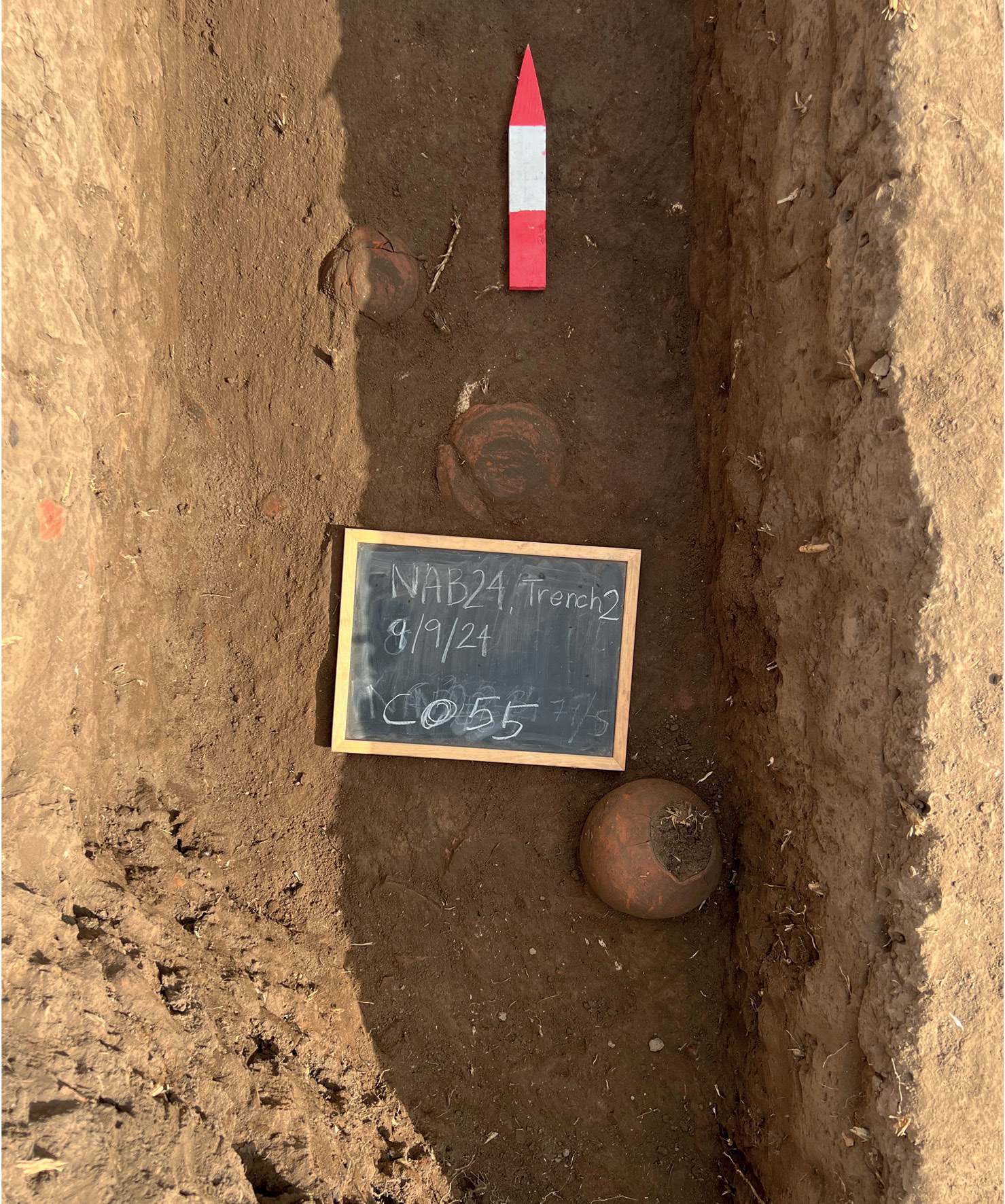
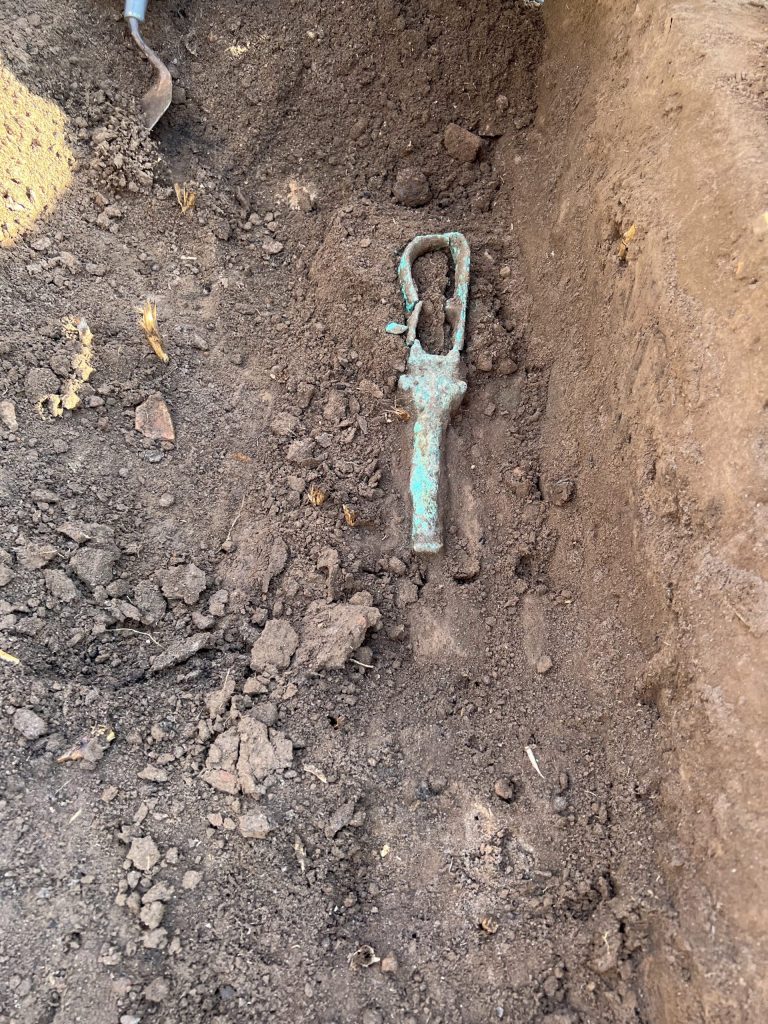
All of this invites questions about why the food had been left uneaten in the first place. ‘Everything seems to suggest that the site was abandoned pretty quickly,’ says Nicky. ‘We found a whole set of completely new, beautiful, ceramic bottles that have been left stacked outside the house entrance, where they were eventually crushed when the building collapsed. There were also the remains of a bronze sistrum – that is, a ritual rattle used in temples – which had been stored in one of the upper storeys and came crashing down with the house. It’s a valuable object, not the sort of thing that you’d normally leave behind. We were pretty lucky, because one of the other things that had been crushed under the house was a Southern Aegean mushroom-rim amphora, which can be dated pretty accurately to about 350 BC, or possibly a little later.’
‘By then, Egypt had been occupied by the Persians for about 100 years. And it had created more or less permanent civil war and rebellion, because the ancient Egyptians didn’t like the Persians at all. All of this ended with the invasion of Alexander the Great in 332 BC. And Tell Nabasha is basically on a straight shot between the border fortress of Pelusium – which we know Alexander passed – and Memphis, which is where he was going. So I wonder if the settlement was abandoned in a rush as Alexander was advancing. We always tend to view Alexander’s invasion of Egypt as positive, because the Egyptians seem to have been genuinely quite happy to see him, simply because he wasn’t the Persians. And the whole thing was pretty bloodless. At the same time, what would the people in the delta have heard about Alexander before he arrived? He’d recently butchered 6,000 people at Gaza and sold another 20,000 into slavery in Tyre before he reached Egypt. So, would you sit there and hope that he was in a good mood when he came past your town? And, frankly, an army of thousands of hungry soldiers is usually terrible news for civilians, whatever mood the soldiers are in. I wonder if that’s why the settlement was abandoned so quickly? Or maybe there was some other catastrophe or episode of civil strife during this turbulent time?’

Village of villas
After the death of Alexander, one of his generals – Ptolemy – famously established a new dynasty in Egypt. During this period, there was something of a resurgence at Imet. Petrie found a village of high-status villas within the former temple enclosure. Now, excavations on the line of the processional route between the main temple and the entrance to its precinct have revealed that another high-status Ptolemaic building was constructed in the early 2nd century BC, right on top of the former sacred thoroughfare. As well as boasting column emplacements that are more than a metre wide, the building had a thick floor that was created by repeatedly applying limestone plaster, apparently over a relatively short time period. This seems to have been geared towards hygiene, with a new layer of plaster being applied after people got tired of cleaning the old surface. What this desire for a pristine surface was in aid of remains unclear, but the strongest options are that the structure was either another villa, or an imposing public bath suite.

A rather less substantial find from the site must have entered the archaeological record in either the late Persian or early Ptolemaic period. It is the broken head of a shabti figurine: one of the statuettes that were placed in tombs to serve the deceased in the afterlife. ‘We found him in a sort of midden, at the bottom of a hill, near the tower house,’ says Nicky. ‘There was also a mould for making shabtis. My theory is that there was a production centre for shabtis on the top of the hill. You could fire 400-500 of them at a time in a big kiln, and some of them would break. I think our one was a misfire, and they literally just threw it or swept it away down the hill to a bit of the site that had – by then – been abandoned. I really like it, though, because we know that Petrie found a lot of shabtis at the site when he was excavating the cemetery. There were so many that he got really frustrated with them. He writes in his diary that he hated shabtis, because they were turning up by the hundreds and thousands. It got so bad that he started plugging rat holes in his house with broken shabtis, because there were just so many of them.’

Something else that Petrie found was evidence for a catastrophic fire that gutted the Ptolemaic villas, extinguishing activity at Imet once more. Although the site was reoccupied in the Roman period, this new settlement seems to have been a fairly low-status village that gradually petered out. All the signs are that by the end of the Roman period, the tell where Imet once stood was little more than a turtle-back once more, with only some standing monumental stonework and scattered finds testifying to its former glory.
Further reading:
N Nielsen, H Hussein, D T Nikolova, M Tichindelean, and K Thomsen (2024) ‘Preliminary report on the 2024 autumn season of the Tell Nabasha Project’, Egypt and the Levant 34: 67-117.
All images: courtesy of Nicky Nielsen