Subscribe now for full access and no adverts
Just how long has humanity been exploiting rainforests? There can be a popular tendency to see such habitats as essentially pristine wilderness, little troubled by our knack for adapting the environments that we call home. When we picture early activity by Homo sapiens in Africa, for instance, it is often bands of hunters stalking big game on grassy plains of savannah that spring to mind. While it is easy to imagine the more intrepid members of such groups frequenting the margins of the rainforests, their depths are typically seen as a very different prospect. The dense vegetation, high rainfall, and less abundant big game appear symptomatic of an environment that was far harder to master than rolling plains.
Until recently, this perception was a good fit with the available dating evidence. The earliest human activity that had been detected in African jungle was just 18,000 years ago – comparatively late for a species that has been around for roughly 300,000 years. Looking at the world more widely did little to dispel the impression that rainforest was hardly humanity’s habitat of choice, with the earliest possible dates from the jungles of Asia running to 73,000 years ago. Even so, there were grounds to wonder if these results were in part a reflection of modern archaeological practices. After all, the same poor visibility so often seen as a barrier to early human activity also hinders modern archaeological site-prospecting. It is well established, too, that rainforest in Africa could either expand or retract and fragment in response to shifts in climate. As a result, finding a stone tool in a modern rainforest offers no guarantee that the area was already jungle many millennia ago when the implement was being used.

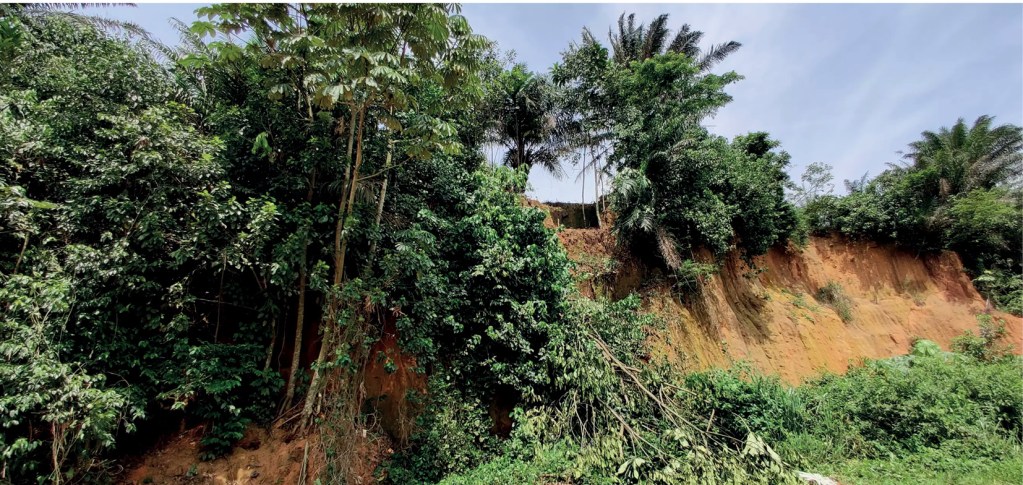
Such considerations mean that any attempt to seek out early activity in African rainforests requires a very special kind of site: one where stone tools, dating materials, and environmental evidence are all preserved. A candidate for just such a site was identified near Anyama, in the Côte d’Ivoire, in the 1980s. There, two geologists noticed deeply stratified layers in a cliff-section that had been exposed by a river, and felt that the find would be of interest to archaeologists. The site became known as Bété I, and was investigated from 1982 to 1993 by a joint Ivorian-Soviet mission, led by the Ivorian Palaeolithic researcher François Yiodé Guédé at the Université Félix Houphouët-Boigny. The team excavated a step trench to a depth of 14m, and recovered a wealth of stone implements from several layers. The dates of these tools, though, and the nature of the environment when they were deposited, remained uncertain.

An interrupted survey
It would be more than 25 years before an archaeological team returned to Bété I for fresh fieldwork. ‘The project has a long history,’ says Eleanor Scerri, from the Max Planck Institute of Geoanthropology. ‘Back in 2014, I started a project in Senegal, in West Africa. As that developed, I got a position in Germany with a research group. Part of its scope was to expand the work across West Africa more widely. One of my goals, as I was putting together a team, was to find out how far back human habitation in the rainforests went. I am not by any means the first person to think of this question, but it has proven to be a very hard one to answer. That was when I came across a brief review in English about the site at Anyama; the formal site report had been published in Russian. After that, I looked into what had been found there in more detail, and decided it was a place that we had to return to. So I wrote to the Leakey Foundation, seeking funding for a project focusing on Anyama.’

After funding was secured and preparations had been made, the field team assembled in the Côte d’Ivoire, where they planned to spend five weeks investigating the site. Events, though, rapidly intervened. The excavations were scheduled for March 2020, and the archaeologists’ expectations of what could be achieved changed abruptly as the world began to lock down in response to the COVID-19 pandemic. ‘We spent a couple of days meeting people at the university, as well as local landowners, and the mayor of Anyama,’ remembers field-team leader James Blinkhorn, from the University of Liverpool, ‘just to make sure that we would be able to spend the next month working there. We were hoping to expand the original excavations, collect new stone tool assemblages – something that was partly necessary because the original specimens had been lost during the 2011 civil war – and take new approaches to recording the lithic technology. Then things rapidly evolved over the course of a weekend, and we went from thinking “Oh yes, we have some time to do an excavation” to “The international team members need to fly back to Europe as soon as possible”. Obviously, that curtailed what we could achieve. But what we did manage to do was clean back the existing trench created during the work in the ’80s and ’90s.’
‘We were in the field with Professor Guédé, who led the earlier work at Anyama, and even included it in his PhD, so he knew the site well. Over the course of the last 25 years the key section in the original trench had reverted to forest, but we were able to return – in a very short space of time – the top 5m-6m to the way it looked in the original excavation photographs, with lots of nice, clean sediments. It was clear that there were artefacts in the section, in exactly the layers where they had been described by the Ivorian-Soviet team. There were even one or two bits of artefacts sticking out of our section, but with only a single day of work available, the responsible choice was to leave them there and hope we could come back later. Instead, in a very hectic morning, we took lots of sediment samples for every kind of analysis I could imagine. By 2pm that afternoon, we were fighting the traffic near Abidjan, the capital, and by 7pm we were at the airport waiting to fly home. So we didn’t have time to complete all of our original goals for the season, but we did come away with everything that we’d need for a new chronological study of the site, and to undertake palaeoenvironmental analysis.’
The value of this material was destined to prove even greater than originally expected. Hopes of being able to pick up work at Anyama once more and complete a full season of excavation were dashed because the site was destroyed when a nearby aggregates quarry was extended. Any understanding of the age of the layers containing stone implements, and the nature of the environment at the time, therefore depended on unlocking the information held in the samples secured in 2020.

When it came to the challenge of establishing dates for these samples, the team turned to Eslem Ben Arous, a geochronologist at the Max Planck Institute of Geoanthropology. ‘I joined the project in October 2020,’ Eslem says. ‘In West Africa, we don’t have many options for materials that we can date. For example, we don’t have bones, or volcanic material that we could apply well-established scientific dating techniques to. Because we were extremely constrained by this, I decided to apply two semi-independent dating methods: Optically Stimulated Luminescence (OSL) and Electron-Spin Resonance (ESR). OSL and ESR are based on the same physical principle, which is detecting the energy represented by electrons trapped into mineral. So for the OSL measures, we are using light stimulation to quantify this energy, while for the ESR we are using a magnet to measure this trapped energy.’
‘It was not easy to get a precise result. But we adapted the method again and again to refine the dates and reduce the uncertainties. These were still quite high with the ESR, but because it was overlapping with the OSL results we could say clearly that the samples belonged to a particular date range. So, in the end, this double-method-based approach succeeded and provided very meaningful results for the chronology of the site, which were quite amazing. They place the oldest samples associated with stone tools at approximately 150,000 years ago, which was also important because that made it the earliest dated site of any kind in West Africa. It was exciting to be able to fill that gap.’
Reconstructing the environment
The scientific dating, then, made it certain that the site was more than twice as old as the earliest previous dates for human activity in rainforests, but was Anyama jungle at the time? Here, too, the 2020 samples came up trumps. The palaeoenvironmental material contained within them clearly demonstrated the nature of the local habitat during the critical period. This information came from a number of complementary lines of evidence, including isotope and leaf wax records that point to species favouring a wet, seasonally submerged landscape. That fitted very well with the nature of the fine clay sediments making up the layer, which were formed in wetland conditions. At the same time, phytoliths – that is, microscopic traces of minerals found in certain plant tissues – indicated the presence of jungle. The biggest clue, though, came from plant anthers, which are the pollen-producing parts of a flower. While pollen itself can be carried some distance on the wind, anthers are not. Instead, when they are shed, the anthers tend to drop to the ground directly below the plant. At Anyama, there were several examples of anthers from key rainforest species – such as Hunteria and oil palms – in the layers associated with stone tools. Without doubt, then, the site lay within wet tropical forest 150,000 years ago. What is more, a shortage of grass pollen suggests that this was not the fringes of the forest, but instead lay some distance from the nearest savannah.
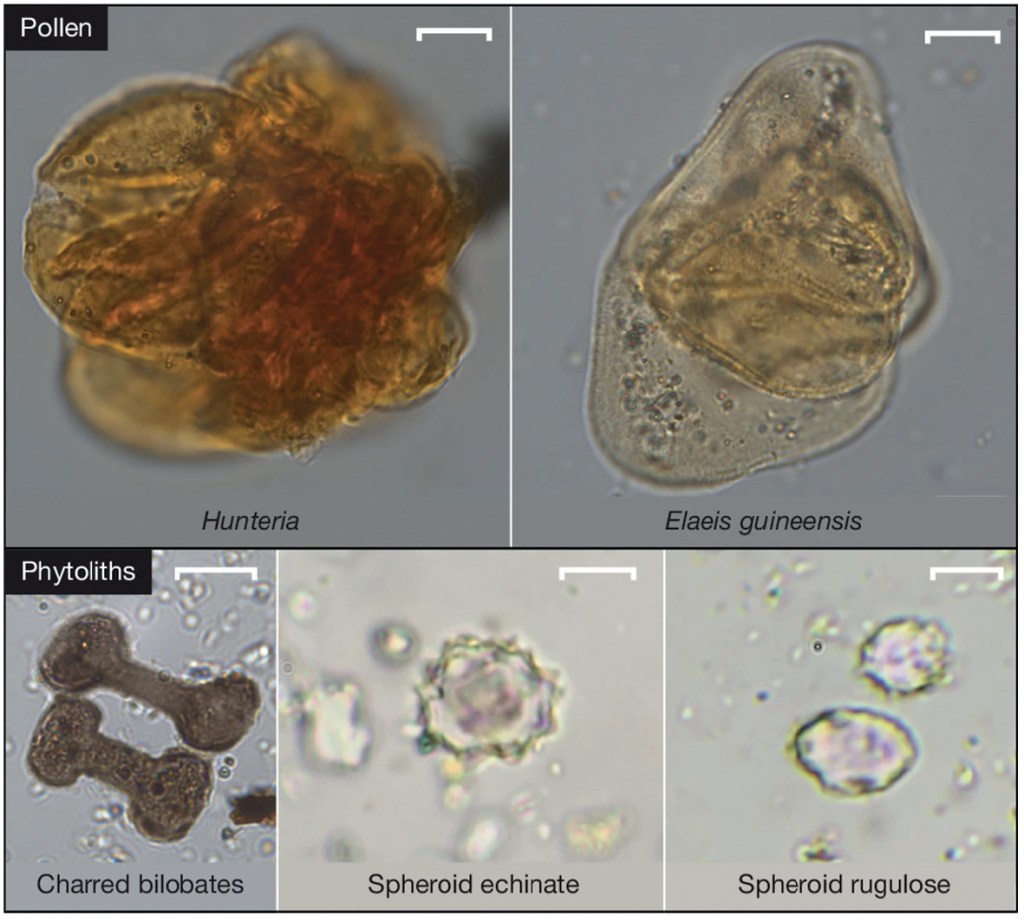
The stone tools may also reflect the environment they were used in. Fortunately, the examples recovered in the 1980s and 1990s were extensively published before the assemblage was lost in 2011. All of the implements were made of quartz, which was presumably selected because it was the only lithic resource naturally occurring in the wider region. While the general nature of the objects fits well with examples from sites in Senegal, which have now been dated by Eslem to a similar period, the Anyama implements do display some unusual features. While they belong to a Middle Stone Age tradition in the sense that there are flakes and cores, there is also a large tool component, including particularly robust, axe-like implements. Such large-cutting tools are known in Sub-Saharan Africa, but nothing comparable has been seen elsewhere in West Africa during this period. Could it be, then, that they had been specially adapted for use in the rainforest, or were they tools for a variety of uses not exclusively confined to forest environments? While the evidence does not allow anything specific to be said about the precise range of activity under way at Anyama, the evidence for a wetland environment does provide one clue about what might have tempted humans into this habitat. In tropical environments, mangrove lagoon habitats can be a very rich source of accessible food.

The chronology that has now been established for Anyama demonstrates, too, that the human presence at the site was not a one-off visit. Instead, it is absolutely clear that people returned intermittently over thousands of years. In which case, it is natural to wonder whether the date of 150,000 years ago – while stunningly early from a modern perspective – will always be considered surprising. ‘I don’t think so,’ says Eleanor. ‘We know that there were more stone tools in layers just below the ones that we took samples from at Anyama. We did that purposefully to be conservative, but the implication is that the deeper tools will be earlier, so I wouldn’t be surprised if the dates for activity in such environments one day go back before 150,000 years ago. Another reason for thinking that comes from the nature of the stone tools: if they had been adapted to a rainforest environment, then clearly the people using them were not the first arrivals. These were people who had already had time to experiment. To be sure, though, we will need to find a new site to investigate. Anyama was fairly unique for its combination of sediment depth and preservation conditions. Finding a site like that again is definitely going to be a challenge.’
Further Reading: The results of this research have been published as E Ben Arous et al. (2025) ‘Humans in Africa’s wet tropical forests 150 thousand years ago’, Nature 640: 402-407.