
Subscribe now for full access and no adverts
Born in c.AD 390, Flavius Aetius exemplified in his youth the new kind of warrior defending the Roman Empire in the 5th century. His father was a high-ranking soldier of barbarian blood who married into a wealthy family from the Italian peninsula. Because of his family background, Flavius was sent as a boy to the court of Alaric I, king of the Visigoths, as a hostage. Later, at the age of 20, he was again submitted as an imperial hostage, this time to the Huns. It turned out to be a tremendous break for him, because it allowed him to study the Huns at close quarters and to learn the secrets of the warrior people he would eventually have to face in battle.
Dwelling beyond the Danube, and never having settled on imperial territory, the Huns had not been Romanised to the degree of other Germanic barbarians. The court into which Aetius was delivered was thus far removed from the Mediterranean palaces he had enjoyed in his youth. The Huns were a Turkic confederation of tribes, comprising many central Asian and eastern European peoples. They fought in the manner of all Eurasian horsemen, placing a special emphasis on archery. To Aetius, this would not necessarily have been as alien as it was to other Romans or Germans. His father, Gaudentius, now dead, had come from Scythia, and maybe it was Sarmatian and not Germanic barbarian blood that pumped through his body.

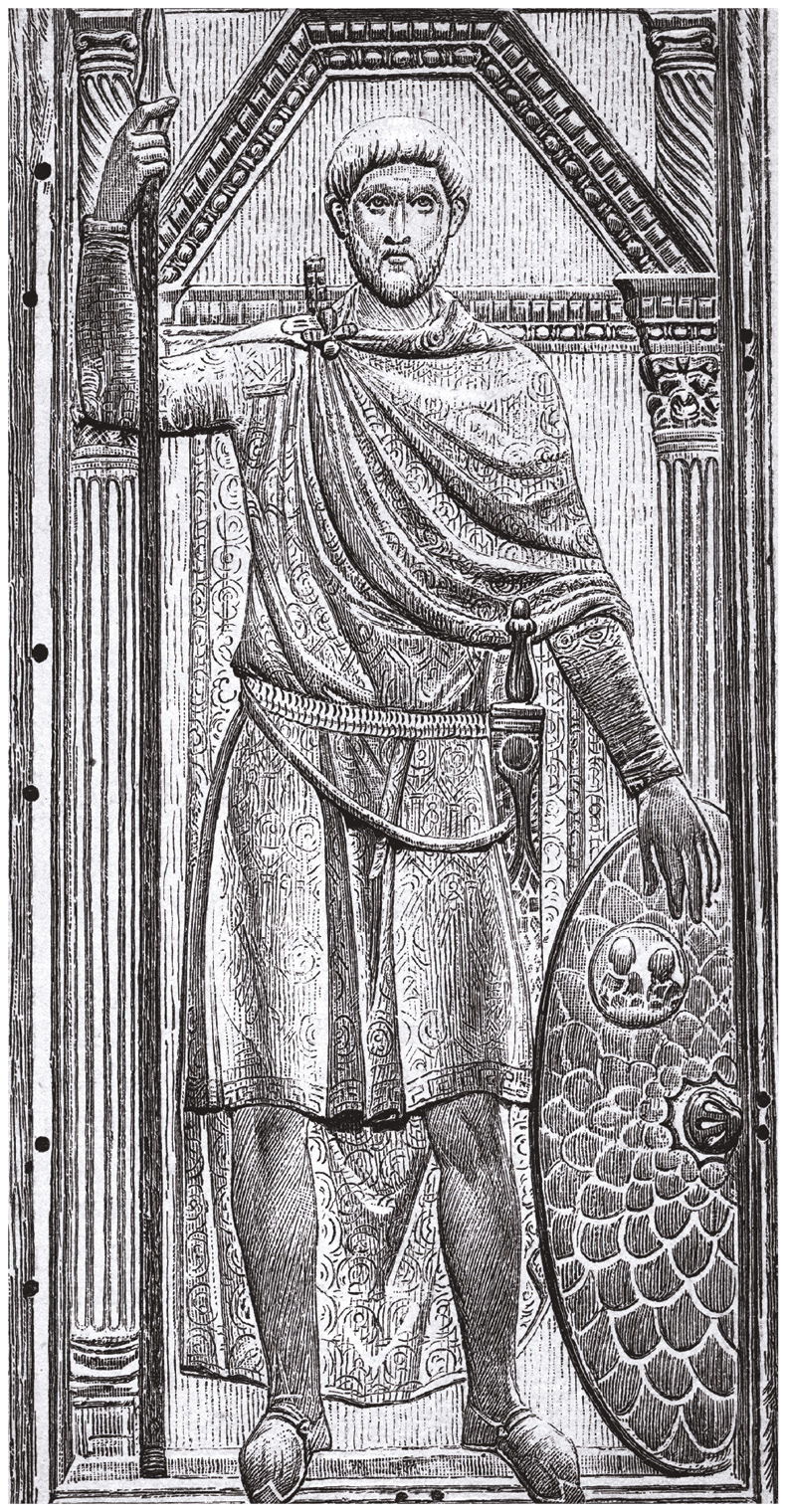
In the company of Hun horse-archers, Aetius developed a high level of horsemanship and handled both lance and bow expertly. Later chroniclers remarked specifically on these skills acquired among the Huns. ‘His intelligence was keen and he was full of energy,’ wrote the 5th-century historian Renatus Frigeridus, ‘a superb horseman, a fine shot with an arrow and tireless with the lance.’ On the plains of Hungary, Aetius also learned the ability to withstand hardship. ‘He bore adversity with great patience and was ready for any exacting enterprise,’ continued Frigeridus. ‘He scorned danger and was able to endure hunger, thirst, and loss of sleep.’ Aetius’ hardship among the Huns earned him a reputation for toughness that gained him the respect of common soldiers.
In the second decade of the 5th century, the Huns were ruled by a king known as Charaton. It was at his court that Aetius became acquainted with the leading warriors of the horde. During feasts, Hun noblemen were fascinated to hear him recount his experiences with Alaric and the Visigoths during the sack of Rome in 410. On hunting expeditions, Aetius may even have exchanged words with a similarly ambitious young man by the name of Attila. It was Aetius’ association with the older members of the horde, however, that was to prove invaluable in the future. He was securing a friendship with the Huns that would provide him with real military power. They were supposedly the most terrible of all the barbarians, but Aetius knew them as drinking partners.
Imperial enforcer
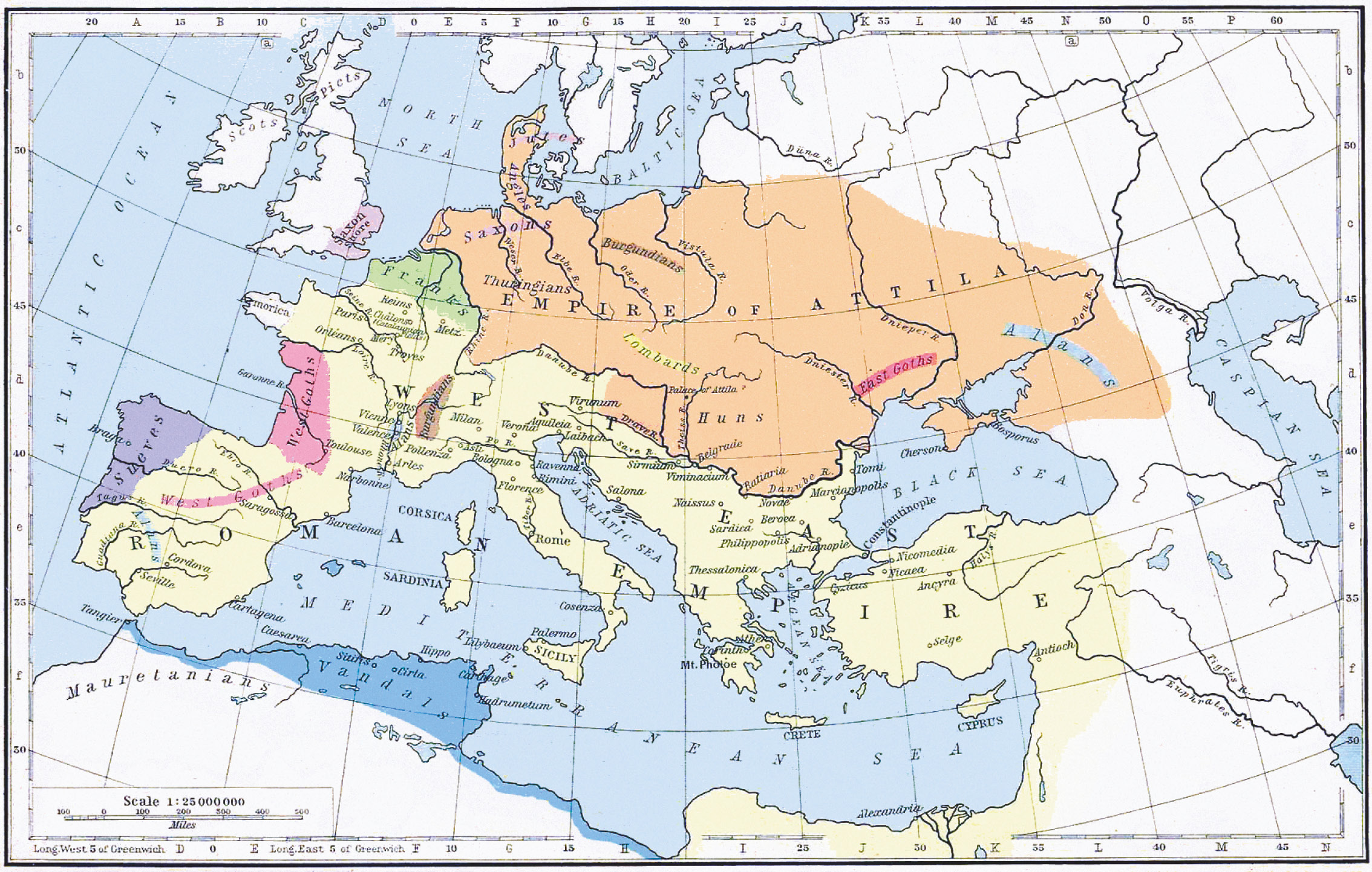
Over the next two decades, Aetius strengthened his ties with the Huns. He sent his own son among them as a hostage to learn the lessons he had. He successfully used Hun contingents to defeat the Visigoths in the south of France and the Franks in the north. The clash with the Franks was a typical case of marauding Germans from beyond the Rhine border being driven back by the Empire. The struggle with the Visigoths, however, was an act of policing and serves as a useful example to explain their complicated role within the Western Roman Empire in France.
After the death of Alaric and the succession of his brother-in-law Ataulf, the Visigoth leadership had sought to reach an agreement with the Romans. But there was dissension between the Goths and Constantius, magister militum (‘master of soldiers’) and co-ruler of the Western Empire, and they were expelled from the prosperous cities of southern France. For a few years, they fought on behalf of the Empire in Spain against less acceptable barbarians. But, in 418, Constantius recalled the Visigoths to southern France. He had another task for them. He signed a peace treaty with their leaders and settled them in Aquitaine, around the city of Toulouse. It is interesting to note that such a move was not the wild roving of independent barbarian war-bands, but on the orders of a Roman with whom they were eager to deal.
The military strength of the Visigoths was clearly inferior to that of the Romans. So why should Constantius invite the Goths back into France and give them the prime land of Aquitaine, which for years had been the major source of grain for the imperial army on the Rhine frontier? The fact that this territory was such a key agricultural area for the Empire holds the answer to Constantius’ strategy. It is explained also by the fact that Aquitaine was not a borderland, but in the heart of France. The Goths had been settled there not to defend the frontiers of the Empire against outside barbarians, as other tribes were. Aquitaine had to be protected from its own people – the discontented farmers and peasants of Roman France known as the Bacaudae.

Enter Attila
In 445, Attila murdered his brother Bleda to become King of the Huns. By now, Aetius was over 50 and losing his old friends among the horde. He sent his eldest son, Carpilio, and other skilled ambassadors to make treaties with the new barbarian ruler. The meetings were tense. Attila was no longer content for his people to be the sword and bow of Aetius. He had ambitions of his own. ‘He fancied himself about to grasp the Empire of the world,’ remembered one envoy. An old friendship could not be counted on. In 448, Eudoxius, leader of the Bacaudae, found sanctuary among the Huns – and, when Aetius asked for his extradition, it was not granted. But the two warlords did hold much respect for each other and did business together. Above all, Attila seemed more interested in ravaging the Eastern Roman Empire, centred (since 330) in Constantinople.
The reputation of Aetius appears to have persuaded Attila on to softer targets. In 450, Theodosius II, Emperor of the Eastern Empire, was dead. The succession was smooth and the new Eastern Emperor, Marcian, made it clear that no more tribute money would be paid to the Hun unless peace could be guaranteed. He did not fear Attila and would be happy to prove the point in battle. In the West, in that same year, the King of the Franks lay dead also. His succession, however, was far from agreed. The King’s younger son – a boy adopted by Aetius – went to the warlord for help.
The rival elder son, not wishing to face Aetius alone, rode out of France to the court of Attila. An opportunity to crack open the West was welcomed. In the imperial court at Ravenna, there was much scheming as well. According to the chroniclers, Honoria, sister of Valentinian III, Western Roman Emperor since 425 and son of Constantius, sent her ring to Attila and pledged herself in marriage to him. Arising out of a family squabble, her ridiculous though important offer suggested Honoria would give herself to Attila if he used his power to avenge an arranged marriage forced on her. But was the real purpose behind this affair an attempt by Valentinian to recruit Attila as a new magister militum – the only hard man strong enough to oppose Aetius?
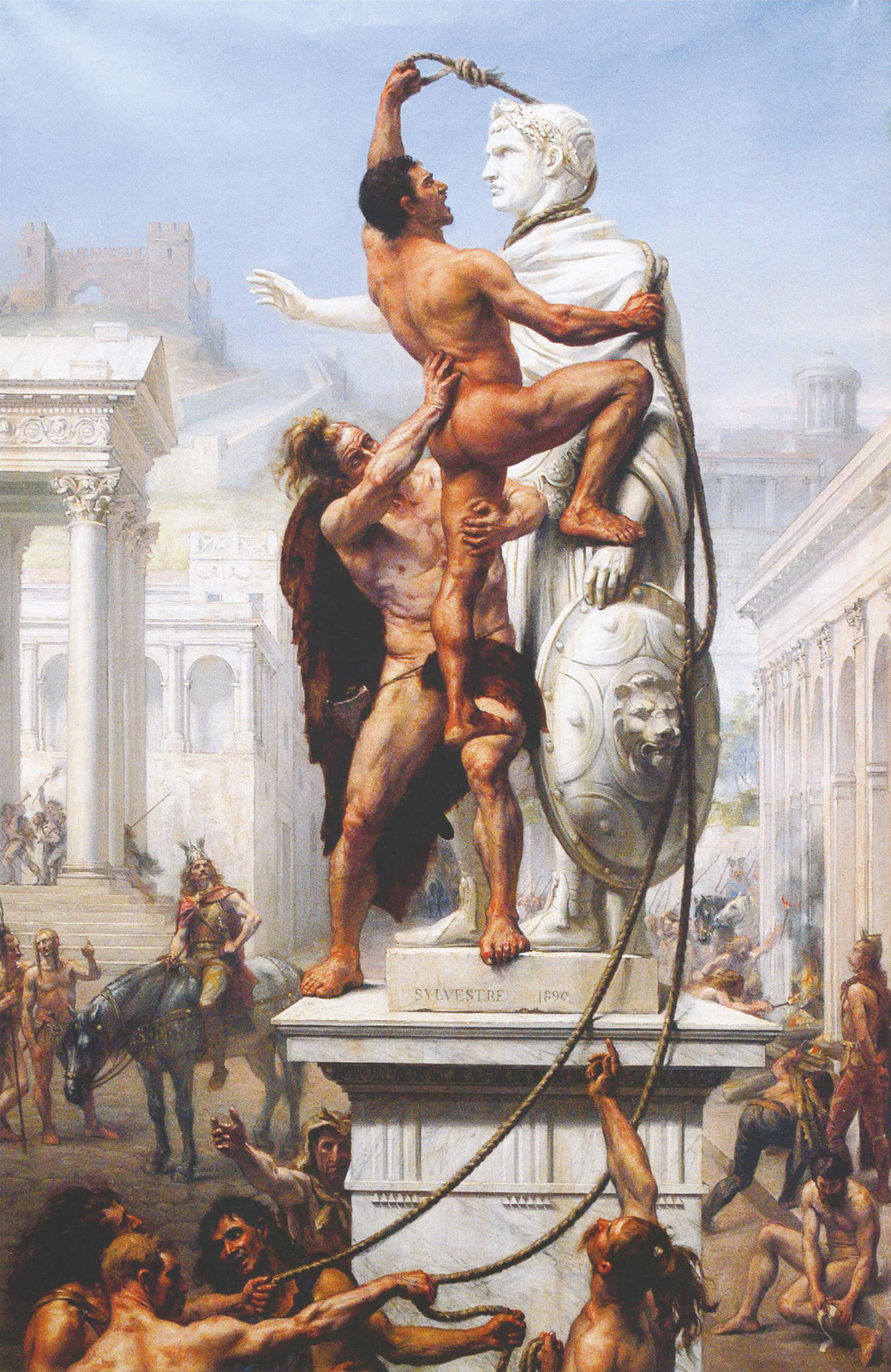
In his correspondence with the imperial court, Attila proclaimed he would advance into France on behalf of the Empire against the Visigoths, just as Aetius had done. Was Attila proposing himself as a new Defender of the West in return for the hand of Honoria and the possibility of inheriting the imperial throne?
The new strength of the Eastern Empire, the Frank succession crisis, and the political offers of the imperial court at Ravenna, all enticed Attila westwards. Throughout the remaining months of 450, the Huns prepared for a major campaign. Attila called on subject Eurasian and Germanic tribes that owed him service. The harvest was gathered and booty stored. Attila put pressure on the imperial court, demanding half of the Western Empire as his dowry on marriage to Honoria. Attila’s demands frightened Valentinian – he knew he could not handle the Hun, and begged Aetius for help.
The last Roman
Aetius was well aware of the growing crisis and the threat of invasion. He mobilised his own forces. These were normally sufficient to quell any internal insurrection, but against a major external threat he was less well prepared. He had relied for so long on the Huns as his prime source of warriors, that he was now somewhat at a loss facing them as enemies. Who could he turn to?
The forces that Aetius eventually gathered all had a common stake in the defence of imperial France. Essentially barbarian, they had all been settled on imperial territory in accordance with Roman treaties and now enjoyed their lives as Romano-barbarian landowners. Aside from his own bucellarii – elite bodyguard – and the private armies of imperial magnates, Aetius was joined by the Visigoths, Burgundians, Alans, and Franks loyal to Aetius’ adopted son. Curiously, the Armoricans are mentioned among the Western forces as well. Presumably, that refers to the Bacaudae. Perhaps the rebels realised their safety depended also on a concerted defence against Attila. In recognition of their service, Aetius acknowledged their presence as an independent contingent – a precedent they could call on in future dealings with the Empire.

In the spring of 451, Attila and his horde crossed the Rhine into northern France. They rode for Metz and captured it. Then they cut through Champagne until they struck Orleans with their battering rams. With this direct attack on his homeland, Sangiban, King of the Alans, lost his nerve and offered the city to the Huns. Just in time, Aetius and his allies arrived to prevent the loss. Outside the city walls, they set up earthworks and forced the Huns to withdraw. The Huns probably regrouped on the plains of Champagne, grassland admirably suited to their horsemanship and the confrontation they now anticipated.
The scene was set for a battle whose exact location has forever remained a mystery. Variously called the Battle of Locus Mauriacus, the Battle of Chalons, or the Battle of the Catalaunian Plains, it has most recently been accepted as having taken place somewhere near the city of Troyes. Throughout the centuries, the battle at this location has been viewed as one of the decisive conflicts of history – Attila poised with a mighty army to crush the Western Empire in one final blow. It is little wonder the man standing in his way should have been called ‘one of the last Romans’, even though he was himself half-barbarian. It would be Aetius’ greatest test.
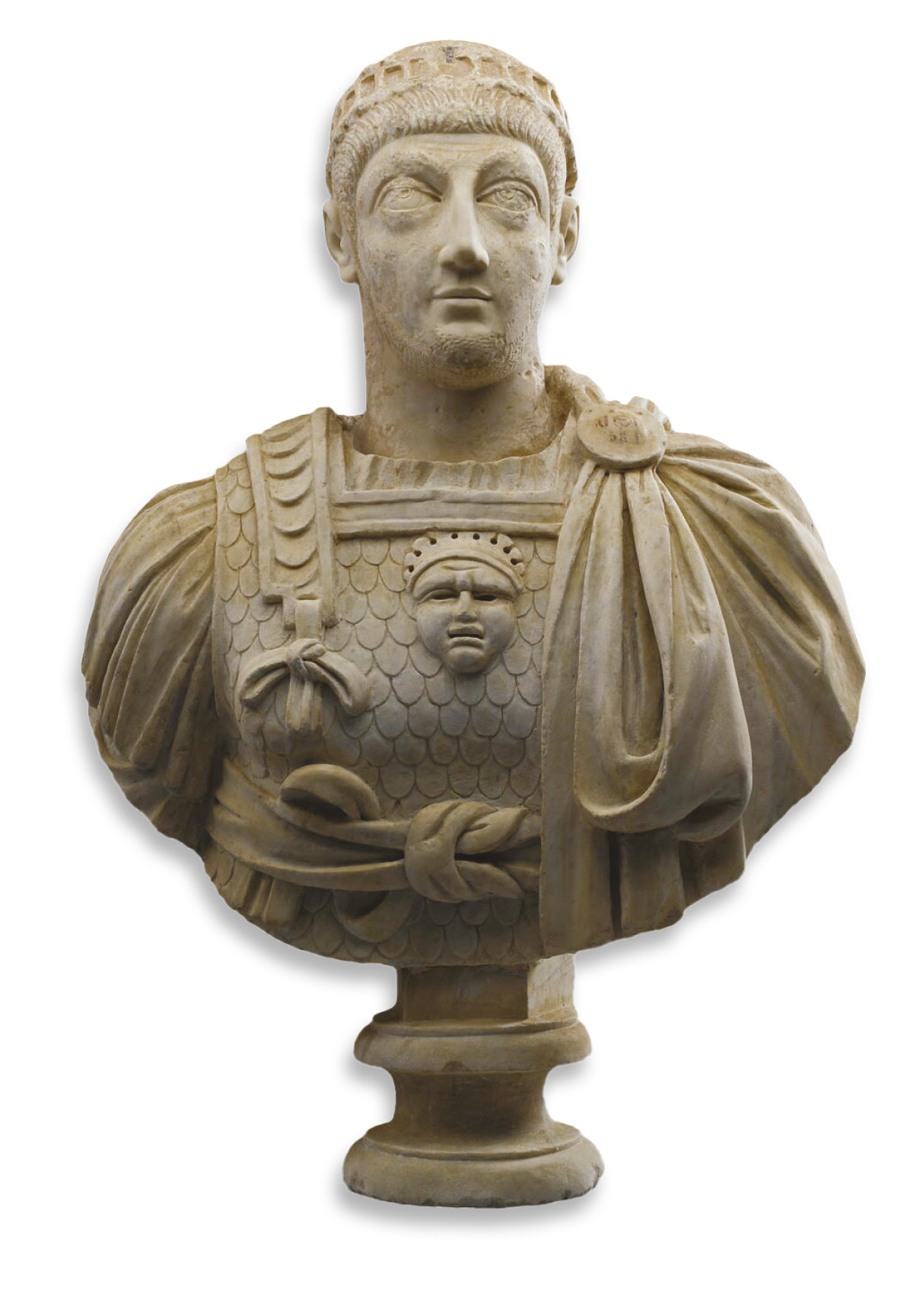
On the eve of the titanic battle, Attila consulted his shaman for good omens. The man of magic examined the cracked shoulder blades of a sheep. The cracks did not augur well. The next day, Attila postponed the conflict until the afternoon, knowing that any disastrous withdrawal could be covered by night. The battlefield was a plain rising by a sharp slope to a ridge.
Attacking Attila
When fighting finally broke out, both sides sought to gain the advantage of the terrain. According to the sources, horse-warriors from both sides rode up the slopes of the ridge. Aetius’ horse-archers clad in mail and scale armour dashed forward. Joined by Visigoth nobles and their retainers, wielding lance and sword, they captured one side. On the other slope charged the Huns with subject Germanic tribes. A great struggle ensued for the crest of the hill. Archers let fly from afar while Germanic warriors thrust and hacked at each other.
Theoderic, the King of the Visigoths, commanded his forces on the right wing of the allied Western army, while Aetius held the left. In the centre were the suspect Alans led by Sangiban. ‘For he who has difficulties placed in the way of his flight,’ wrote the 6th-century chronicler Jordanes, ‘readily submits to the necessity of fighting.’ Attila positioned himself alongside his bravest warriors in the centre, with Ostrogoths and other Germans on his flanks. As the fight for the hilltop intensified, foot-soldiers joined the flailing crowd. Those Franks allied with Aetius hurled their famed francisca axes at the enemy, before running into close combat.
Eventually, Aetius and the Visigoths gained the upper hand and threw the Huns back down the hill. Attila rode into the action and rallied his men with words of strength. ‘Let the wounded exact in vengeance the death of his foe,’ he cried. ‘Let those without wounds revel in the slaughter of the enemy! No spear shall harm those who are sure to live. And those who are sure to die, Fate overtakes anyway in peace!’
Warriors hammered each other until exhaustion or pain overcame them. Theoderic, the old and venerable chieftain, encouraged his Visigoths against their rival kinsmen, the Ostrogoths. They fought furiously and, in the crush, Theoderic was thrown from his horse. Trampled in the chaos, he did not rise again. Enraged by such a loss, the Visigoths pushed back their adversaries and fell on the majority of the Huns. Many Huns and their allies now took flight, while Attila and the body of his army retreated behind the bulky wagons of their encampment. As dusk drew on, fighting became confused in the half-light, gradually ceasing as weary, wounded warriors stumbled back to their camps. During the night, it was claimed, the ghosts of the fallen continued the battle.

The next day, each side awoke to the dreadful spectacle of a battlefield heaped with the slain and wounded. Aetius and his followers felt certain they had won a great victory. But Attila still remained in the battle zone within his wagon fortress. ‘He was like a lion pierced by hunting spears,’ wrote Jordanes, ‘who paces to and fro before the mouth of his den and dares not spring, but ceases not to terrify the surroundings with his roaring.’
Aetius and his Germanic commanders decided to besiege the Hun camp. Attila had no great supply of food and, according to Jordanes, could make no successful counter-attack as Aetius maintained a large number of archers within his camp. The Visigoths burned to avenge their dead chieftain. Attila prepared for a last stand. Determined not to be taken alive, he piled saddles within his wagons to form a fire on which he would fling himself. But, as the Visigoths grieved for their king and the Western army prepared itself for a final assault, Aetius had second thoughts. Why finish off the Huns?
In the past, the Huns had proved a most effective means of controlling the ambitions of the Germans in France. Attila would not rule the Huns forever and it seemed foolish to wipe out totally any possible renewal of the working alliance in the future. Besides, if the Visigoths were allowed to deliver the final blow, Aetius could not imagine restraining their demands for more land as a reward. Therefore, Aetius advised the son of Theoderic that others might seize power in his homeland if he suffered badly in the forthcoming fight. Accepting this counsel, the Visigoths left immediately for Toulouse. Aetius used a similar argument to recommend the withdrawal of the Franks. With his mauled forces, Attila was allowed to retreat eastwards, where he died two years later.
Defender of Empire
Aetius had won the greatest victory of his career. His reputation and power could stand no higher. He was truly Defender of the Western Empire. To his followers, it seemed remarkable that their lord should not wish to assume the Western Emperorship for himself. After all, Valentinian was weak and posed no opposition. But Aetius seemed content instead to rule as overlord of his pleasant estates in France. Besides, he knew from his youth the complications of usurpation, and was wary of provoking a vigorous Eastern Emperor. It didn’t seem worth it – everyone already acknowledged him as the most powerful man in the West.
In September 454, Aetius was in Rome to speak with the Emperor. If he had no imperial aspirations for himself, he appears to have possessed them for his younger son, Gaudentius. Repeatedly, Aetius pressed a marriage between the young man and a daughter of Valentinian. The anxious Emperor could not bear the subject. He suddenly leapt up and cast wild accusations at the amazed warlord. All the resentment and fear Valentinian felt for the success of Aetius spurted out. ‘Your desire for power will not end until you rule the Eastern Empire as well as the West.’
Aetius tried to calm the nervous anger of the Emperor, but in the excitement Valentinian drew his dagger and stabbed Aetius. The Emperor’s chamberlain also drew a blade and cut the warlord down. Boetius, a close friend of Aetius, tried to prevent the tragedy, but was stabbed before he could save his master’s life. To prevent the news of Aetius’ death arousing the fury of the warlord’s bucellarii (escort troops), Valentinian blamed the murder on others and had them executed immediately. In the words of a shocked court minister, the Emperor had ‘cut off his right hand with his left’.
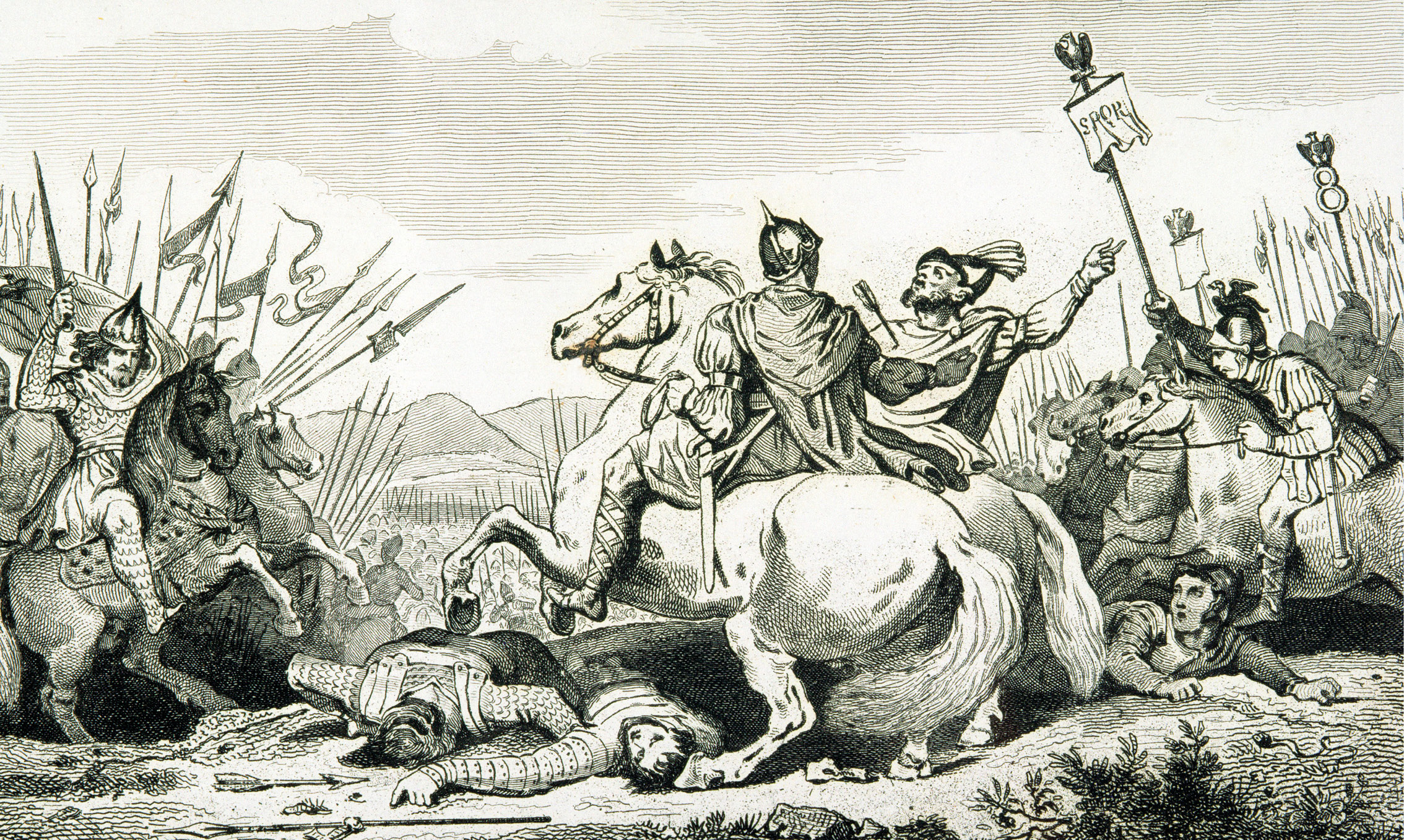
The truth of this foolish, mad act did not remain long hidden from Aetius’ most ardent followers. A few months later, one of the warlord’s most loyal bucellarii completed the revenge. His name was Optila and fittingly he was a Hun. One morning, Valentinian rode into Rome’s Campus Martius to practise archery. As he helped the Emperor dismount, Optila plunged a knife into Valentinian’s temple. When he staggered round to view his striker, Optila dealt him a second blow to the face that brought him down. Members of the Emperor’s bodyguard stood by and watched. No one raised a hand to defend him. The assassination was an execution.
The loss of Aetius would have a profound effect on the future of the Empire. He alone had maintained imperial control over France, giving reality to the concept of a Western Empire. Without him, the individual Germanic settlements would soon rise to replace the old Roman province with a fragmentation of German kingdoms that in 476 finally sounded the death knell for the Empire in the West.
All images: Wikimedia Commons, unless otherwise stated