Subscribe now for full access and no adverts
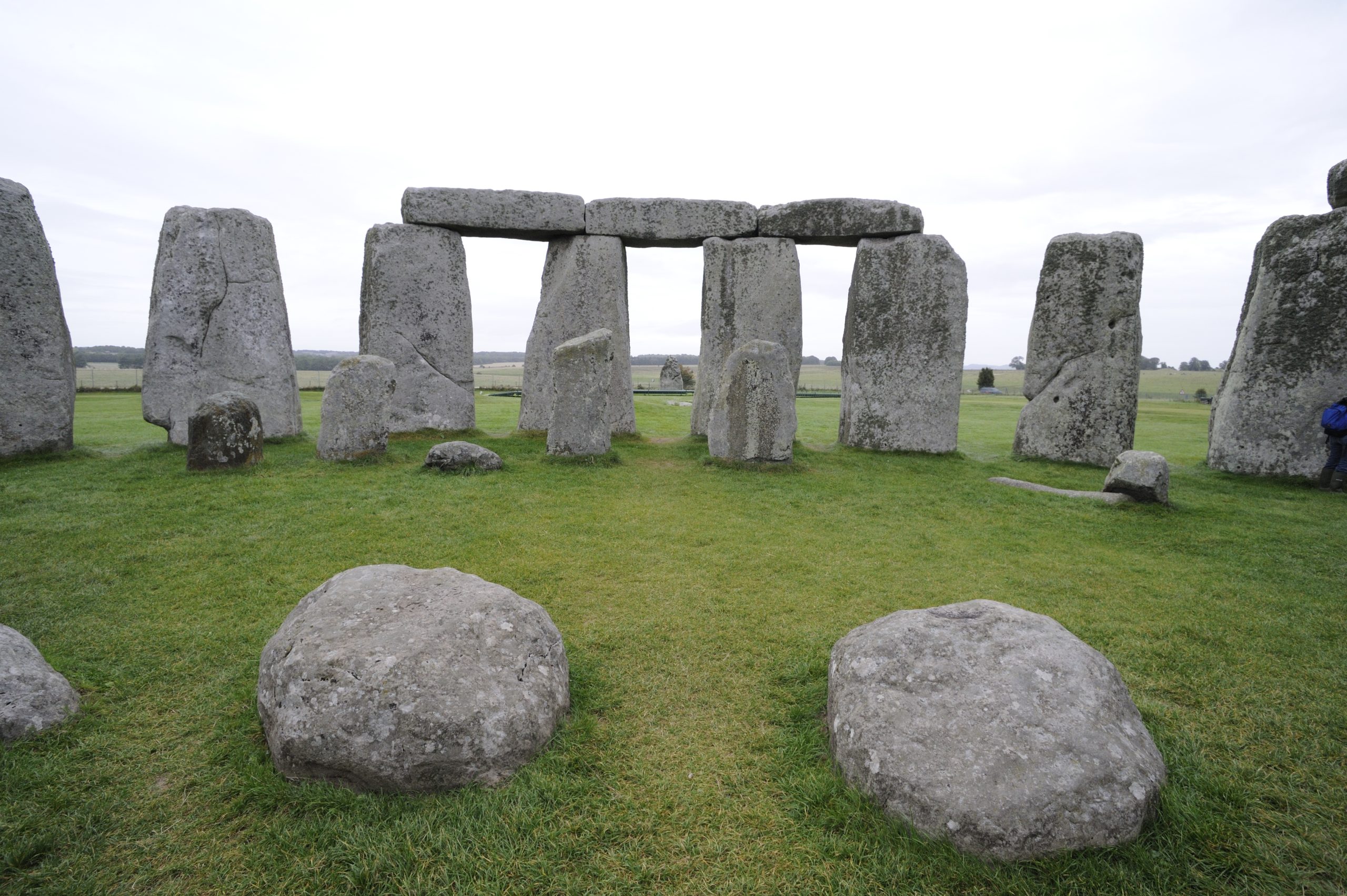
Of all the stones at Stonehenge – despite being the only recumbent one – the Altar Stone stands proudly declaiming its uniqueness among the Neolithic monument’s ‘bluestones’. It is anomalous in so many ways, being of neither Welsh nor Wessex extraction like the celebrated circle’s other components; moreover, while it is nowhere near the size of the locally sourced sarsens, it is substantially larger than the other ‘bluestones’ (shorthand for ‘non-local’ stones: they are predominantly from the Preseli Hills in south-west Wales) with which it had been grouped for all of the 20th century. The other bluestones are mostly igneous in origin, whereas the Altar Stone is a grey-green sandstone – and its position within the monument sets it apart, too. The slab occupies a near-central location within the apse of the sarsen and bluestone horseshoes, and appears to be astronomically aligned to the winter solstice sunrise and summer solstice sunset, unlike the monument’s other main and more-famous alignment on the winter solstice sunset and summer solstice sunrise.
Now nearly 20 years of investigation into the Altar Stone’s provenance have demonstrated quite how special it was. Two recent papers have radically changed our thinking about the origin of the Altar Stone, the role of Stonehenge itself, and indeed the ‘connectivity’ of Neolithic peoples in the British Isles. The story of the search for its source, however, began more than 100 years earlier. In 1923, H H Thomas published a seminal paper suggesting that the Altar Stone had been sourced from either the Old Red Sandstone (ORS) Cosheston Beds near Milford Haven, or possibly from the ORS Senni Beds, somewhere in the historic county of ‘Glamorganshire’ to the east. Implicit in this was the belief that the Altar Stone was an ‘extra bluestone’ that had been picked up during the Preseli stones’ journey to Salisbury Plain. Whichever was the case, Thomas was convinced that it had a Welsh source, a provenance that went unchallenged for exactly a century.

Fast-forward to the 21st century, however, and the picture has changed somewhat. For the past two decades, a team of geologists and geochemists (initially comprising Rob Ixer, Richard Bevins, and Peter Turner, but soon expanding to include Duncan Pirrie, Nick Pearce, and Steve Hillier as the core of this group) have been exploring the source of Stonehenge’s bluestones. Recently, we turned our attention away from the Welsh bluestone dolerites and rhyolites, and tuffaceous andesites, and (thanks to a Leverhulme Trust grant awarded to Richard Bevins) have focused instead on investigating the petrology and geochemistry of the Altar Stone, using a succession of analytical techniques to try to determine its source. The number of investigators involved in this initiative has gradually increased (currently, the total runs close to 20) – and, as the group grew, so did the distance between the Altar Stone and a Welsh origin.
By 2020, the team had discovered that the Altar Stone had a distinctive mineralogy, with an early cementing baryte (barium sulphate), as well as the rare clay mineral tosudite, combined with an absence of the mineral K-feldspar (the latter being common in the majority of ORS sandstones in Britain). The occurrence of baryte is reflected in high barium contents measured in the Altar Stone (and its derived fragments), detected by the non-destructive portable XRF technique. With a passing interest, the researchers also noted the apparent and strange presence of very old zircons.

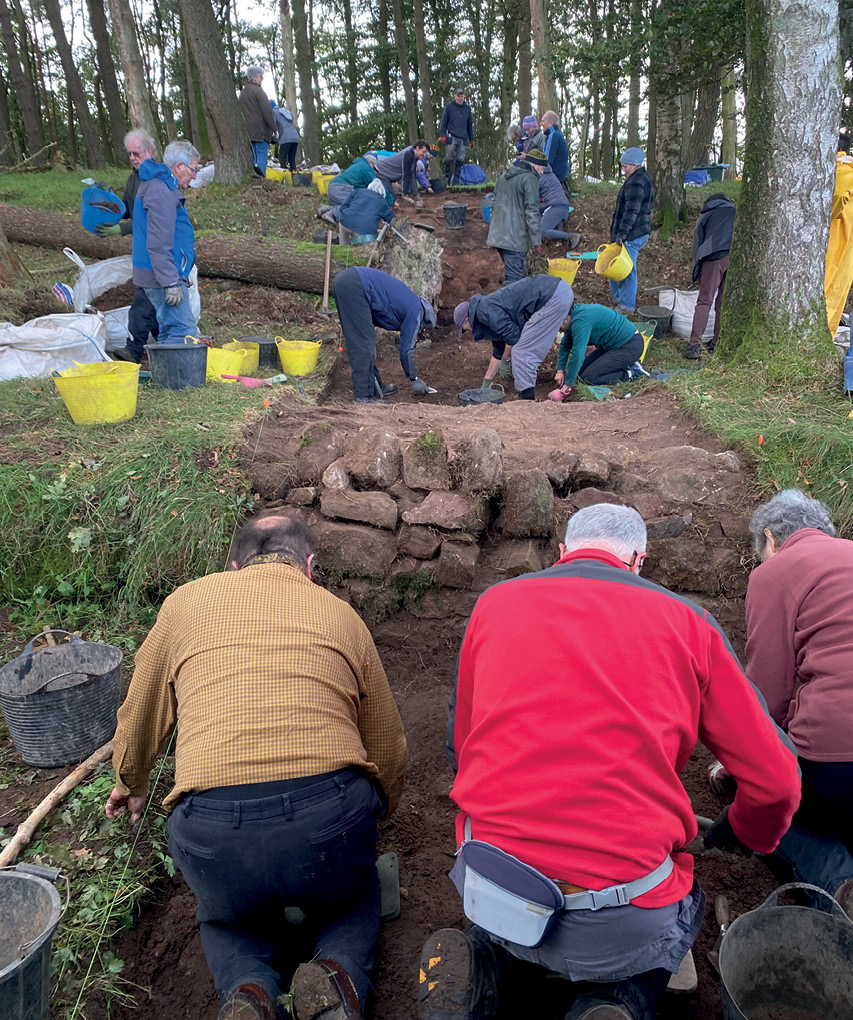
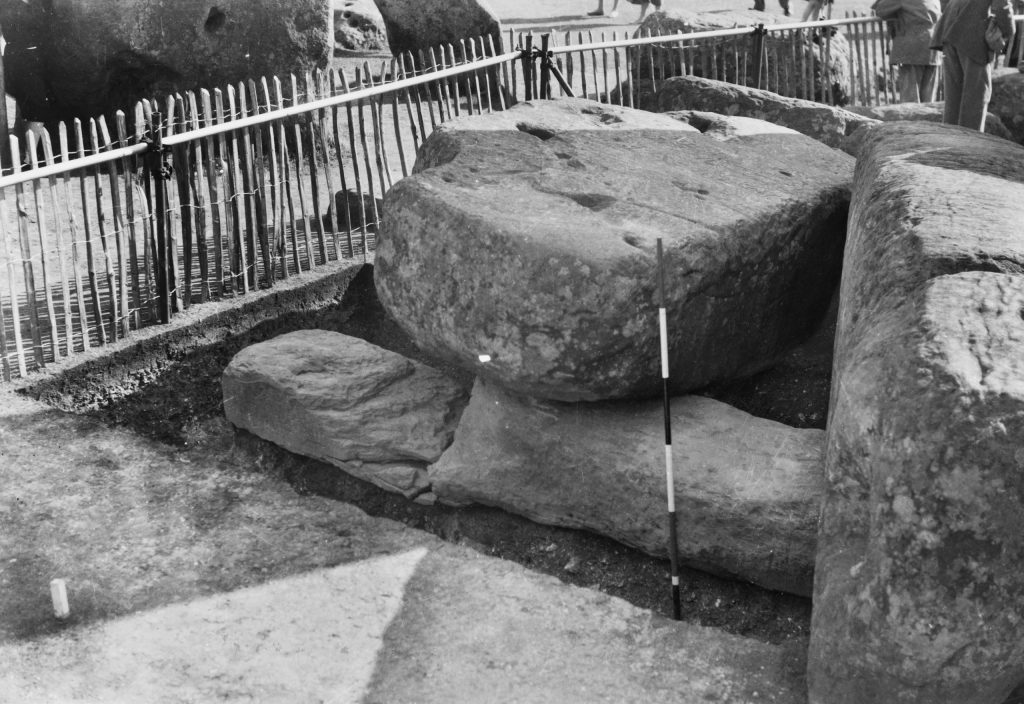
Above & below: The Altar Stone is poorly exposed at Stonehenge today. The plan shows three areas of stone exposed below sarsen stones 156 and 55b; the photo shows Area B in more detail. Images: Bevins et al. 2022 (above) / Richard Bevins (below)

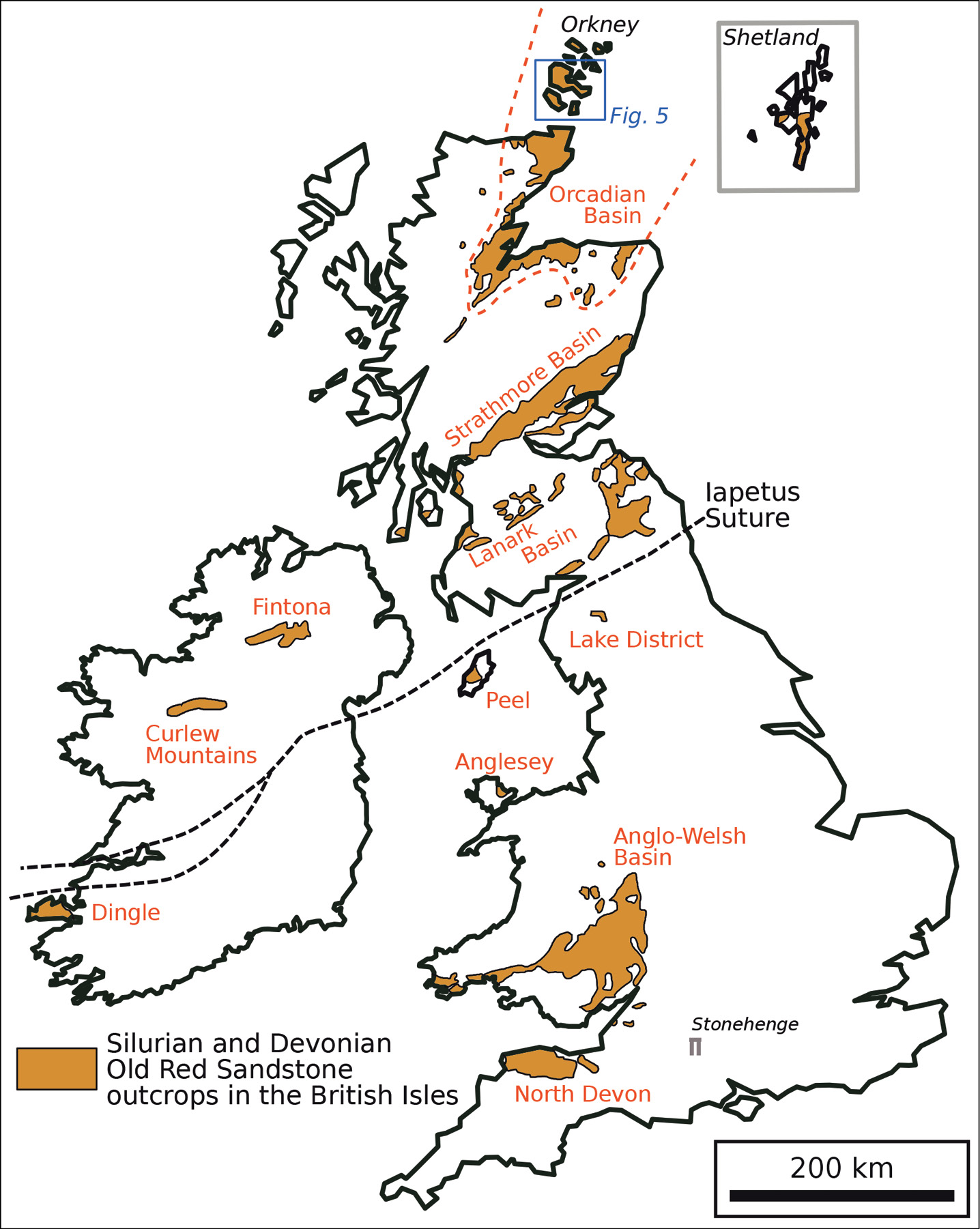
Investigations initially focused on Wales, gradually ruling out possible provenances. First, the team decoupled the Altar Stone from the Lower Palaeozoic Sandstone (often debitage from the two rocks had been confused in the Stonehenge Landscape and in the literature), as well as both lithologies from Milford Haven, the origin favoured by Richard Atkinson in his research. Instead, the stone’s origin seemed to move eastwards along the outcrop of the ORS in south Wales, mainly following the present-day A40 – but by late 2021 the researchers were still drawing a blank, concluding (in a paper subsequently published in the Mineralogical Magazine) that all their mineralogical and geochemical data suggested that the Altar Stone might not have come from anywhere in the ORS Anglo-Welsh Basin.
The road to Scotland
While pondering on this – the first of a succession of three unexpected results – a pivotal breakthrough came when Bevins realised we must cease to think of the Altar Stone as a bluestone but instead treat it as a separate, independent component to the circle, brought from a very different place to the Welsh bluestones and perhaps at a very different time. It was time to ‘broaden horizons’, as suggested by the title of our detailed findings, published in the Journal of Archaeological Science: Reports in 2023, which showed that exploration was required in the other ORS basins in mainland northern Britain – especially including those of the Scottish islands of Arran, Orkney, and Shetland. These are huge areas to search, so triaging on both geological and archaeological grounds was needed to narrow down the provenance targets in order to make the search areas more manageable and affordable.
The opportunity to discover more about the old zircons mentioned above came in late 2022 when, quite by luck, Nick Pearce offered Anthony Clarke (a PhD student at Curtin University in Perth, Australia) the chance to determine further the ages of the zircons, plus two other minor minerals, in two samples of the Altar Stone from the Salisbury Museum. The samples were MS-3, an excavated debitage fragment, and, more importantly, 2010K 240 (also known as Wilts 277), a small block of the Altar Stone that, in the 19th century, had been directly collected from its bottom surface (CA 391).
The results, published in August of this year in the journal Nature, were quite astonishing: our second great surprise. They showed that ages obtained from grains of zircon, apatite, and rutile best matched those in ORS sandstones deposited in what is defined geologically (in time and space) as the Orcadian Basin. Around 380 million years ago, this occupied an area now covered by parts of Shetland, all of the Orkney archipelago, portions of Caithness, and Sutherland, extending down to Inverness and then eastwards across to Aberdeenshire – and that is the ‘story so far’, up to the point told by CA 415.
Subsequent to this coverage, there followed some speculation in the media and elsewhere that the Altar Stone might have been derived from Orkney itself, and that we were suggesting just that; we most definitely were not. Partly, this error was due to a misunderstanding between the specific use of the geological term ‘Orcadian Basin’ and the more generalised use of ‘Orcadia’ and ‘Orcadians’ for the land and people of Orkney – an understandable mistake given the often-noted rich Neolithic culture of Orkney with its famous stone circles, in addition to the number of long-distance ‘cultural’ links between Neolithic peoples in Orkney and those in Wessex. In fact, as our research would soon show, emphasising this archipelago was a red herring.
Investigating Orkney
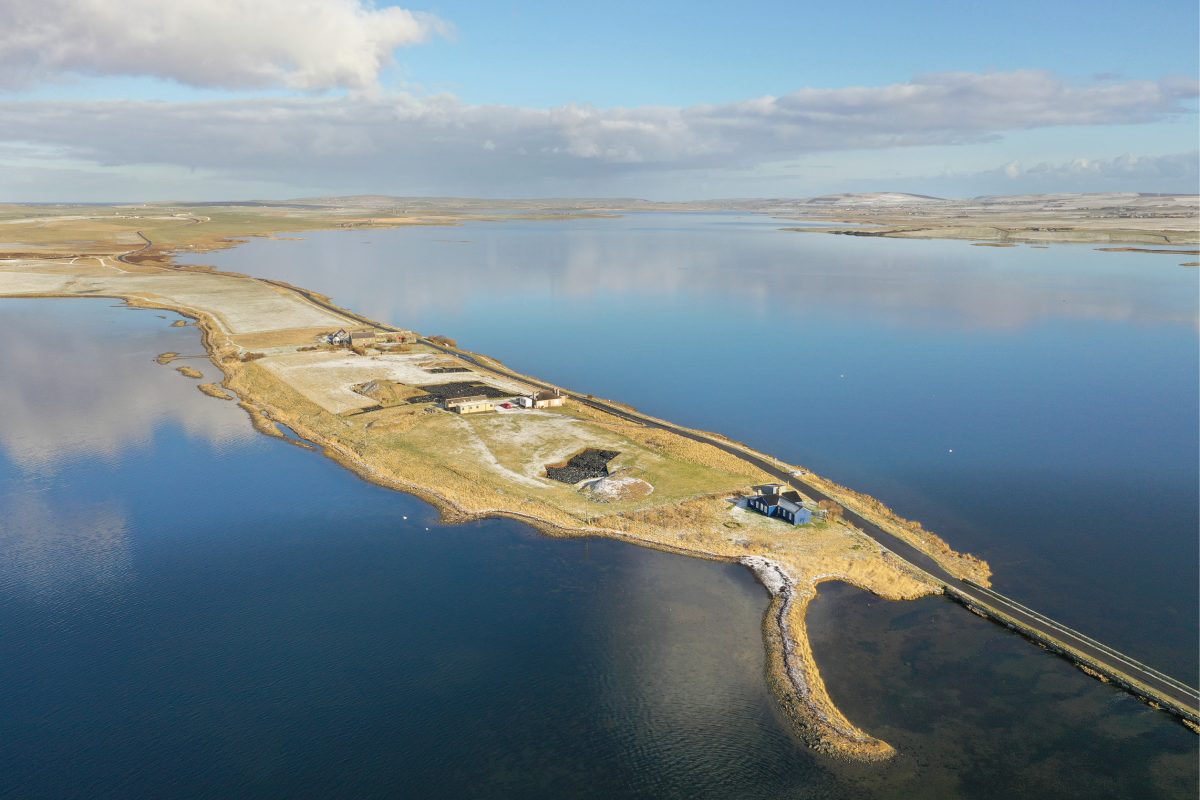
When we set out to ‘broaden horizons’ in 2023, Mainland Orkney had become an obvious first choice when deciding which new ORS basin to investigate – and so in June of that year Bevins and Pearce used the portable XRF technique (the prime technique used for all earlier field and laboratory work) to examine two of the island’s best-known Neolithic monuments. They analysed one stone from each of the seven petrographic groups that previously had been identified at the Ring of Brodgar, and all of the above-ground stones at the Stones of Stenness. Alongside this work, they analysed and collected ORS field samples from all of the major rock units across Mainland Orkney.

This map of Mainland Orkney and its surroundings shows locations mentioned in the text; the inset detail shows the area around the Ness of Brodgar where the Ring of Brodgar and Stones of Stenness are located.
The results were published in the Journal of Archaeological Science: Reports, just a few weeks after the Nature paper (despite a seven-month difference in their submission dates), and proved to be the third surprise. They showed that there was no compositional match between the Altar Stone and any of the stones in the Orkney monuments, or any of the field samples. Confirmation of these geochemical results (by petrographical and mineralogical investigation, notably using SEM-EDS analysis, X-ray diffraction, and Raman spectroscopy) showed significant additional differences between all of the analysed Orkney lithologies and the Altar Stone. Notwithstanding all the favourable archaeological pointers, the data simply do not support Orkney being the source of the Altar Stone, nor any physical link between the stones of the monuments of Orkney and Wessex.

Furthermore, the chemical analyses confirmed that the majority of the stones at the Ring of Brodgar and the Stones of Stenness came from relatively local lithologies. The Stenness stones all appear to be material from the Upper Stromness Flagstone Formation. By contrast, the Brodgar stones appear to be more diverse, being dominated by Upper Stromness Formation lithologies, but they also include sandstones which appear (from their composition) to be from the Lower Stromness Formation, which crops out close to the Ring of Brodgar, and the Caithness Flagstone Formation, which crops out in a strip across southern Mainland Orkney. While the majority of stones are generally consistent with the lithologies present in the quarries described by Richards and colleagues at Vestra Fiold and Staneyhill, these are both in the Upper Stromness Flagstones and thus are not consistent with being the only stone sources, notably for some of the Ring of Brodgar’s uprights. These additional sources are as yet to be identified – unfortunately, the general lack of characteristic compositional variation among these lithologies makes it difficult to refine their provenance further, with the possible exception of one uranium-rich Brodgar stone.

These results may seem disappointing. Had Mainland Orkney been the source of the Altar Stone then a marine route (or, at least, a partial one) would have been proved, but with the provenance now believed to be on mainland Scotland, it allows terrestrial or maritime movement to remain an open question. The lack of a link between ORS sediments on Orkney and the Altar Stone means that other areas of the Orcadian Basin on the Scottish mainland now must be investigated, and this work, which will combine all our mineralogical, petrographic, and geochemical skills, is under way.

As an end note, it seems ironic that two of the most-illustrious stones that have had long lives in England – the red ORS Stone of Scone/Stone of Destiny (which, until 1996, was incorporated into Westminster Abbey’s Coronation Chair – see CA 283 – and is now housed in the new Perth Museum) and the grey-green ORS Altar Stone – are both Scottish, the former taken as a trophy of war and the latter perhaps sent as a peaceful gift.