


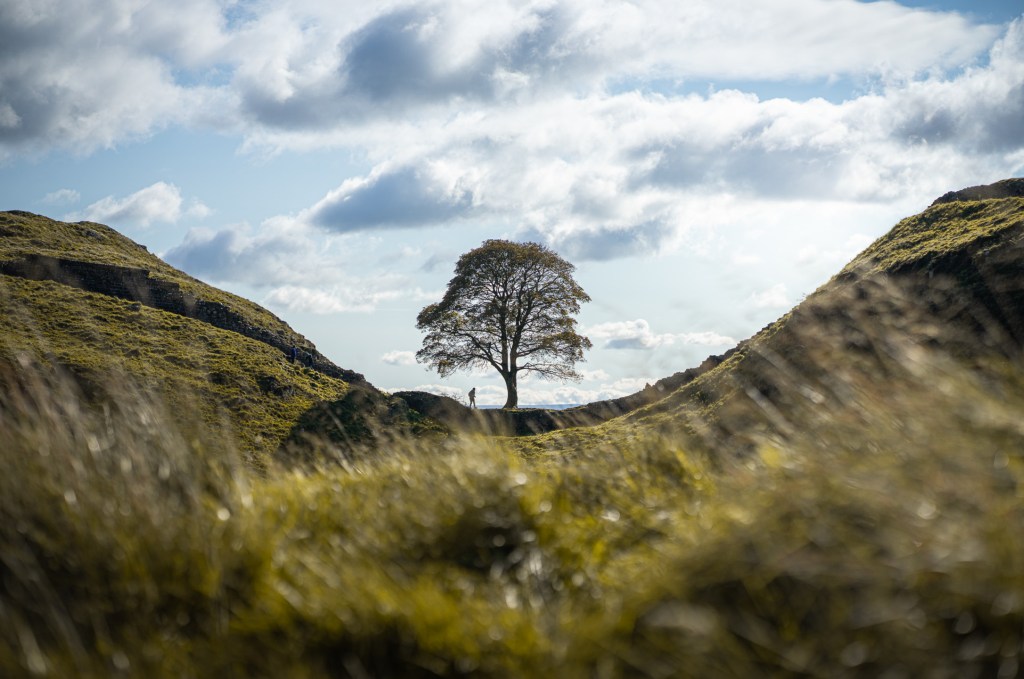
As news of the felling of the Sycamore Gap tree spread online, there was an outpouring of shock and grief for the perceived loss of a landmark that had long featured prominently in the popular imagination. Its highly photogenic placement adjacent to Hadrian’s Wall made it seem like an integral part of the Roman landscape, and initial reactions described the felling as an ‘irreplaceable loss’ and an ‘attack on nature’, concluding ‘the tree is gone.’ We contend, however, that the tree still lives, as the Roman wall itself still lives, although in ruins. We will discuss below the connection between the tree and Hadrian’s Wall, and how this unfortunate event can encourage us to embrace change and transformation in nature and culture.
The origins of Hadrian’s Wall will be familiar to many CA readers: the fortifications were built almost 2,000 years ago, during the reign of the emperor of the same name, as part of a Roman frontier network that stretched more than 7,500 miles across Europe, the Near East, and northern Africa. Spanning Britain at the Tyne/Solway isthmus, this wall would operate on and off as the Empire’s northern boundary for the next three centuries. Although, as Richard Hingley points out in his Hadrian’s Wall: a life (see ‘Further reading’ on p.50), the end of official Roman administration in Britain in the 5th century, and the conclusion of the Wall’s life as a Roman frontier, was ‘only one form of ending’. From the early medieval period onwards people have used the Wall – ‘recreating it as a vital element of the landscape of northern England for their own times and telling many different stories that have kept its remains alive’.
Today, Hadrian’s Wall stands as an archetypal ancient border, commonly perceived as a hard boundary between ‘civilisation’ and ‘outsiders’, with surrounding popular narratives so strong that there is an ongoing misperception that the Wall equates to the modern-day border between England and Scotland. However, archaeological research has shown that Hadrian’s Wall is better understood as a complex of structures meant to observe and manage the movement of people; alternatively (or additionally), it stood as a symbol of Roman power and authority in this distant region of the Empire. The Wall was, therefore, about far more than ‘barbarians’ versus ‘Romans’ – yet, because of the strength of the popular narratives surrounding the ‘border’ fortifications, many visitors continue to experience the remains of the Wall in this way. Such views encourage a static, unchanging public perspective of the remains, but we argue that Hadrian’s Wall is a living monument with real relevance to modern socio-political narratives, often being drawn into discussions surrounding modern borderlands and ideas of national identity (see, for example, E Hanscam and B Buchanan’s recent paper in Antiquity, ‘Walled in: borderlands, frontiers, and the future of archaeology’).


